Boat Fuel Additives Explained: What Stabilizers, Ethanol Treatments and Boosters Really Do
The marine store shelf is full of bottles that promise to fix fuel problems. Learn what stabilizers, ethanol treatments, water removers, octane and cetane boosters, cleaners and diesel biocides actually do, what no additive can do, how to dose them by the label and why you should not stack several products in one tank.
Time
20 min
Applies to
All engines
Safety first: Fuel additives are flammable chemicals, and diesel biocides are registered pesticides. Add them outdoors with the engine off, wear gloves and eye protection, wipe up spills and never pour them near a running engine or a flame. Keep the bottles closed and away from children. If a treatment causes fuel to leak or you smell gas in the bilge, stop, do not start the engine, and call a marine technician; on the water, call the USCG on VHF 16 or dial 911.
Owners often ask
- Can a fuel additive fix gas that has already phase separated?
- Is it OK to use more than one fuel additive in the same tank?
This guide walks you through it. Still stuck? Ask the AI Mechanic about your engine.
Tools
- Measuring cup or the dosing chamber on the bottle
- Notebook or the BoatMend maintenance log
- Clean glass jar with a lid (for a fuel sample)
- Funnel
Parts & supplies
- A marine fuel stabilizer approved or recommended by your engine maker
- A diesel biocide registered with the EPA (diesel boats, if needed)
Before you start
Gasoline and diesel already leave the refinery with additives in them. What you add at the dock is an extra layer of protection, mostly against time: fuel that sits in a boat for weeks or months goes stale. Honda says gasoline can start to deteriorate in as little as 15 days in some regions, and Mercury says oxidation can start in about two weeks.
The single most important rule comes from the engine makers themselves. Yamaha's fuel page says it plainly: no additive will restore stale fuel, remove water or cure ethanol-related problems. Mercury's FAQ says there is no practical additive that prevents phase separation. Additives prevent; they do not repair.
Before you buy anything, open your owner's manual and look for the fuel section. Many engine makers list the additives they approve and warn against others. Using a product your manual forbids can cause problems and may create a warranty argument.
Steps
Type What it is for Who needs it Fuel stabilizer Slows oxidation, gum and varnish in stored fuel Almost every gasoline boat, every tank or before storage Ethanol treatment Stabilizer plus corrosion protection for E10 Gasoline boats on E10 Fuel system cleaner Removes carbon and varnish deposits Occasional use, per the engine maker Water remover / "dryer" Claims to absorb or disperse small amounts of water Rarely; see step 5 Octane booster Raises octane Almost never in boats Diesel biocide Kills bacteria and fungi in diesel tanks Diesel boats with water or slime problems, or long storage Cetane booster / diesel conditioner Starting and combustion, lubricity, corrosion Optional for most diesel boats A stabilizer slows the chemical reactions that turn fuel into gum and varnish, which clog carburetor jets and injectors. Mercury and Yamaha both say their stabilizers keep fuel usable for up to about a year in storage when added to fresh fuel. Both makers recommend treating fuel regularly, not only at layup; Yamaha suggests treating every tank.
How to use one well:
- Add it to fresh fuel, ideally as you fill so it mixes. Treating old, stale fuel does not make it fresh again.
- For storage, run the engine about 10 minutes after treating, as Mercury describes, so treated fuel reaches the carburetor or injectors.
- If you fill portable cans, add the stabilizer before you fill the can.
- Don't count on a stabilizer forever. MasterCraft's storage instructions say even properly treated gasoline shouldn't be stored more than a year, and that adding stabilizer in spring won't undo gum or water that formed over winter. Its gasoline storage routine also adds a biocide alongside the stabilizer; follow your own engine maker's list.
- How full to store it depends on the tank. Mercury's fuel page says an older vented tank should be filled to about 95% (room for expansion) to cut condensation, while a newer sealed, EPA-style tank can be stored with a low level as long as the fuel in it is treated. Ask your dealer if you're not sure which you have.
Products sold as "ethanol treatments" are mostly stabilizers with extra corrosion inhibitors for E10. Yamaha also markets one of its products for protecting fuel system metals against ethanol-related corrosion. What they cannot do, according to both Mercury and Practical Sailor testing, is stop phase separation. In Practical Sailor's test of five well-known products, none prevented cooling-induced phase separation.
Your real protection against ethanol problems is: buy fresh fuel from a busy station, use ethanol-free gas when you can, keep water out of the tank, and use a water-separating filter. The ethanol fuel care guide covers all of this.
No additive makes E15 safe. Many pumps now sell E15 (15% ethanol), often cheaper and sometimes labeled "Unleaded 88." The EPA's E15 rules say it cannot be used in nonroad engines such as boats, and Mercury says its engines are built for no more than E10 because higher blends attack metal, rubber and plastic fuel parts. Read the pump label before you fill a boat or a portable can. MasterCraft warns its owners that E15 is now sold year-round, including through the summer boating season, so the risk of grabbing the wrong nozzle no longer goes away in June.
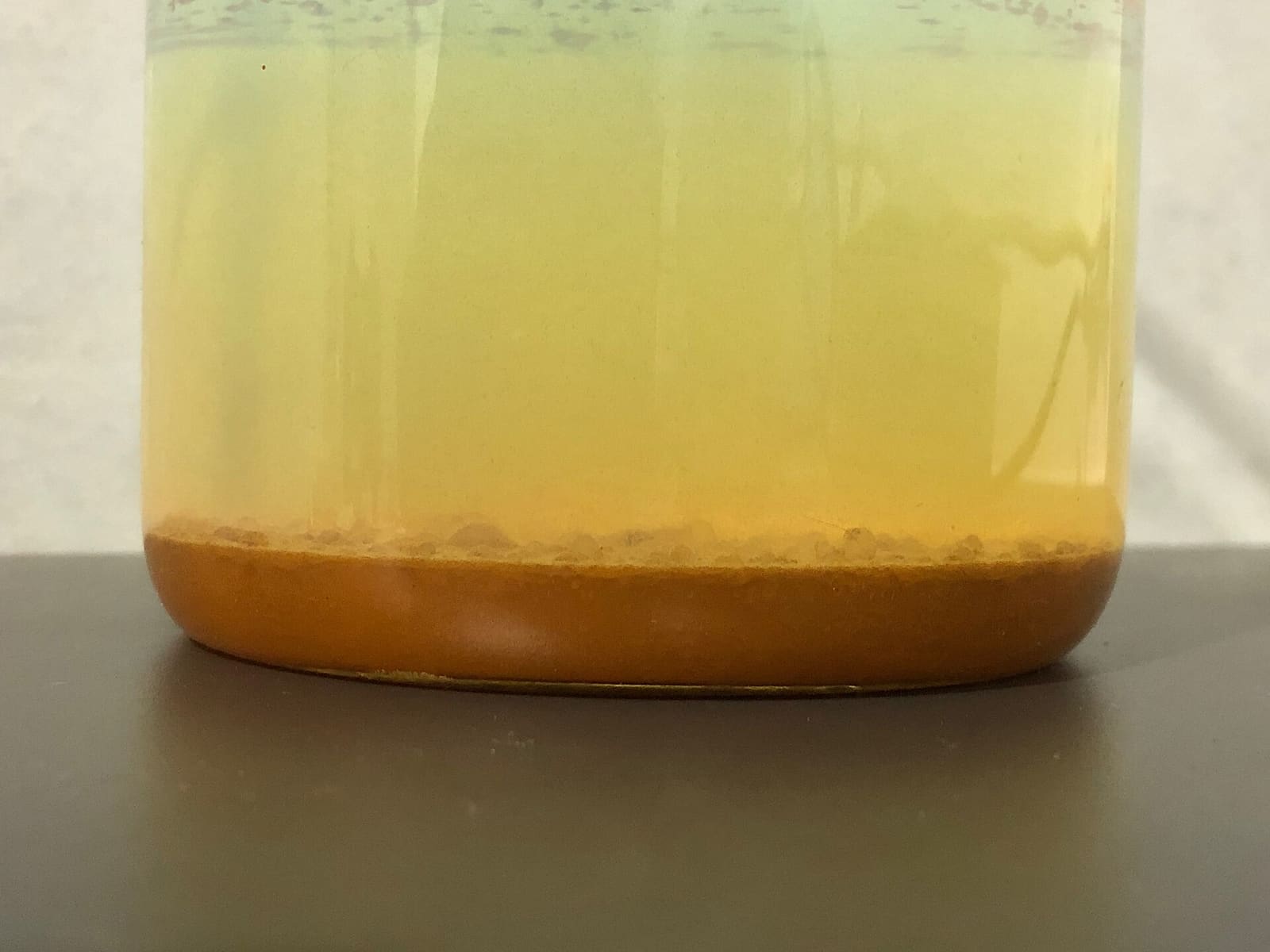
If your fuel sample shows a cloudy layer or water at the bottom of the jar, Mercury's answer is clear: remove the water, dispose of the bad fuel, clean the tank and start over with fresh fuel. Some products claim to "restore" separated fuel by absorbing the water back into it. Practical Sailor did not recommend routinely using high doses for that, especially in two-stroke engines, and engine and fuel makers say phase-separated fuel cannot be safely treated. Have a pro pump out the tank.
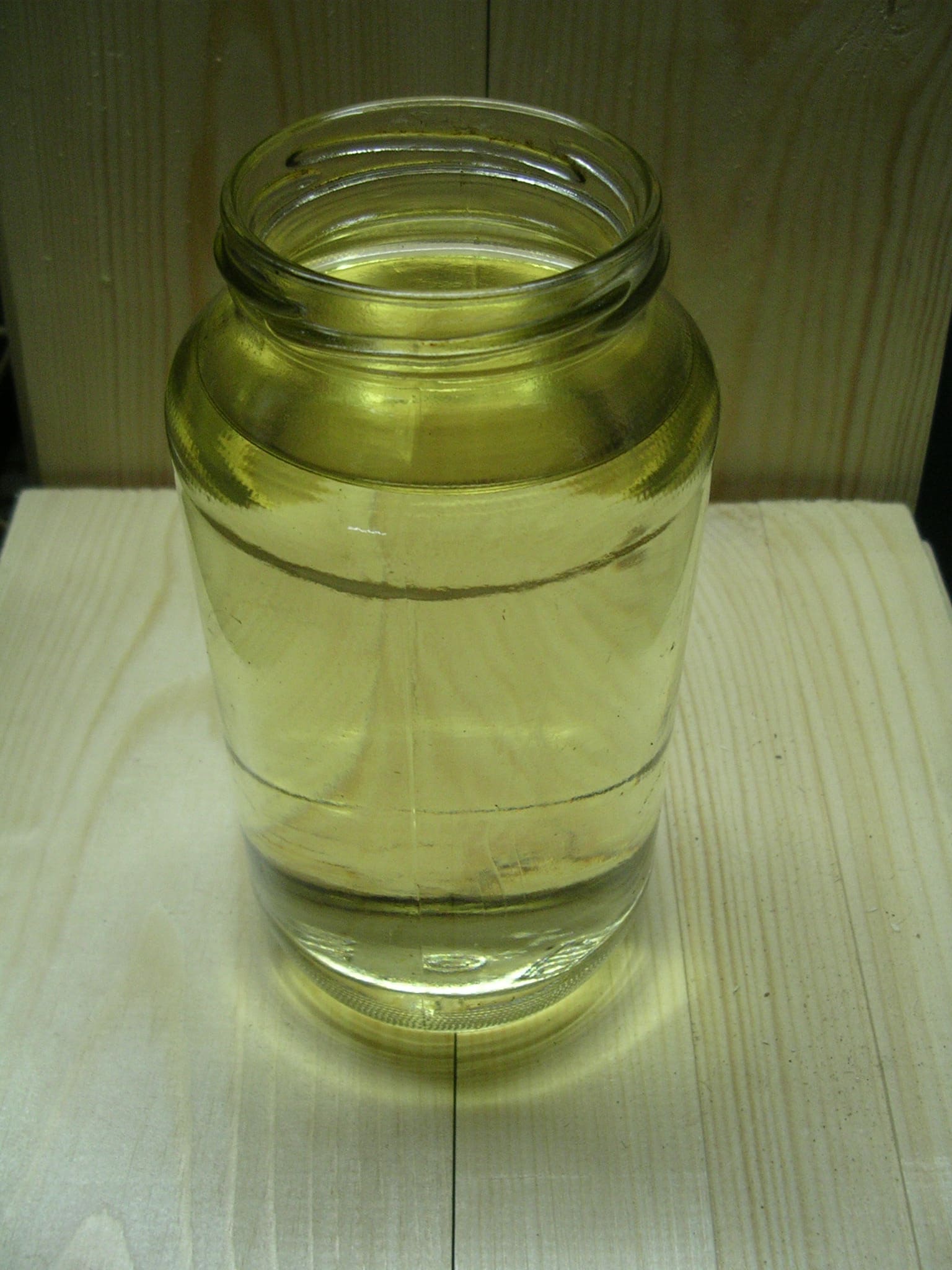
A sample of clean gasoline: clear all the way to the bottom of the jar. Photo: Burger / Wikimedia Commons · Public domain Many car-store gas dryers are alcohol based. Your E10 gasoline already contains ethanol, and marine stabilizer makers such as Yamaha advertise alcohol-free formulas for boats. Do not add car gas-line antifreeze to a boat tank unless your engine maker approves it. Small amounts of water are the water-separating filter's job; large amounts mean the tank needs pumping out and the source of the water found (see the fuel tank inspection guide).
Cleaners contain strong detergents that remove carbon and varnish from injectors, valves and combustion chambers. Mercury describes using its deep-cleaning treatment periodically during the season, and Yamaha sells one meant for every fill-up. Use the product your engine maker recommends, at the label dose and frequency. A heavily varnished carburetor still needs to be cleaned by hand (see the carburetor cleaning guide), and a badly carboned engine is a dealer job.
Use the octane your owner's manual specifies, measured at the pump. Practical Sailor points out that higher octane only helps an engine that is knocking because of its design; it does not add power to an engine built for regular. If your engine knocks on the correct fuel, have it checked instead of masking the problem with a bottle. (Westerbeke's FAQ does list octane booster as an option for its gasoline generators; as always, your own engine manual decides.)
Diesel fuel can grow bacteria and fungi wherever a little water is present, especially in warm weather when the boat sits. The signs are brown, gray or black slime in the filter bowl or on the filter element. Practical Sailor explains:
- Keeping water out (a good water-separating filter and a dry tank) is the main defense.
- Real biocides must be registered with the EPA as pesticides. Magnetic "bug killers" showed no effect in Practical Sailor's tests.
- Killing a heavy infection releases a surge of dead slime that clogs filters. Do not shock a badly infected tank right before a rough trip; plan for tank cleaning or fuel polishing (see the diesel fuel polishing guide).
Use a biocide at the maintenance dose on the label if your boat sits for long periods or has had water problems, and at the shock dose only as part of a cleanup plan.
Cetane measures how quickly diesel ignites; higher cetane mainly helps cold starting. Practical Sailor ranks cetane improvers as "nice to have, not essential" for most boats, and found that some conditioners did help against corrosion and lubricity. Check your diesel engine manual for approved products. Diesel exhaust fluid (DEF) is not a fuel additive: never put it in the fuel tank.
Westerbeke's FAQ recommends a stabilizer for diesel, mentions cetane boosters for cleaner burning (less soot on the transom) and an anti-algae treatment for diesel tanks, and stresses following each maker's directions because more is not better. Not every diesel maker agrees: Yanmar's FAQ says it does not advise any fuel additives, and recommends keeping the tank full to limit condensation and draining water instead. If you own a Yanmar, or your manual says the same, ask the dealer before treating the tank (a biocide to clean up an actual microbe problem is a conversation to have with them, not a routine dose). Westerbeke's lay-up advice also warns that any additive must be compatible with your primary filter/water separator, so check the label before you buy; some additives are designed to disperse water into the fuel instead of letting the separator catch it.
Practical Sailor's mixing tip for diesel: do not pour concentrated additive into an already full tank, where it can settle out. Add it while fueling, or premix it in a gallon of fuel first.
- Read the label dose and measure it for the gallons you are adding, not the tank size.
- Know your tank size (on the tank label or in the boat's manual) so you can calculate.
- More is not better. Overdosing can leave deposits or, with biocides, attack metal parts.
- Two-stroke owners: use only products the engine maker approves; some additives can affect oil mixing.
Pick one stabilizer or ethanol treatment that your engine maker approves, plus a biocide on a diesel boat if needed, and stop there. Pouring three or four different bottles into the same tank mixes chemistries nobody has tested together, and owners on forums regularly report engines that ran worse after a cocktail of treatments.
Write the date, product and amount in your maintenance log every time you treat fuel. When the engine starts hard next spring, you and your mechanic will know what went into the tank, and you can see whether your routine works.
Common mistakes
- Adding stabilizer to old fuel in the spring and expecting it to run like new.
- Believing an "ethanol treatment" prevents phase separation.
- Pouring car gas-line antifreeze into a boat with E10 fuel.
- Mixing several brands of additive in the same tank.
- Double or triple dosing "to be safe".
- Buying octane boosters for an engine designed for regular fuel.
- Shocking a slimy diesel tank with biocide right before a long trip, then clogging every filter.
- Putting DEF in a diesel boat's fuel tank.
When to call a pro
- Fuel sample shows water or a separated layer: have the tank pumped out and the fuel replaced.
- Diesel filters keep clogging with slime: the tank needs cleaning or polishing.
- The engine runs worse right after an additive and does not improve with fresh fuel.
- Knocking, pinging or loss of power on the fuel grade your manual specifies.
- Any fuel smell in the bilge or fuel leak: stop and call a technician, or VHF 16 / 911 on the water.
Tips
- Buy fuel where lots of boats or cars fill up; fresh fuel is the best additive.
- Keep the stabilizer bottle with your fueling gear so you never forget it.
- Ask your dealer which product they use in their own shop for your brand of engine.
Official references
We read these to write this guide. Your engine's own manual always wins.
- Mercury Marine – Fuel Basics (Maintenance Made Easy)
- Mercury Marine – Owners Resources FAQs (ethanol and additives)
- Yamaha Outboards – Maintenance Matters, Fuel and Fuel System
- Honda Marine – Fuel Recommendations
- Practical Sailor – Best Ethanol Fuel Treatment for Boat Engines
- Practical Sailor – Fuel Additives, Snake Oil or Good Science?
- Practical Sailor – Diesel Biocides Take On Contaminated Boat Fuel
- Practical Sailor – Diesel Performance Additives
- EPA – E15 Fuel Registration (where E15 may not be used)
- Westerbeke – Maintenance and Use FAQs (fuel additives and filters)
- Yanmar Marine – Frequently Asked Questions (Can I use fuel additives?)
- MasterCraft – Knowledge Center, Fuel System Winterization
- MasterCraft – Knowledge Center, Ethanol Fuels
Safety: BoatMend is for information only and does not replace a certified marine technician. You are responsible for your safety and your boat. Read the full disclaimer.
Last updated 2026-10-24
Related guides
Ethanol (E10) Fuel Care: Stabilizer, Phase Separation, Fuel Lines and Tank Vents
Keep E10 gasoline from damaging your boat engine. Learn how to use stabilizer, test for water and phase separation, and inspect the fuel lines, primer bulb, anti-siphon valve and tank vent. Most fuel-related breakdowns start with one of these.
How to Replace a Fuel/Water Separating Filter (and Check for Water in Your Fuel)
Swap the spin-on fuel/water separator on your gas boat and learn to spot water and ethanol phase separation before it stalls the engine. It is one of the cheapest jobs on the boat and one of the best protections for a fuel-injected engine.
How to Inspect Your Boat's Fuel Tank, Fill, Vent and Hoses
A leaking gas tank is one of the most dangerous problems a boat can have, and it usually starts out of sight. Learn how to inspect portable and built-in tanks, spot aluminum tanks corroding from below, know the ethanol risk for old fiberglass tanks, and check the fill, vent, hoses, clamps and sender, plus why tank replacement is a job for a pro.
How to Winterize an Outboard Engine
Protect your outboard from freeze damage, stale fuel and internal corrosion over the off-season. Most owners can do it in an afternoon with basic tools, compared with a shop bill that often runs several hundred dollars.
How to Deal with Diesel Fuel Contamination, Diesel Bug and Fuel Polishing
Learn the signs of water, sludge and microbial growth ("diesel bug") in your diesel tank, how to check a fuel sample, when a biocide helps, and when the tank needs polishing or cleaning. Clean fuel prevents most diesel breakdowns.
How to Clean the Carburetor on a Small or Older Outboard
Old fuel turns to varnish and plugs the tiny jets in a carburetor, so the engine only runs on choke, surges or will not idle. Learn when the carburetor really is the problem, how to drain and clean it, and when a rebuild kit or a replacement makes more sense.