Electronics That Reset or Shut Off When You Start the Engine: Finding and Fixing Voltage Sag
If your chartplotter, fishfinder, VHF or stereo blinks off or reboots when you crank the engine or switch on a big load, the cause is almost always low voltage reaching the device. This guide walks from the cheapest checks (battery, connections, grounds) to the real fixes: a dedicated electronics feed, start isolation between batteries, and voltage-stabilizing converters.
Time
1 h 30 min
Shop would charge
$150-800
Applies to
All engines
Safety first: Work with the engine off and the key out unless a step says otherwise, and keep hands, hair and loose clothing away from belts and the propeller when a helper cranks the engine. Battery terminals can deliver hundreds of amps: never let a wrench touch the positive post and any metal at the same time, and take off rings and watches. If you smell burning insulation, see melted wire, or a battery is hot, swollen or hissing, stop, switch the battery off, and call a marine electrician. Never cut or shorten wiring that you don't fully understand.
Owners often ask
- My chartplotter turns off every time I start the engine. How do I fix it?
- Do I need a separate battery for my fishfinder and GPS?
This guide walks you through it. Still stuck? Ask the AI Mechanic about your engine.
Tools
- Digital multimeter (DC volts)
- A helper to turn the key while you watch the meter
- Wire brush or terminal cleaning tool
- Basic hand tools (wrenches, screwdrivers)
- Flashlight
Parts & supplies
- Corrosion-inhibiting spray or grease for terminals
- Replacement ring terminals and heat-shrink, only if a connection is corroded or loose
- Optional, installed per the maker's instructions or by a pro - automatic charging relay with start isolation, or a DC-DC converter/voltage stabilizer sized for your electronics
Before you start
What's happening: most marine electronics need roughly 10 to 11 volts or more to keep running (check the spec in your unit's manual). When the starter motor turns over, it pulls a huge current for a few seconds and the battery voltage dips. Blue Sea Systems explains that cranking causes voltage sags and spikes in the starting circuit, and if the house circuit is tied to it at that moment, the dip can reset GPS and navigation gear and could even damage sensitive electronics.
A healthy, fully charged battery with clean, tight connections usually stays above the reset point. A weak battery, a corroded terminal, a thin or long power wire, or a bad ground adds just enough loss that the voltage at the screen drops below the minimum.
Common symptoms:
- The plotter reboots or loses its route every time you start the engine
- The VHF or stereo shuts off when the trim, windlass or bilge pump runs
- Engine data on the display drops out at startup and comes back later
- Electronics work at the dock but act up after a long day of fishing with the engine off
How to use this guide: work through the steps in order. The early ones cost nothing and solve most cases. Write down every meter reading in BoatMend so you can compare later.
Steps
Does it reset only during cranking, or also when a big load starts (trim, windlass, thruster, livewell pump)? Does it happen with a cold engine only, or after the electronics have run a while with the engine off? Is it one device or all of them? One device usually points to that device's own wiring or fuse; everything at once points to the battery, main cables or the shared power feed.
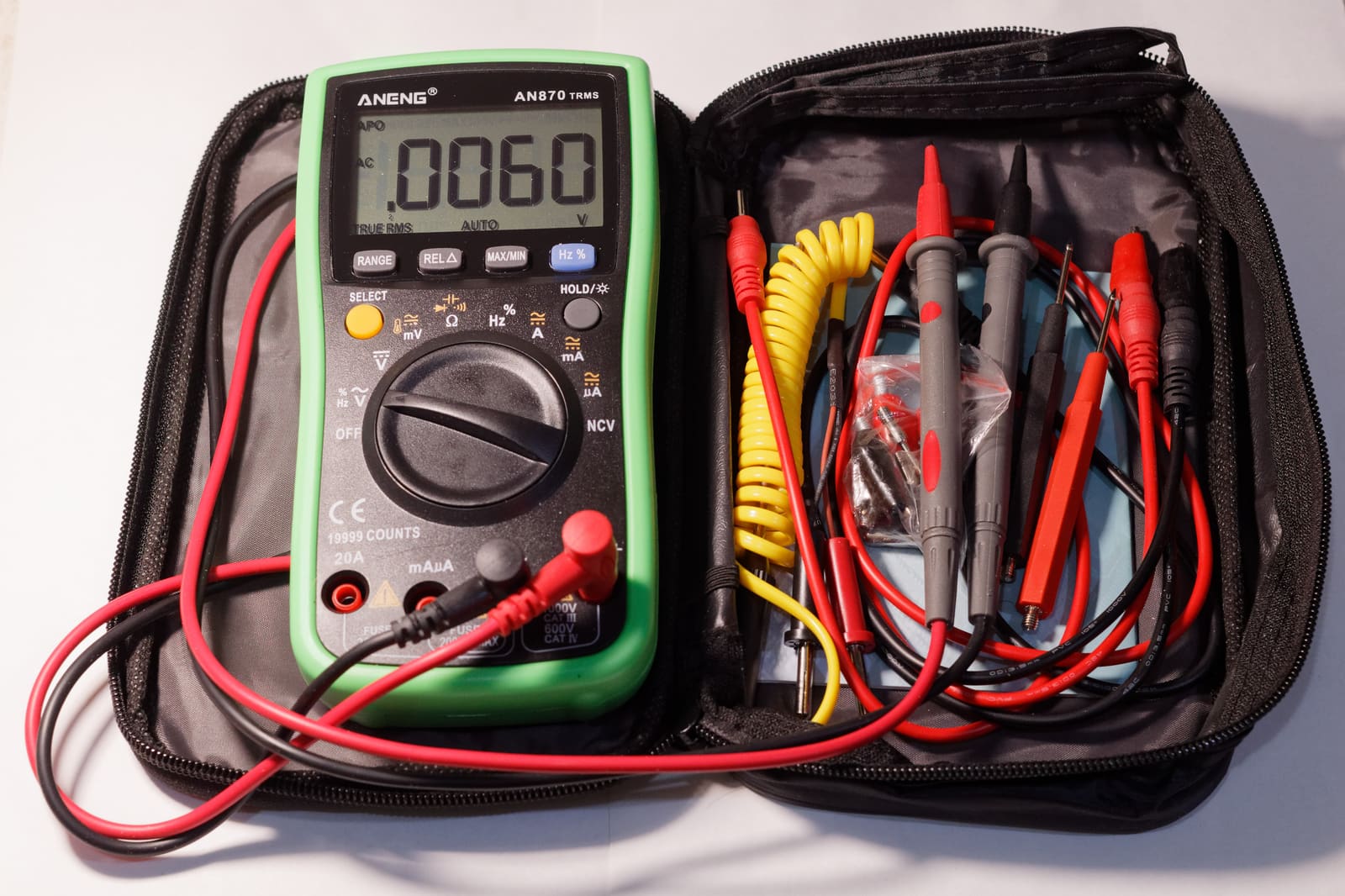
With everything off for at least a few hours (overnight is best), measure across the battery posts. As a rough guide, a 12-volt lead-acid battery near 12.6–12.7 volts is fully charged, and around 12.2 volts is about half charged (typical figures; check your battery maker's chart, and lithium batteries read differently). A low battery is the most common cause of resets. Charge it fully and see if the problem goes away. See marine battery care.
Put the meter on the battery that feeds your electronics, then have a helper crank the engine for a few seconds (clear of the prop and belts). Note the lowest number you see.
- It dips well below 10 volts: the battery is weak or undersized for the engine, or the starting cables have a bad connection. Have the battery load-tested before buying anything else.
- It stays reasonably high at the battery, but the electronics still reset: the loss is between the battery and the device. Move on to the wiring steps.
Repeat the same test with the meter at the electronics' power terminals or fuse block if you can reach them safely. A big difference between "at the battery" and "at the device" means resistance in the path.
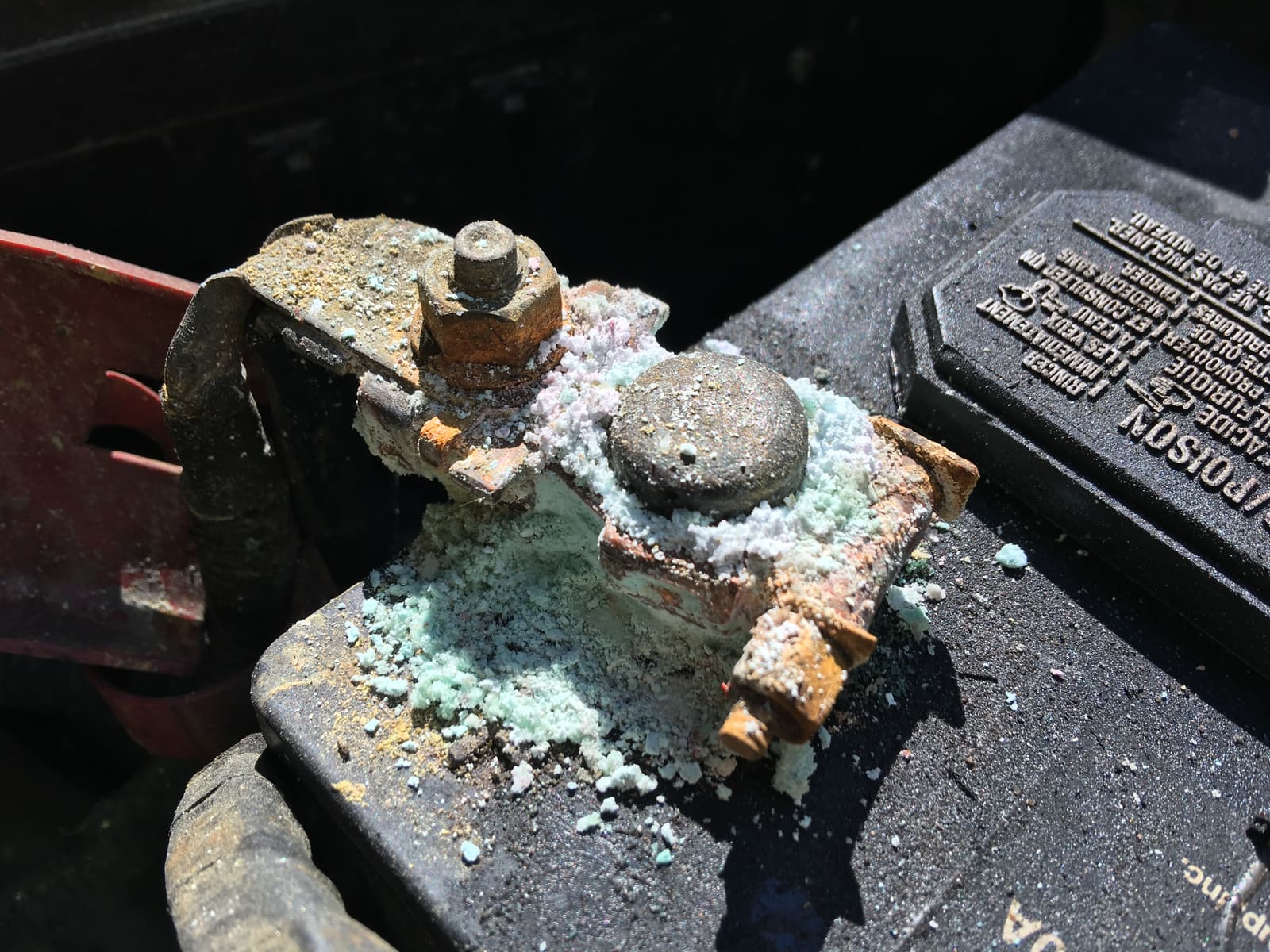
Switch the battery off. Look for white or green crust, loose wing nuts, stacked terminals that wobble, or a cable that turns on its post. Remove, clean to bright metal, reinstall snugly and coat with a corrosion inhibitor. Do the negative cable too: a bad ground causes exactly the same symptoms as a bad positive. See electrical corrosion and connections.
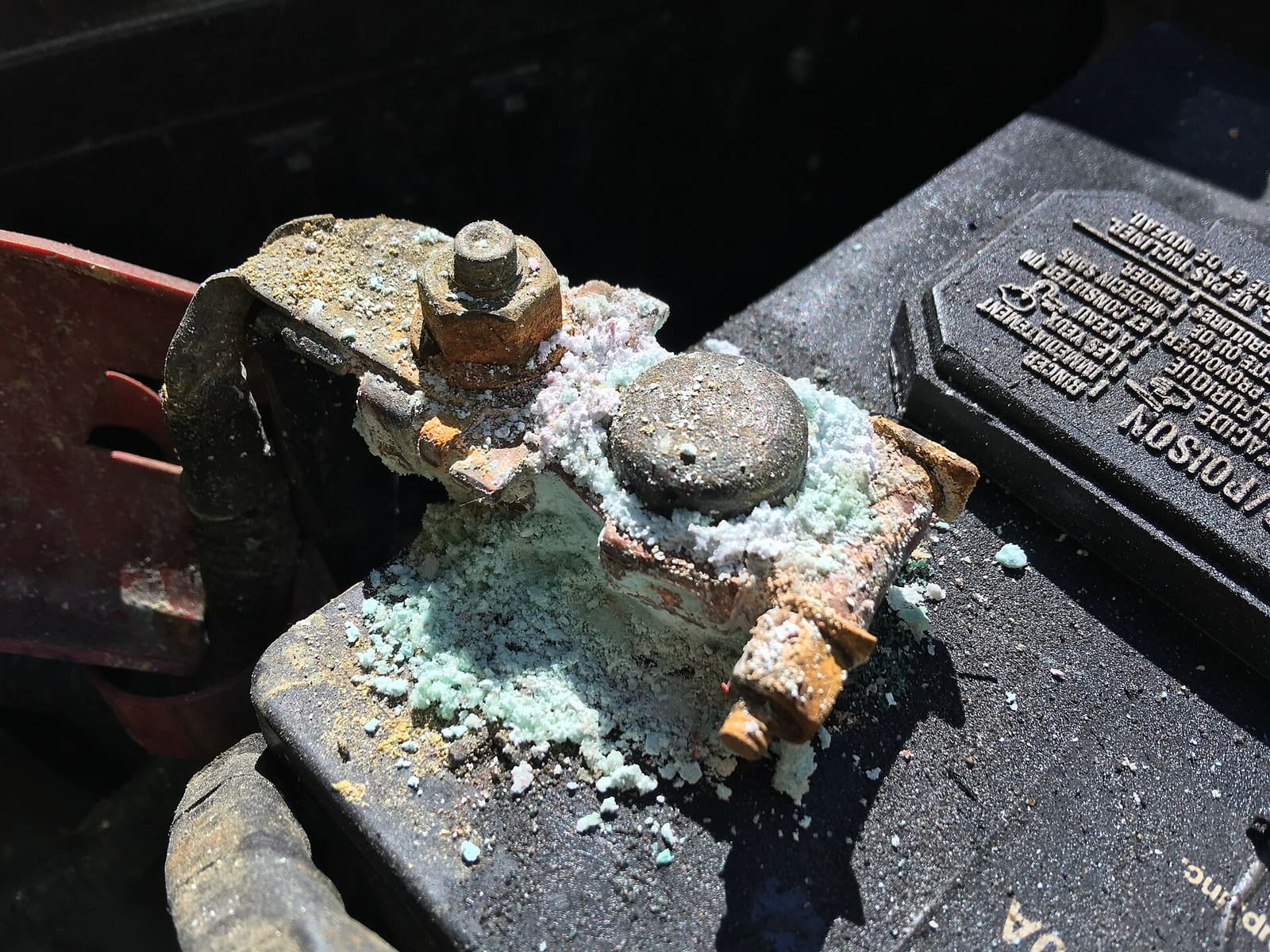
A terminal like this adds resistance every time the starter pulls current, which is exactly when the electronics reset. Photo: MarkBuckawicki / Wikimedia Commons · CC0 1.0 If a cable or terminal feels hot after a few starts, that is resistance turning into heat. Stop cranking, switch the battery off and find that connection before you go on.
Trace the negative wire from your electronics back to the negative bus or battery. Look for corroded ring terminals, a ground screwed into a random bolt, or several grounds piled under one loose nut. Electronics should share a clean negative bus that runs directly back to the battery negative. A ground that wanders through the engine block or a steering cable can drop voltage when the starter runs.
Pull each electronics fuse and look at the blades and the holder. Cheap in-line fuse holders corrode inside and create resistance even when the fuse is good. A holder that is green inside, loose, or warm is a likely culprit. Replace it with a sealed marine holder of the same fuse rating. See fuses and breaker panels.
Thin wire run a long way loses voltage. Blue Sea Systems, working from ABYC E-11, lists electronics among the "critical" circuits allowed only about 3% voltage drop, versus 10% for things like general lighting. Remember that circuit length is the round trip from the battery to the device and back. If your electronics feed is a thin wire that snakes from the bow to a console, it may simply be too small. Wire sizing charts (Blue Sea has a free one) show the gauge for your amps and length. Re-running a feed is moderate DIY for some owners; if you're unsure, have a marine electrician do it.
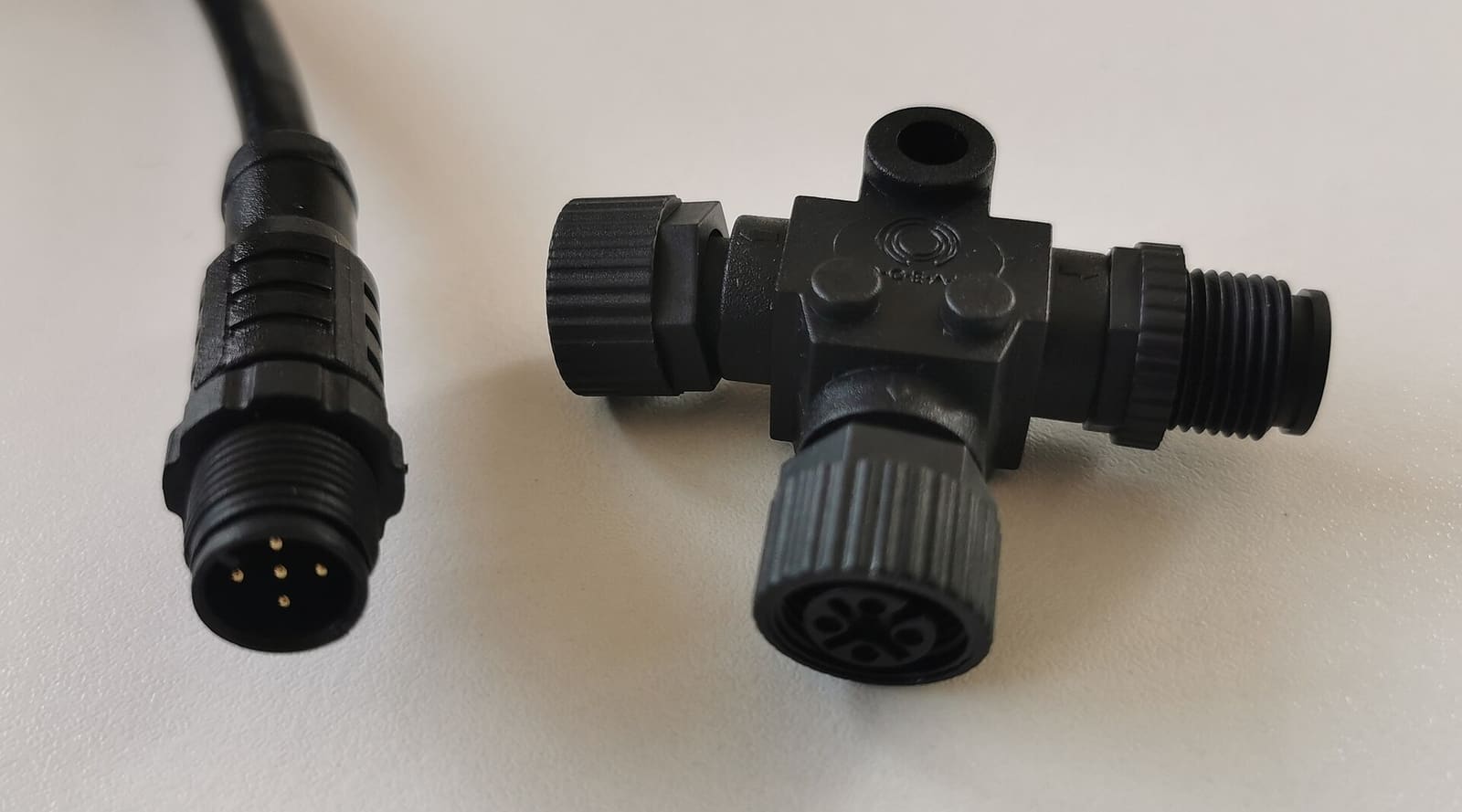
If engine data or a network sensor drops out, look at where the network gets its power. Garmin's design rule is no more than 1.67 volts of drop between the power T-connector and the farthest device; long backbones with many devices may need the power fed into the middle instead of one end. Garmin also recommends powering the network through the ignition or a dedicated switch. See NMEA 2000 network care.
On boats with two batteries, the most effective fix is to run the electronics from a house battery that is not connected to the starter while you crank. With a manual 1-2-Both switch, start on the engine battery alone, then switch as your manual says. Starting with the switch on "Both" ties the electronics straight into the cranking dip. See battery switches and dual batteries.
Many boats use an automatic charging relay (ACR) that joins the batteries when charging and separates them when not. Blue Sea's start isolation feature goes one step further: a signal wire from the key switch tells the relay to open before the starter engages, so the house battery and electronics are separated during cranking. Blue Sea notes that this wire is optional for normal relay operation, but it is what protects sensitive electronics from the cranking dip. The signal must come from the wire that is live only in the START position. If your boat already has an ACR, check whether that wire was ever connected. Installing or rewiring an ACR is best left to a pro if you are not comfortable with the starting circuit.
Single-battery boats, or boats where the electronics must stay on during cranking, can add a DC-DC converter (sometimes sold as a voltage stabilizer or "power conditioner") between the battery and the electronics. These units hold a steady output even when the input dips, within their rated input range. Victron, for example, makes isolated Orion-Tr converters with a remote on/off that can be triggered by a low-current switch such as the engine run/stop circuit. Size the converter for the total current of everything it feeds, with margin, and follow the maker's fusing and mounting instructions. A converter does not fix a dead battery or a corroded terminal; do Steps 2 through 7 first.
Repeat the cranking test from Step 3 with your helper, watching both the meter and the electronics. Record the lowest voltage at the battery and at the device, and what you changed. BoatUS also suggests measuring at the device's plug with the engine running: a reading much higher than normal while running points to the alternator's regulator rather than the wiring. If the problem started after you added new equipment, note that too, as it points to an overloaded feed or a new ground problem.
Common mistakes
- Buying a new chartplotter or "power filter" before testing the battery. A tired battery is the usual cause.
- Starting the engine with the battery switch on "Both," which ties the electronics straight into the cranking dip.
- Fixing only the positive side. Bad grounds cause the same resets.
- Wiring the electronics to the starter's positive post or to a random ignition wire to "save a run." That puts them right in the path of the cranking surge.
- Using undersized wire for a long feed because "it's only a fishfinder."
- Connecting an ACR start-isolation wire to an accessory or ignition wire instead of the start-only signal, so it never isolates when needed.
- Ignoring a warm fuse holder or terminal. Heat means resistance, and resistance can start a fire.
When to call a pro
- The battery tests fine but voltage at the electronics still collapses and you can't find the bad connection
- Any wire, terminal or fuse holder that has melted, discolored or gets hot
- Installing or rewiring a battery switch, ACR, DC-DC converter or new main feed if you are not confident with the starting circuit
- Resets that started after a lightning strike, a flooding event, or engine work
- Electronics that reset with the engine running (not just cranking), which can point to a charging system problem; see charging system test
Tips
- Turn the plotter and radio on after the engine is running and off before you shut it down. It costs nothing and avoids most reset annoyances while you chase the real cause.
- Label every electronics wire at both ends while you're tracing them. You'll thank yourself next time.
- Small outboards have small charging systems. Mercury, for example, rates the alternator on its newer 25 and 30 hp electric-start models at 17 amps and pitches it as enough for a couple of depth finders; an older or smaller motor may make far less. If you've added a big display, livewell pump and lights, the battery can slowly run down even while the motor runs, and then the next start drops the electronics. Many engines with digital gauges or an app can show battery voltage, which makes this easy to watch.
- Boat on shore power with an AC panel? A charger or inverter that keeps tripping the dock pedestal or the boat's ELCI is a different problem (AC leakage, not 12-volt sag): BoatUS says that belongs to a certified marine electrician, not trial and error.
- If you add a house battery, keep the bilge pump on its own 24-hour circuit straight from the battery, as Blue Sea recommends for bilge pumps and alarms; don't let a battery switch or converter cut it off.
- Keep a copy of your cranking-voltage readings in BoatMend. A slow drop in that number year over year is an early warning that the battery is aging.
- Batteries flat after storage? Charge them with a proper marine charger before the first trip rather than jump-starting and expecting the alternator to refill two dead batteries at idle. Mercury notes that leaving batteries discharged shortens their life, and a deeply discharged battery is exactly the kind that drops low enough to reset your electronics.
Official references
We read these to write this guide. Your engine's own manual always wins.
- Blue Sea Systems – Overcoming Dropout of House Electronics during Engine Starting
- Blue Sea Systems – Upgrading Battery Switching and Charge Management with the ADD A BATTERY Dual Circuit System
- Blue Sea Systems – Part 1, Choosing the Correct Wire Size for a DC Circuit
- Blue Sea Systems – 24 Hour Circuit Solutions
- Garmin – Technical Reference for NMEA 2000 Products, Power Distribution and Balance
- Victron Energy – Orion-Tr DC-DC Converters Isolated
- BoatUS – How To Troubleshoot Depth Sounders and Fish Finders (display blackouts on the start battery)
- Mercury Marine – Marine Battery Basics (Dockline)
- Mercury Marine – Mercury Introduces All-New 25 and 30hp Outboard Engines (alternator output, voltage on SmartCraft gauges)
- BoatUS – The Electrical Dilemma On The Dock (AC leakage and ELCI, for boats on shore power)
Safety: BoatMend is for information only and does not replace a certified marine technician. You are responsible for your safety and your boat. Read the full disclaimer.
Last updated 2026-10-25
Related guides
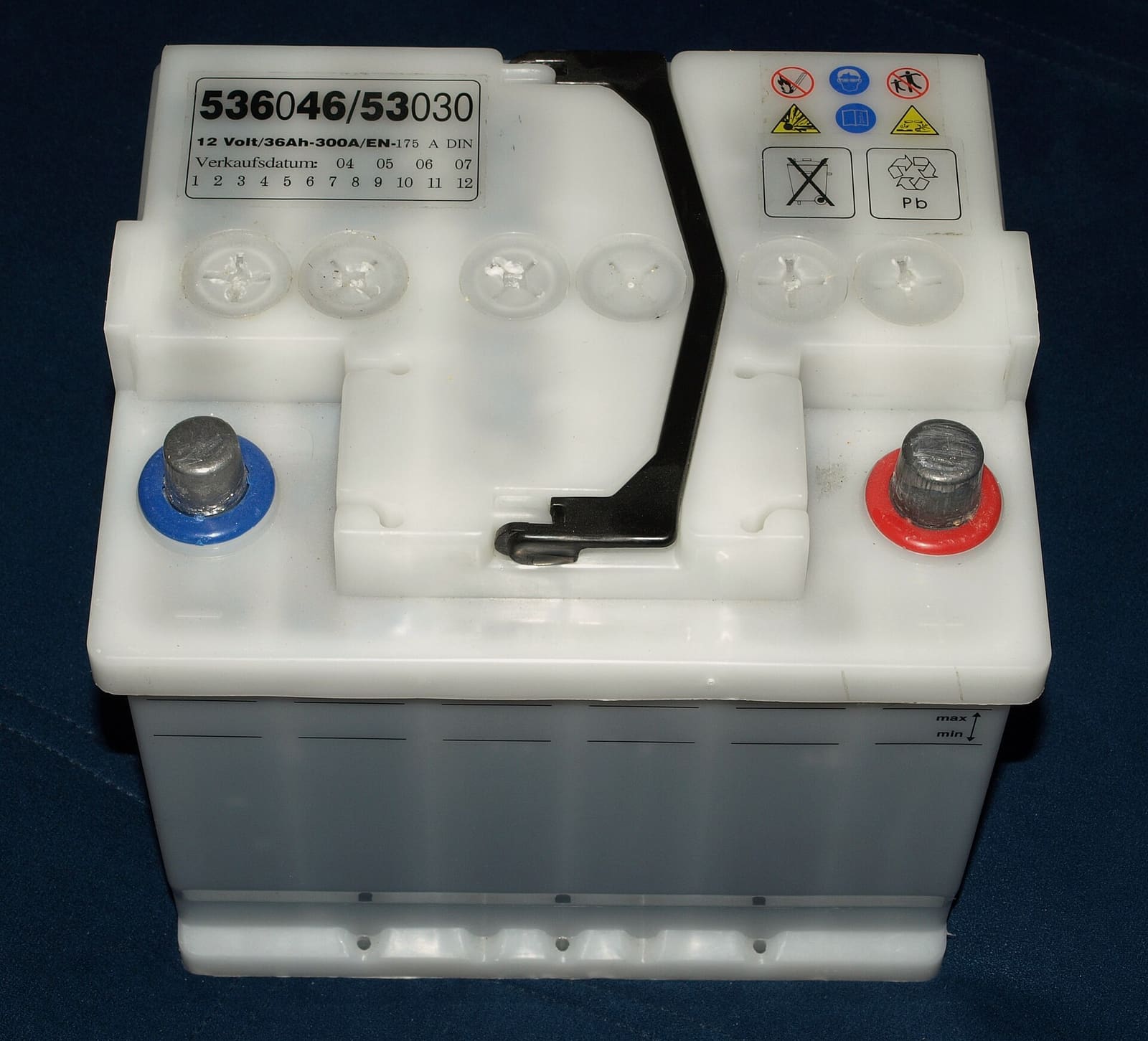
Marine Battery Care: Test, Charge and Store for Winter
Check your boat battery's health, charge it the right way for its type (flooded, AGM or lithium), and store it so it is ready in spring. Most "boat won't start" calls start with a neglected battery.
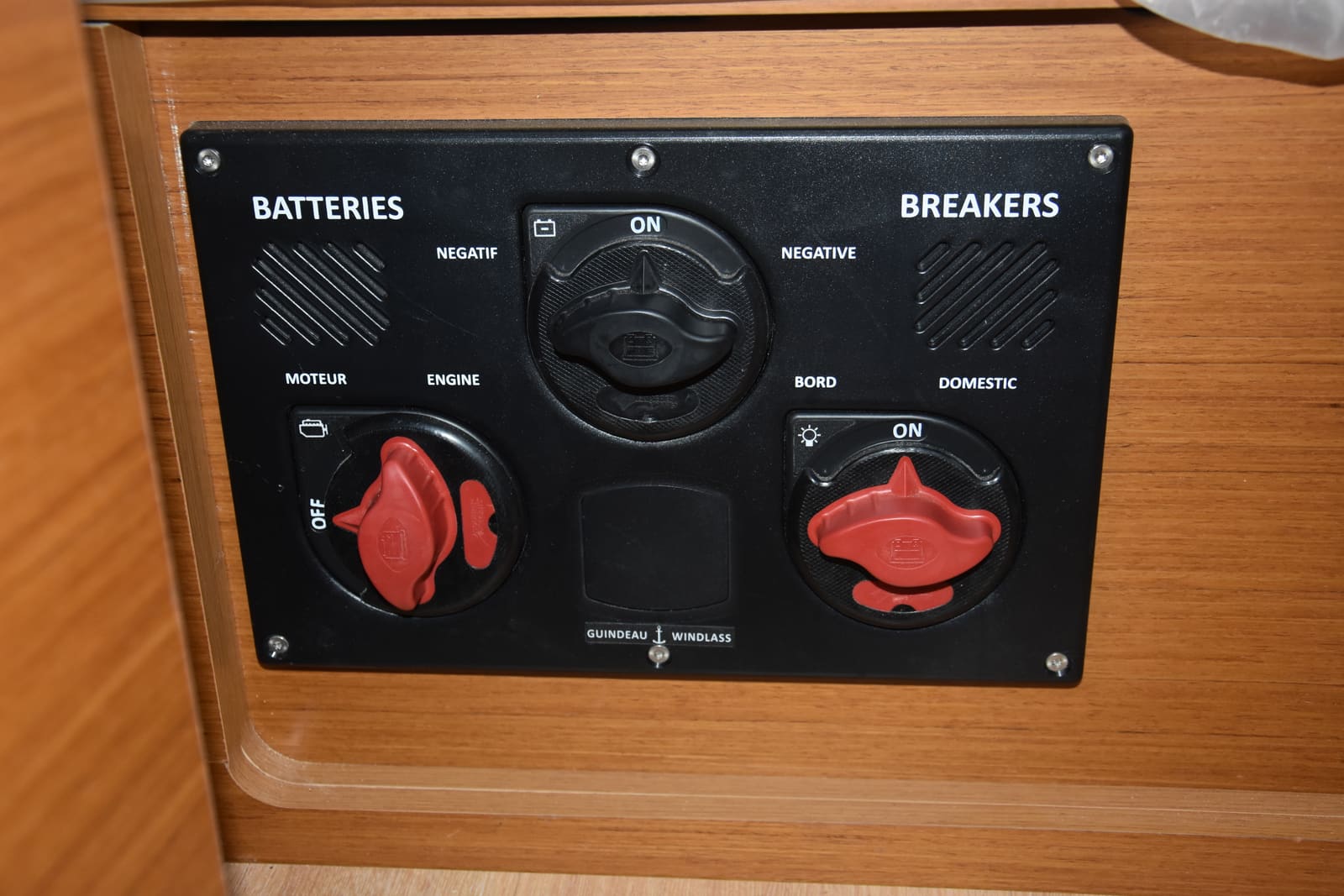
How to Use a 1-2-Both Battery Switch and Run Two Batteries
Learn what the 1, 2, Both and Off positions really do, a simple routine that keeps one battery ready to start the engine, how to check that both batteries are charging, and when an automatic charging relay makes life easier. Rewiring high-current cables is a job for a marine electrician.

12-Volt Boat Wiring Basics: Circuits, Color Codes, Fuses and Wire Size
Learn how your boat's 12-volt system is laid out, what the ABYC wire colors mean, how fuses and breakers protect the wiring, why voltage drop and tinned wire matter, and how to read a wiring diagram, so you can troubleshoot smarter and know which jobs belong to a marine electrician.

Fuse Keeps Blowing? How to Troubleshoot a Boat Fuse Block or Breaker Panel
Work through a blown fuse or tripping breaker the safe way: confirm it, tell a short from an overload, isolate the device or wire at fault, replace a worn breaker or panel switch with the same rating, and label every circuit, without ever fitting a bigger fuse.
NMEA 2000 Network Basics and Troubleshooting (Plus Chartplotter Updates)
Understand the backbone, terminators, power tap and drop cables that tie your chartplotter, engine data, GPS, depth and autopilot together, then track down why a device keeps dropping off. Finish by updating chartplotter and device software the safe way.
How to Find and Fix Corroded Electrical Connections on a Boat
Track down the green crust and loose terminals behind flickering lights, dead gauges and slow cranking with a simple voltage-drop test, then remake the connection the marine way: tinned wire, a proper crimp, adhesive-lined heat shrink and a protective coating.
Is My Engine Charging the Battery? Test the Charging System With a Multimeter
A step-by-step way to find out whether your outboard's stator and rectifier/regulator or your inboard's alternator is really charging the battery, what the voltage readings usually mean, and when the problem is just a dirty connection. Exact test specs come from your engine's service manual.
Engine Clicks but Won't Crank - Testing the Battery, Cables, Neutral Switch, Solenoid and Starter
A click (or nothing) when you turn the key is usually a power delivery problem, not a dead engine. Work from the battery and cables through the neutral switch, start relay and solenoid to the starter motor using simple voltage-drop tests, and learn how to jump-start safely when gasoline vapor may be around.