Epoxy and Two-Part Paint Safety: How to Avoid Becoming Allergic
Epoxy and isocyanate-cured paints can make you allergic for life, sometimes after many jobs with no problem at all. Learn how sensitization happens, which gloves and clothing to wear, how to get epoxy off skin without solvents, when you need a respirator, and how to handle sanding dust and leftovers safely.
Time
20 min
Applies to
All engines
Safety first: Sensitization is permanent. Once your body has become allergic to epoxy or isocyanates, even a tiny exposure can bring the rash or the breathing problems back, and isocyanate asthma can be severe: NIOSH reports deaths from severe asthma attacks in sensitized people. If you have trouble breathing, wheezing or chest tightness after working with resins or two-part paint, stop, get to fresh air and get medical help (call 911 for severe breathing trouble). If epoxy gets in your eyes, flush with gently running water for 15 minutes and get medical help if discomfort continues. Never spray two-part (isocyanate) paint yourself.
Fuel smell, water coming in, CO alarm or smoke? Stop, get everyone in life jackets and call USCG on VHF 16 or 911. For a tow: Sea Tow or TowBoatUS.
Owners often ask
- I got a rash after working with epoxy. Can I keep using it if I wear gloves?
- Is it OK to clean epoxy off my hands with acetone or vinegar?
- I have to sand epoxy filler the day after I put it on. Is the dust dangerous?
This guide walks you through it. Still stuck? Ask the AI Mechanic about your engine.
Tools
- Disposable chemical-resistant gloves (nitrile, or the type the product's SDS lists), plus spares
- Safety glasses or splash goggles
- Long sleeves, disposable sleeves or a disposable coverall
- N95 (or better) dust mask for sanding; an organic-vapor respirator if the SDS or ventilation calls for it
- Box fan or other ventilation
- Plastic sheeting, scrapers and paper towels for spills
Parts & supplies
- Waterless skin cleanser (hand cleaner made for resin or grease)
- Mild soap
- Acetone or other solvent for tools only (never skin)
Before you start
What "sensitization" means: your immune system learns to treat a chemical as an enemy. WEST SYSTEM explains you can't know ahead of time how much exposure you can take: it can happen after one big exposure or after many small ones, over days, months or years. Owners who "never wore gloves and never had a problem" are often the ones who suddenly can't touch epoxy anymore.
The two main families on a boat:
- Epoxy (resin + hardener): used for fillers, fairing, core repairs, filling screw holes and barrier coats. The main risk is skin. WEST SYSTEM says skin is the most common route of exposure; reactions are usually a rash (contact dermatitis), and a smaller number of users develop a true allergy. Liquid epoxy is the riskiest; fully cured epoxy is much safer.
- Isocyanates: the activator in two-part polyurethane topside paints and clears, some two-part varnishes, and some foams and adhesives. OSHA lists occupational asthma and other lung problems as the main effects, plus irritation of the eyes, nose, throat and skin. NIOSH notes both breathing and skin contact can lead to sensitization.
Your best tool is the Safety Data Sheet (SDS). Every resin, hardener, activator and paint has one, usually on the maker's website. It lists the exact glove material, respirator and eye protection for that product. When this guide and the SDS differ, follow the SDS.
Steps
Look at sections on hazards, first aid, exposure controls and personal protection. Note the glove material, the respirator type and whether the product is a skin or respiratory sensitizer. Words like "may cause an allergic skin reaction" or "may cause allergy or asthma symptoms or breathing difficulties if inhaled" mean exactly what they say.
WEST SYSTEM's first step for preventing overexposure is picking the least hazardous product. For a DIY topside job, a one-part paint avoids isocyanates altogether (see topsides-painting). Pre-measured pumps and small kits mean less handling and fewer spills.
Cover the bench and floor with plastic sheeting. Have paper towels, a scraper, a trash bag, your skin cleanser and soap within reach. Set up a fan to move fresh air through the space. Inside a boat (cabin, bilge, locker), vapors build up fast even with low-VOC epoxy, so ventilation matters more there, not less.
Wear disposable chemical-resistant gloves whenever you touch resin, hardener, mixed epoxy, activator or sanding dust. Disposable nitrile gloves are the common choice; WEST SYSTEM's Epoxyworks also suggests neoprene for good chemical and puncture resistance. Use the material the SDS lists. Thin vinyl or fabric work gloves don't keep resin out.
Change gloves when torn or heavily smeared, and take them off inside out so you don't touch the outside. With dirty gloves, don't touch door handles, light switches, your phone or your face: WEST SYSTEM points out you'll touch those again later bare-handed.
Long sleeves, disposable sleeves or a disposable coverall keep resin off your wrists and forearms, where gloves end and rashes often start. Epoxyworks notes epoxy can soak through clothing to the skin. If you spill on your clothes, change right away. Barrier creams can add some protection but don't replace gloves.
Wear safety glasses or splash goggles when mixing, pouring, rolling or sanding. Hardeners are corrosive, and a splash from a stir stick is very common.
If you get epoxy on your skin, remove it quickly:
- Resin or mixed epoxy: wipe off what you can with a paper towel, then use a waterless skin cleanser (it's not water-soluble), then wash with soap and warm water.
- Hardener and sanding dust: wash with soap and warm water.
- Never use acetone, lacquer thinner, paint thinner or alcohol on your skin. WEST SYSTEM says never use solvents on skin: they dissolve the epoxy and help carry it into your skin. Epoxyworks makes the same point about vinegar: it can drive epoxy deeper and raise the chance of an allergic reaction, so don't make it a habit.
Wash your hands and face before eating, drinking or smoking, and at the end of the day.
For epoxy mixing and spreading, WEST SYSTEM's minimum is good ventilation. If you can't ventilate a confined space well, it says to wear an air-purifying respirator with an organic vapor (or multi-contaminant) cartridge. Heat makes it worse: warm epoxy and hot curing pots give off more vapor.
For two-part (isocyanate) paints, follow the paint's SDS exactly, use the respirator it calls for, and keep people and pets away. Isocyanates can be harmful at levels you can't smell. Interlux says its two-part topside paint is dangerous when sprayed and needs specialized breathing equipment, so it recommends a professional for spraying. Spraying belongs in a pro's booth with supplied-air equipment, not in your driveway.
Sanding dust from partially cured epoxy still has unreacted chemicals in it. WEST SYSTEM says breathing it raises your risk of sensitization and recommends waiting at least overnight before sanding, longer in cool weather; full cure can take two weeks or more at room temperature. When sanding:
- Use a dust mask or respirator rated N95 or better (or what the SDS calls for), plus eye protection.
- Use a sander with dust extraction or a shop vacuum when you can.
- Wear sleeves and gloves: dust on sweaty skin can cause dermatitis too.
- Clean up with a vacuum, not by blowing dust around with compressed air.
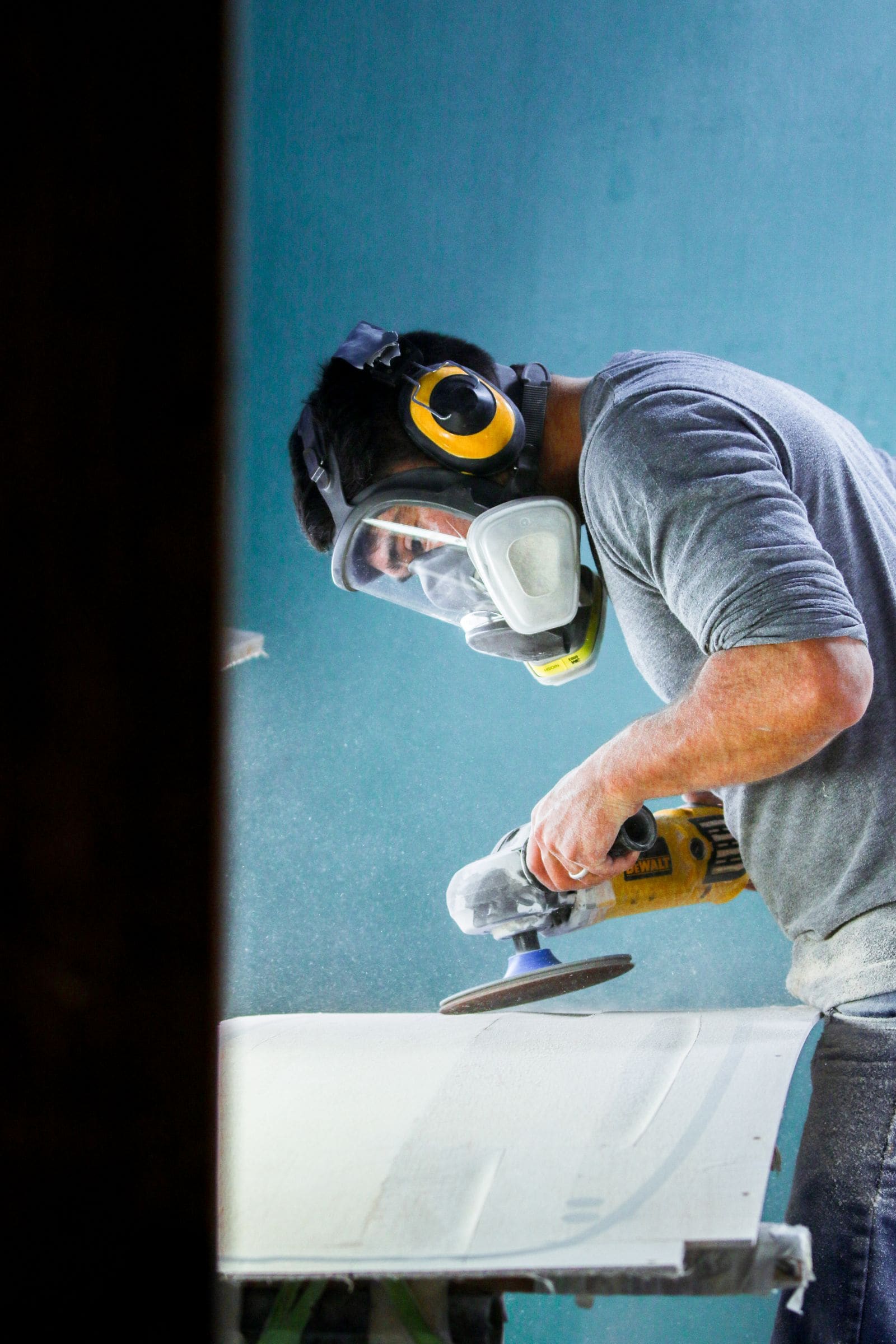
Power sanding fills the air with fine dust. A respirator protects your lungs; add gloves and long sleeves so the dust stays off your skin too. Photo: Harold Granados / Pexels · Pexels License For antifouling bottom paint dust, which has its own hazards, see bottom-paint-antifouling.
Mixed epoxy in a cup heats itself as it cures, and a big mass can get hot enough to smoke, give off fumes or start a fire. Mix only what you can use within the working time. If a pot starts to overheat, carefully move it outside, away from people and anything that burns, and leave it until it's fully cured and cool.
Scrape up spills, then wipe with paper towels. For a bigger spill, WEST SYSTEM says to contain it with sand, clay or another inert absorbent, and never to soak up hardener with sawdust or other fine wood or paper material. Clean tools (not skin) with the solvent the maker recommends, outdoors, away from flames. WEST SYSTEM warns not to throw hardener into trash with sawdust or other fine paper or wood material: it can spontaneously combust. Let leftover mixed epoxy cure fully before disposal. Unused liquid resin, hardener, activator and solvents go to your local household hazardous waste program, not down a drain.
Skin signs: redness, itching, rash, swelling or blisters, often on hands, wrists, forearms, face and eyelids. Breathing signs: cough, wheezing, chest tightness, shortness of breath, or a runny nose and "cold" that comes back every time you work with the product. If symptoms appear:
- Stop using the product. WEST SYSTEM advises resuming only after symptoms clear, and with better protection.
- See a doctor, ideally one familiar with work-related allergies, and bring the SDS. NIOSH's list of warning signs for isocyanates includes symptoms people often brush off: eye irritation, a stuffy nose, a dry or sore throat and "cold-like" symptoms that keep coming back.
- If symptoms keep coming back, stop working with that product and hire out jobs that involve it.
Common mistakes
- Skipping gloves because "I've never reacted." Sensitization can show up after years of exposure, and then it doesn't go away.
- Cleaning hands with acetone or thinner. It feels effective but carries the chemicals into the skin.
- Sanding the day after with no mask. Partially cured dust is a sensitization risk.
- Working inside a closed cabin or bilge with no airflow.
- Wearing gloves but bare forearms. Rashes on wrists and forearms are classic.
- Touching your face, phone or door handles with dirty gloves.
- Spraying two-part polyurethane at home. Leave spraying to pros with the proper breathing equipment.
- Throwing a full cup of mixed epoxy in the trash. It can overheat and start a fire.
When to call a pro
- You've developed a rash or breathing symptoms after resin or paint work: see a doctor, and hire out future resin and two-part paint jobs
- The job calls for spraying any two-part (isocyanate) product
- You'd have to work for long periods in a cramped, poorly ventilated space (bilge, inside a tank compartment, small cabin)
- Large fairing, barrier coat or recore jobs that mean days of mixing and sanding
- Anyone with asthma or known allergies who would otherwise do the work
Tips
- Keep a box of gloves and a bottle of waterless cleanser in your boat repair kit, not just in the garage.
- Use pre-measured pumps for epoxy: fewer drips and spills.
- Tape a copy of each product's SDS (or a link) inside your tool box.
- Wear a long-sleeve shirt you don't care about, kept just for resin work.
- Bag resin-stained clothes and wash them separately. WEST SYSTEM says not to keep wearing clothes you can't get uncured epoxy out of; clothes with mixed epoxy can be worn again once it has fully cured.
Official references
We read these to write this guide. Your engine's own manual always wins.
- WEST SYSTEM – Why Use Skin Protection from Epoxy?
- WEST SYSTEM – General Epoxy Safety Guidelines (Preventing Overexposure)
- Epoxyworks – Epoxy Safety for DIY Boat Repair
- Epoxyworks – Vinegar, Save It for Salads
- OSHA – Isocyanates overview
- NIOSH (CDC archive) – Isocyanates topic page
- Interlux – Which product to spray-apply on topsides (isocyanates)
Safety: BoatMend is for information only and does not replace a certified marine technician. You are responsible for your safety and your boat. Read the full disclaimer.
Last updated 2026-11-06
Related guides

How to Paint Your Boat's Topsides (Roll and Tip)
When the gelcoat above the waterline is too chalky or crazed to polish back, a one-part or two-part polyurethane paint can bring back the shine. This guide covers choosing the paint, prep, weather windows, roll-and-tip technique and the safety gear two-part paints demand.
How to Repair Small Gelcoat Chips and Scratches
Fill and blend small chips, dings and scratches in your boat's gelcoat with a repair kit so they stop letting water into the fiberglass and look close to new. Also learn to spot damage that is structural and needs a pro.
How to Fill Old Screw Holes in Fiberglass Decks and Hulls
Close up the holes left by removed cleats, rod holders, electronics and trim so water can't reach the deck core. Covers simple epoxy fills, the overdrill-fill-redrill method for cored decks, a gelcoat finish, and why holes below the waterline are a haul-out job.

How to Find Soft Spots and Wet Core in a Fiberglass Deck
Tap, press and meter your deck to find wet or rotting core before it spreads, track down the leaking hardware that let the water in, and decide whether a small DIY injection repair will do or the deck needs a pro to recore it.

Bottom Paint (Antifouling): Do You Need It, Which Type, and How to Repaint
Learn whether your boat needs antifouling bottom paint, how ablative and hard paints differ, and how to prep and roll on a fresh coat safely, without poisoning yourself or the water and without ruining an aluminum hull.

How to Match Gelcoat Color for Small Repairs
Get a chip or screw-hole repair to blend in with your hull instead of standing out as a bright patch. Learn to polish first so you see the real color, find your builder's color code or a matched gelcoat, tint by tiny steps, test cured samples in daylight, and allow for sun fading.