Loss of Power, Hesitation or Misfire - Troubleshooting Guide
Figure out why your engine bogs down, stumbles, will not reach full rpm or runs rough. Work from simple checks like trim, prop and fuel filter to ignition and engine protection modes before paying for diagnostics.
Time
1 h 30 min
Applies to
Outboard, Sterndrive (I/O), Gas inboard
Safety first: Do not work on spark plugs, wires or the fuel system with the engine running. If you smell gasoline, see fuel in the bilge, or notice a burning smell from wiring, shut down and do not restart. If you lose power far from shore, anchor if needed and call TowBoatUS or Sea Tow; in an emergency use VHF channel 16 or dial 911.
Owners often ask
- My motor bogs down or loses power at full throttle after a few minutes.
- My boat won't get up on plane anymore. Is it the engine or the prop?
This guide walks you through it. Still stuck? Ask the AI Mechanic about your engine.
Tools
- Flashlight
- Basic wrench and socket set
- Spark plug socket and gap gauge
- Filter wrench for your water-separating filter
- Prop wrench or socket, plus a block of wood
- Portable fuel tank with fresh fuel (for testing)
- Digital multimeter
Parts & supplies
- Spark plugs (the exact type your manual lists)
- Water-separating fuel filter
- Fresh, stabilized fuel
Before you start
Notice the pattern before you start wrenching:
- Sudden loss of power with a warning horn or light: the engine is probably protecting itself (overheat, low oil pressure, over-rev, sensor fault). Start with step 1.
- Can't reach normal top rpm, but runs smoothly: often prop, trim, hull or load. See steps 2–5.
- Stumbles, hesitates or surges when you throttle up: usually fuel. See steps 6–10.
- Rough running, shaking or popping (misfire): often spark plugs or ignition. See steps 11–12.
Your owner's manual lists the full-throttle rpm range for your engine. Knowing your normal top rpm and speed makes diagnosis much easier.
Steps
Look at the gauges and display for warning icons or codes, and listen for the alarm horn. Many modern engines cut power (often called guardian, limp or protection mode) when they overheat, lose oil pressure, or detect a fault. Check the telltale or exhaust water and the oil level. If the engine was overheating, see the overheating guide before continuing.
With the engine off and the key and lanyard removed, look at the prop. Rope, fishing line, weeds or a plastic bag can rob power. A bent, chipped or cracked blade causes vibration and lost speed. A prop hub that has spun (rubber or plastic hub slipping) makes the engine rev up with little push; that needs a prop shop. Running through sand or mud can bend blades slightly with no obvious damage; if vibration or lost speed started after a shallow-water trip, have the prop checked.
Too much trim up can make the prop ventilate (rev high and lose grip); too much down makes the boat plow. Try different trim settings. Also think about load: extra people, gear, water in the bilge or a full livewell all slow the boat down. A waterlogged hull or bilge full of water is serious; check it.
Barnacles, slime and weeds on the bottom add a lot of drag, especially if the boat lives in the water. If speed and top rpm have slowly dropped over the season, a dirty bottom is a common reason.
Have someone push the throttle to full while you check that the engine's throttle actually opens all the way. Stretched or poorly adjusted cables can limit throttle. On electronic controls, a fault code may show.
A blocked tank vent starves the engine as it runs, causing power loss that gets worse over time. Open the vent, or loosen the fuel cap as a test. On outboards, the primer bulb tells you a lot:
- Bulb collapses (sucks flat) while running: the engine is struggling to pull fuel through a restriction. Check the tank vent, kinks, a closed valve, a clogged filter, a sticking anti-siphon valve or a blocked pickup. Old fuel hose can also collapse on the inside while looking fine outside.
- Bulb never gets firm when you squeeze it: air is getting in, or the bulb's internal check valves are worn. Look for loose fittings and torn quick-connect O-rings first; if you find none, replace the bulb.
A partly clogged water-separating filter or on-engine filter lets the engine idle fine but starves it at high rpm. Check for water and debris, and replace the filter. Yamaha suggests replacing the 10-micron separator every 50 hours or after a bad tank of fuel (typical; confirm for your brand in your manual).
Water in the fuel, phase-separated ethanol fuel, or stale fuel all cause stumbling and hesitation. Run the engine from a portable tank of fresh fuel to test. If the problem goes away, the main tank's fuel is the issue. Additives will not restore bad fuel; it needs to be removed.
Use the octane your manual requires and avoid fuel above E10. Low-octane fuel can cause knocking, and many engines pull back ignition timing (and power) to protect themselves when they detect knock. Old ethanol fuel can lose octane in the tank too: Mercury explains that when water makes E10 phase-separate, the gasoline left on top can be up to about 3 octane numbers lower than what you bought, even if no water reaches the engine.
Loose fittings, a cracked primer bulb or a torn O-ring at a quick connector can draw air into the fuel, causing surging and hesitation. Check every connection between the tank and engine. Any fuel leak means stop and repair before running.
Remove and inspect the plugs (engine off, lanyard removed). They should be a light tan or brown color. Black and sooty, oily, white and blistered, or with worn rounded electrodes all point to problems or simply plugs that are due. Replace them with the exact type in your manual, gapped correctly. Many engines call for new plugs every 100–300 hours; typical, confirm in your manual.
Look for cracked plug wires or boots, corrosion in coil connectors, and loose engine harness plugs. Corrosion inside connectors causes intermittent misfires. Clean and protect connections. Testing coils and sensors needs a meter and the service manual, or a dealer.
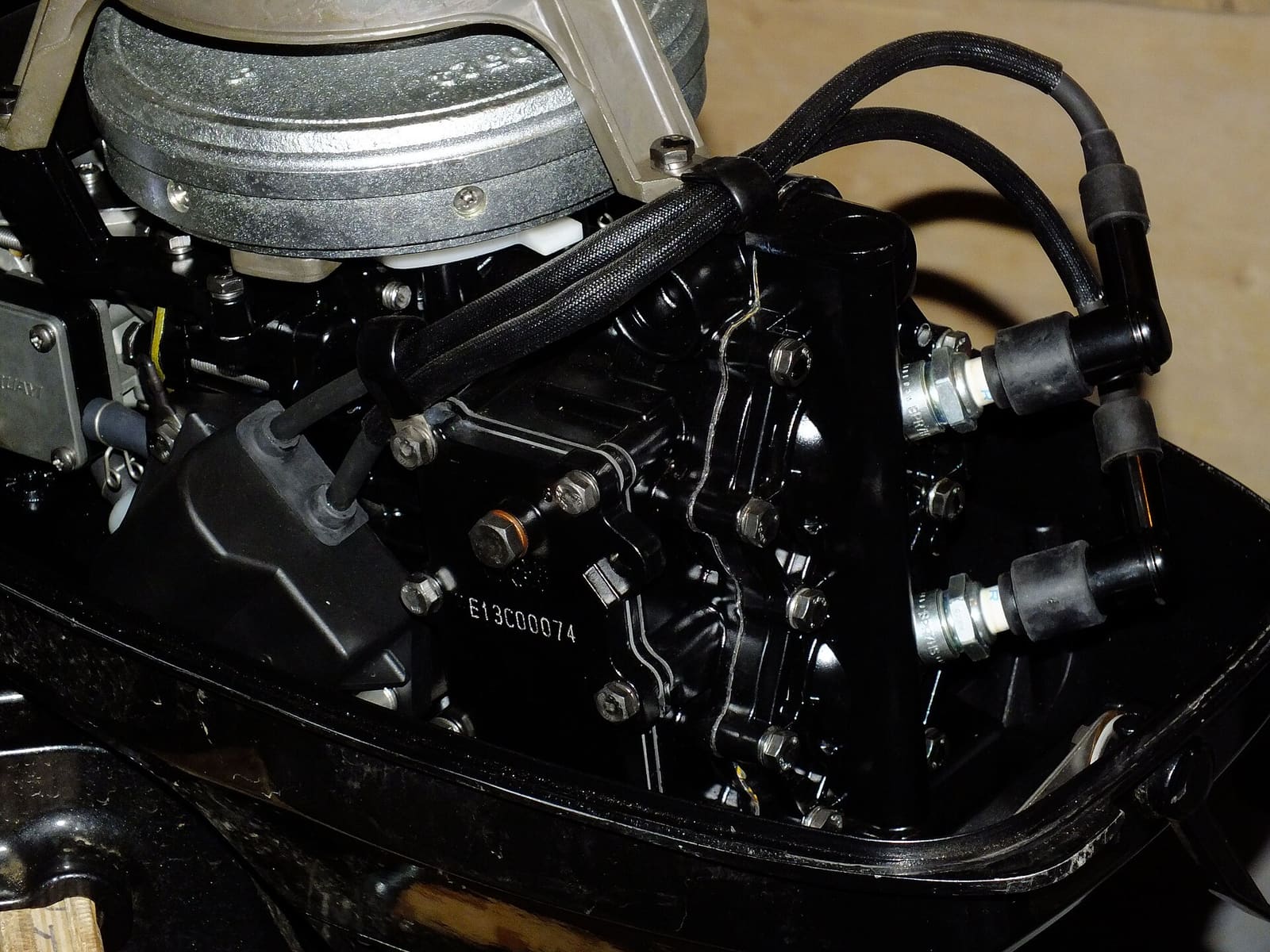
Plug wires, boots and the ignition coil on a small outboard. Look for cracks, chafing and corroded connections. Photo: Andshel / Wikimedia Commons · CC BY-SA 4.0 Bird or mouse nests, a blocked flame arrester (sterndrive/inboard) or a cover left on the intake will choke the engine. Make sure the area under the cowling and around the air intake is clear.
If none of the above solves it, a dealer can read fault codes and check fuel pressure, injector function, compression and sensors. Bring your notes about when the problem happens (rpm, temperature, after how long).
Common mistakes
- Blaming the engine when the real problem is a damaged prop, a spun hub or the wrong pitch, or the other way around. Compare your full-throttle rpm with the range in your manual first.
- Judging "lost power" on a day with extra people, a full livewell or water in the bilge.
- Forgetting the tank vent and the anti-siphon valve, which starve the engine only at higher demand.
- Replacing the fuel pump when a cracked primer bulb or a torn quick-connect O-ring is letting air in.
- Pouring in additives to rescue bad or water-contaminated fuel instead of removing it.
- Installing a "cross-reference" spark plug instead of the exact type your manual lists.
- Adding an extra fine-micron fuel filter to "protect" the engine. Mercury warns the added restriction can starve the engine of fuel, which shows up first at high rpm.
- Bolting on a higher-pitch prop for more top speed on a small engine. Boating Magazine notes too much pitch can bog an engine down and wear its internal parts; the engine should still reach the full-throttle rpm range in your manual.
When to call a pro
- Fuel smell, fuel leak or water in the fuel tank
- Warning alarms for oil pressure, overheating or a check engine code you cannot clear
- Low compression, knocking or metallic noises
- Spun prop hub or a damaged gearcase
- Power loss that comes back after you replaced the filter and plugs
- You are on the water and cannot make safe headway: call TowBoatUS or Sea Tow, and in an emergency VHF 16 or 911
Tips
- Record your normal top rpm and speed at full throttle with a normal load. It is your baseline.
- Carry a spare prop, prop nut kit and the wrench if you boat in shallow or rocky water.
- Keep spare plugs and a water-separating filter on board.
- A slight drop in performance over a season usually means maintenance is due, not a major failure.
Official references
We read these to write this guide. Your engine's own manual always wins.
- Yamaha Outboards – Maintenance Matters, Fuel and Fuel System
- Yamaha Outboards – Maintenance Matters, Additional Tasks
- Yamaha Outboards – Maintenance Matters, Electrical System
- BoatUS – What If Your Temperature Gauge Spikes?
- BoatUS – 4 Steps to Take if Your Outboard Quits
- Honda Marine – Fuel Recommendations
- Mercury Marine – Maintenance Made Easy, Propeller Maintenance
- Mercury Marine – Owner FAQs (all categories)
- Boating Magazine – Understanding Propeller Pitch
Safety: BoatMend is for information only and does not replace a certified marine technician. You are responsible for your safety and your boat. Read the full disclaimer.
Last updated 2026-10-23
Related guides
Engine Starts Then Dies - Troubleshooting Guide
Track down why your boat engine fires up and then stalls, whether at idle, when you shift into gear, or after a few minutes of running. Most causes are in the fuel supply and can be checked with no special tools.
Engine Overheating - Troubleshooting Guide
Work through the most likely causes of a hot engine or overheat alarm, from a blocked water intake to a worn impeller or stuck thermostat. Acting fast and in the right order can save your engine and often gets you home without a tow.
Engine Won't Start or Won't Crank - Troubleshooting Guide
Find out why your boat engine will not turn over or will not fire, starting with the simple things owners miss most, like the kill switch lanyard and battery switch. Many no-starts are fixed at the ramp in minutes without a tow.
How to Change Lower Unit (Gearcase) and Sterndrive Oil
Drain and refill the gear oil in your outboard lower unit or sterndrive, and learn to spot water intrusion before it destroys the gears. It is a 30-minute job that protects a gearcase costing thousands to replace.