Engine Starts Then Dies - Troubleshooting Guide
Track down why your boat engine fires up and then stalls, whether at idle, when you shift into gear, or after a few minutes of running. Most causes are in the fuel supply and can be checked with no special tools.
Time
1 h
Applies to
Outboard, Sterndrive (I/O), Gas inboard
Safety first: Many of these checks involve opening the fuel system. Work with the engine off and cool, no smoking or sparks nearby, and wipe up every drop. If you smell gasoline in the bilge or see a leak, do not restart: ventilate and call a pro. If you are stranded, anchor if needed and call TowBoatUS or Sea Tow; in an emergency use VHF channel 16 or dial 911.
Owners often ask
- My engine starts, runs for a few seconds, then dies. Why?
- My outboard won't idle and stalls when I shift into gear.
This guide walks you through it. Still stuck? Ask the AI Mechanic about your engine.
Tools
- Flashlight
- Basic wrench and socket set
- Filter wrench for your water-separating filter
- Clear container for checking fuel
- Portable fuel tank with fresh fuel (for testing)
- Digital multimeter
Parts & supplies
- Water-separating fuel filter
- Primer bulb assembly (if faulty)
- Fresh, stabilized fuel
Before you start
Pay attention to when it dies. That tells you a lot:
- Dies within seconds of starting: usually fuel starvation (no fuel getting through) or a safety system shutting it down.
- Dies when you shift into gear: idle too low, a line or rope wrapped on the prop, or a neutral safety/shift problem.
- Dies after running a few minutes: fuel tank vent closed, clogged filter, overheating, or a fuel pump that is failing.
- Dies at idle but runs at higher speed: dirty carburetor or injectors, stale fuel, or an idle air control problem.
- Ran fine last fall, starts and stalls on the first spring start: most often old fuel that went stale over the winter and gummed the idle circuits, or water in the fuel. Start with steps 5 to 7.
Check warning lights and alarms right after it stalls. A horn or warning icon can point straight to the cause (overheat, low oil pressure, low oil).
Steps
A loose lanyard clip or a worn switch can cut the engine as you move. Make sure the clip is fully seated. If it dies when you bump the helm, the switch or its wiring may be faulty.
A closed or blocked fuel tank vent creates a vacuum and the engine starves after a few minutes. Open the vent on a portable tank. On a built-in tank, a blocked vent (insect nest, kinked hose) often shows as a "whoosh" of air when you open the fuel cap. If loosening the cap lets the engine run, fix the vent.
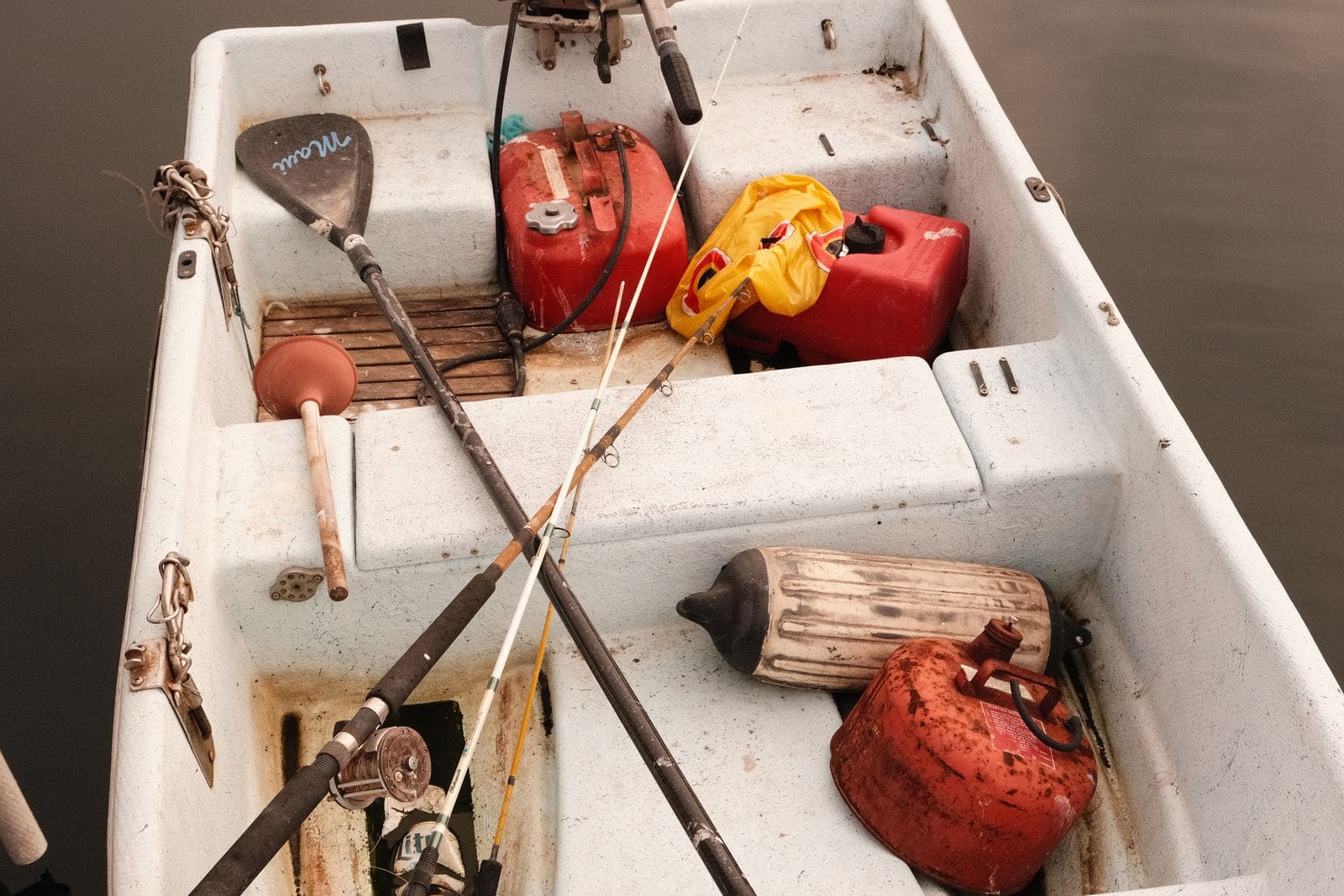
Portable tanks in a small boat. Make sure the vent on the tank is open and the fuel line connection is snug. Photo: Jake Ryan / Pexels · Pexels License On outboards, if squeezing the primer bulb keeps the engine alive, it is not getting enough fuel on its own. Look for a collapsed bulb, a bad bulb check valve, a kinked line, a loose quick-connect fitting, or a torn O-ring letting air in. Check that the arrow on the bulb points toward the engine. BoatUS notes that a bulb gone hard and stiff has tired one-way valves inside and can shed rubber into the fuel, so replace it instead of nursing it along.
Make sure there is enough fuel, the tank selector or fuel valve is fully open, and the line is not kinked by gear or a hatch. A low tank in rough water can uncover the pickup.
Look in the filter bowl or remove the filter and pour some fuel into a clear container. Water or debris means contaminated fuel. Replace the filter. Ethanol fuel can loosen deposits in old tanks and clog filters quickly; carry a spare.
An engine that dies suddenly and completely, with no sputtering, often has water in the fuel. If the filter is full of water, the tank needs to be pumped out and cleaned. Additives will not fix water-contaminated or phase-separated fuel. Do not keep restarting: you can draw more water into the engine.
Even if the water-and-ethanol layer at the bottom never reaches the pickup, Mercury explains that the gasoline left on top has lost much of its ethanol and can drop by up to about 3 octane numbers, which can cause rough running or engine damage. Phase-separated fuel has to be removed, the tank cleaned and refilled with fresh fuel.
Fuel that sat for months untreated can go stale and gum up the idle circuits of carburetors and injectors. Test with a portable tank of fresh fuel connected directly to the engine. If it runs fine on fresh fuel, the problem is in your main tank's fuel.
Many boats with built-in tanks have an anti-siphon valve at the tank outlet. If it sticks, it restricts fuel flow, especially at higher demand. If the engine runs on a portable tank but not on the built-in tank, have this valve and the pickup checked.
If it only dies when shifting into gear:
- Check the idle rpm against your manual; it may be set too low or dropping when the engine is cold.
- Check the prop for rope, line or weeds (engine off, key removed).
- Have a dealer check shift cable adjustment if shifting is stiff or harsh.
Many modern engines shut down or limit power when they overheat or oil pressure is low. Look for warning icons, check the telltale or exhaust water, and check the oil level. See the overheating guide if water flow is weak.
A weak battery or loose connection can make modern fuel-injected engines stall, because the fuel pump and computer need steady voltage. Clean and tighten battery and engine ground connections. Measure the voltage with the engine running; it should be higher than with the engine off if the charging system is working.
On carbureted engines, a choke that stays on, or one that is not used on a cold engine, can make it die. After storage, check for nests or debris in the air intake.
If the fuel supply checks out and it still stalls, the cause may be a failing fuel pump, clogged injectors or carburetor, a vapor separator problem, or a bad sensor. These need a dealer's diagnostic tools and fault code reader.
Common mistakes
- Restarting again and again after a sudden stall with water in the filter. Each restart pulls more water into the engine.
- Pouring in an additive to "fix" water or phase-separated fuel. No additive removes water; the fuel has to come out.
- Unscrewing a spin-on water-separating filter, dumping it and putting it back. Trapped water and dirt can end up on the clean side; replace it.
- Buying a fuel pump before checking the cheap suspects: tank vent, primer bulb, quick-connect O-rings and the anti-siphon valve.
- Turning the idle speed up to hide a fuel problem instead of finding it.
- Running the tank very low in rough water, so the pickup sucks air.
- Adding an extra fine-micron fuel filter "for protection". Mercury warns that each extra filter is another restriction that can starve the engine of fuel; use the filters your engine maker specifies.
When to call a pro
- Fuel smell, fuel leak or fuel in the bilge: stop the engine, ventilate, and do not restart
- Water in the fuel tank (needs to be pumped out and cleaned)
- The engine stalls repeatedly with warning alarms for oil pressure or overheating
- Carburetor cleaning or fuel injector service
- You are on the water and cannot keep it running: call TowBoatUS or Sea Tow, and in an emergency VHF 16 or 911
Tips
- Carry a spare water-separating filter, the wrench for it, and a spare primer bulb.
- Buy fuel from busy stations so it is fresh, and treat it with stabilizer if the boat will sit.
- Keep a small portable tank and hose that fit your engine; it is the fastest test for fuel problems.
- Write down when and how the engine dies. A mechanic can diagnose much faster with good notes.
- Older engine (1990 or earlier) or original fuel hoses? Mercury advises frequent checks of every fuel-system part for leaks, softening, hardening, swelling or corrosion, and replacing anything that shows it before running again.
Official references
We read these to write this guide. Your engine's own manual always wins.
- BoatUS – 4 Steps to Take if Your Outboard Quits
- BoatUS – What to Do if Your Outboard Won't Start
- Yamaha Outboards – Maintenance Matters, Fuel and Fuel System
- Honda Marine – Fuel Recommendations
- Mercury Marine – Service and Support FAQs (fuel and ethanol)
- Mercury Marine – Maintenance Made Easy, Fuel Basics
- Mercury Marine – Owner FAQs (all categories)
- BoatUS – Outboard Primer Bulbs
Safety: BoatMend is for information only and does not replace a certified marine technician. You are responsible for your safety and your boat. Read the full disclaimer.
Last updated 2026-10-23
Related guides
Engine Won't Start or Won't Crank - Troubleshooting Guide
Find out why your boat engine will not turn over or will not fire, starting with the simple things owners miss most, like the kill switch lanyard and battery switch. Many no-starts are fixed at the ramp in minutes without a tow.
Loss of Power, Hesitation or Misfire - Troubleshooting Guide
Figure out why your engine bogs down, stumbles, will not reach full rpm or runs rough. Work from simple checks like trim, prop and fuel filter to ignition and engine protection modes before paying for diagnostics.
Engine Overheating - Troubleshooting Guide
Work through the most likely causes of a hot engine or overheat alarm, from a blocked water intake to a worn impeller or stuck thermostat. Acting fast and in the right order can save your engine and often gets you home without a tow.
Spring Commissioning - Getting Your Boat Ready for the Season
Wake your boat up after storage with a step-by-step check of the battery, fuel system, engine, drive and safety gear. Catching a cracked hose or dead battery in the driveway beats a tow on opening weekend, and saves a typical shop commissioning fee.