Marine Vinyl Stain Removal: Ink, Sunscreen, Grease, Mildew and Pink Stain
A stain-by-stain plan for boat seat vinyl that follows your vinyl maker's own cleaning list, starts with the mildest method, and keeps you away from the products that strip the protective top coat, rot the stitching or crack the vinyl.
Time
1 h
Shop would charge
$100-400
Applies to
All engines
Safety first: Never mix cleaners. Bleach plus ammonia (or plus acids such as vinegar) makes toxic gas, and some vinyl stain charts call for each of them on different stains, so rinse well between products. Rubbing alcohol and mineral spirits are flammable: use only a small amount on a cloth, with hatches open, engines and stoves off, no smoking, and never in a closed cabin or near the fuel fill. Wear gloves and eye protection, and keep bleach out of the water around the boat.
Owners often ask
- How do I get ballpoint pen and sunscreen stains off my white vinyl boat seats without ruining them?
- Is it OK to use a Magic Eraser or bleach on pink stains on my boat seats?
- Can I use rubbing alcohol on my boat seats, or will it ruin the vinyl?
This guide walks you through it. Still stuck? Ask the AI Mechanic about your engine.
Tools
- Soft cotton or microfiber cloths (white, so you can see what comes off)
- Medium-soft bristle brush and an old soft toothbrush for seams
- Two buckets and a garden hose with a gentle nozzle (no pressure washer)
- Dull plastic scraper or old credit card
- Nitrile gloves and safety glasses
- Spray bottle for clean rinse water
Parts & supplies
- Mild soap (gentle dish soap or a marine boat soap)
- The marine vinyl cleaner your vinyl maker approves
- Isopropyl (rubbing) alcohol, only if your vinyl maker lists it
- Household bleach, only if your vinyl is rated bleach-cleanable and always diluted
- Marine vinyl protectant without silicone, only if your vinyl maker allows protectants
Before you start
Find out who made your vinyl. Most boat seats are covered in marine vinyl from a handful of makers (Morbern, Sunbrella Horizon, Spradling and others), and their cleaning lists do not agree. Some examples from their own pages:
- Morbern allows a few named all-purpose and marine cleaners, a bleach solution of up to 10% on vinyls rated bleach-cleanable, and small amounts of rubbing alcohol or mineral spirits as a last resort on stubborn stains.
- Sunbrella Horizon allows cleaning eraser sponges and rubbing alcohol on some stains and a soap-and-bleach mix for mildew, but says no solvent cleaners at all (it names mineral spirits, paint thinner, turpentine and fuels) and no vinyl "conditioners" or "protectors".
- MasterCraft (a boatbuilder) lists bleach, all-purpose sprays and several household cleaners as not recommended, and warns that the wrong cleaner can void the upholstery warranty.
So the same product can be fine on one boat and a warranty problem on another. Look for the vinyl maker's name on a label under the seat, in your owner's manual, or ask the dealer or boatbuilder. Then download that maker's current care sheet and stain chart and keep it on your phone. If you can't find out, stick to the mild methods in steps 1 to 4 and a marine vinyl cleaner.
Speed matters more than products. Every maker says the same thing: stains that are wiped off right away usually come out; stains that bake in the sun for weeks often don't.
For general seat washing, canvas and storage, see our canvas and vinyl care guide. This guide is about getting specific stains out.
Steps
Look closely and decide what you are dealing with: ink or marker, sunscreen or tanning oil, grease or oil, food or drink, black or green mildew dots, or a pink to rosy stain that seems to sit inside the vinyl. Each one gets a different treatment below. Scrubbing everything with the strongest product on board is how seats get ruined.
Morbern and Sunbrella both say to test any cleaner on a spot that doesn't show (the back of a seat skirt or under a cushion). Morbern also points out that cleaner brands change their formulas without notice, so test again when you open a new bottle. Apply, wait a few minutes, rinse, and check for dulling, color change or stickiness.
Most stains come out with warm water and mild soap, followed by plenty of clean rinse water. Morbern suggests a medium-bristle brush to lift dirt out of the grain of embossed vinyl; Sunbrella prefers a soft cloth or non-abrasive sponge on Horizon. Use what your maker says, and work gently: BoatUS points out that hard scrubbing wears away the factory antimicrobial and UV treatments, and they don't come back. Rinse until no suds are left, since soap film holds dirt and feeds mildew.
If soap doesn't do it, use a cleaner your vinyl maker lists. Morbern publishes a list of approved marine cleaners and notes it tests them in the lab; MasterCraft lists its own recommended products. Follow the cleaner's label, then rinse with clean water. Morbern says detergents and cleaners shouldn't be used for routine cleaning, only for stains, and always followed by repeated clear-water rinses.
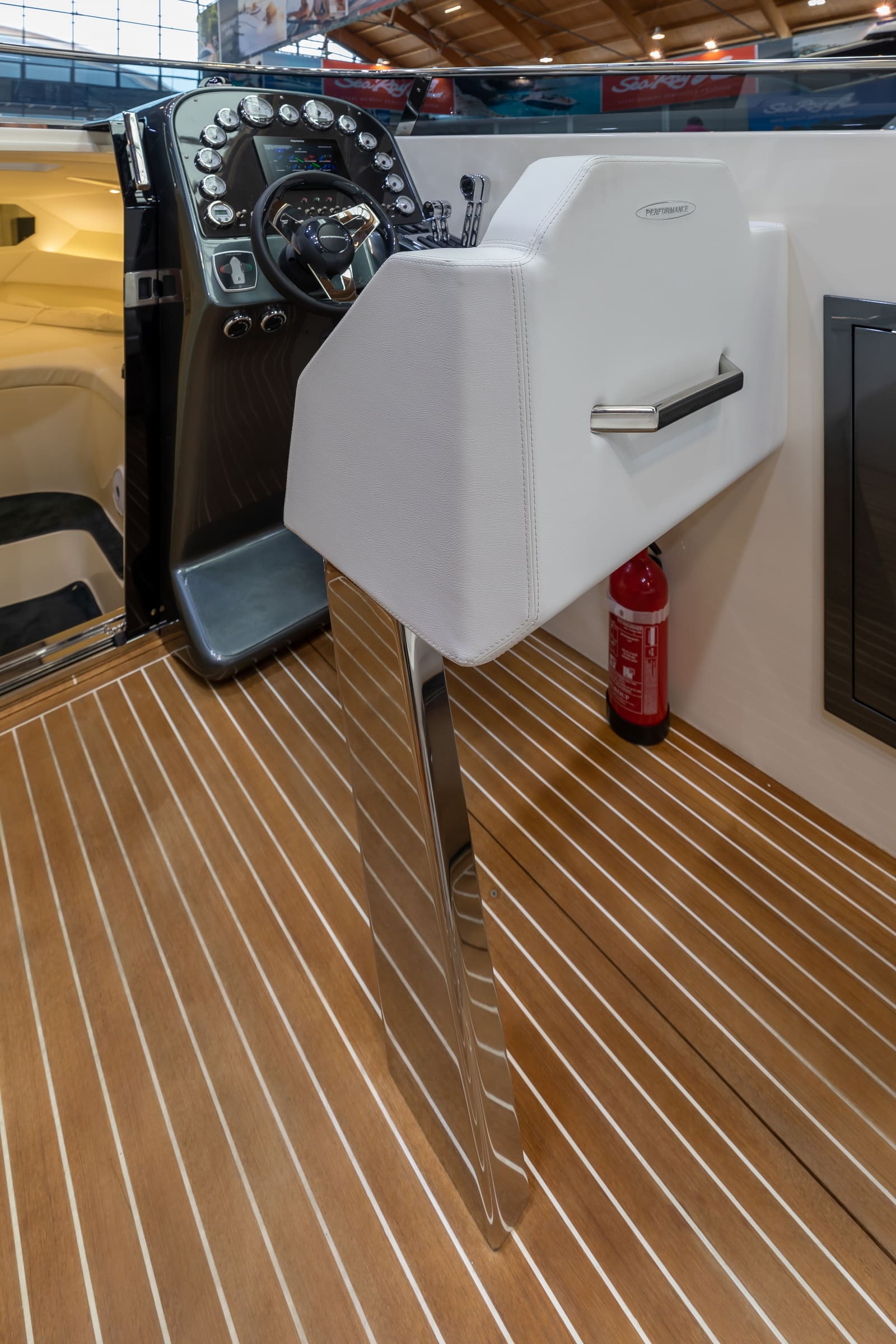
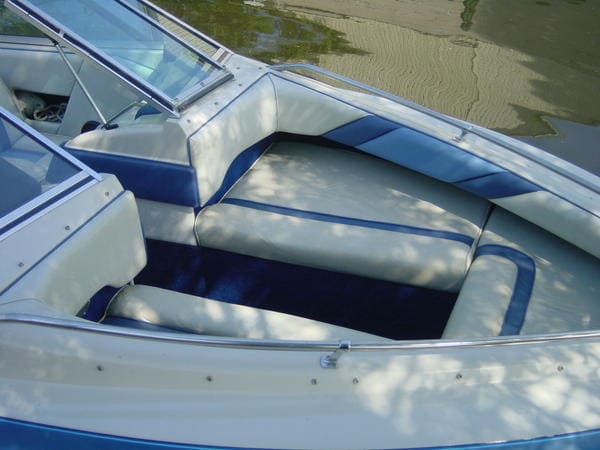
White vinyl shows every stain, and dirt and sunscreen hide in the seams. Photo: Matti Blume / Wikimedia Commons · CC BY-SA 4.0 Act fast: Morbern warns that ink will stain vinyl permanently if left. Its advice is to wipe right away with rubbing alcohol on a cloth, in a well-ventilated area. Sunbrella's Horizon chart starts ink with a cleaning eraser sponge or pad and moves to rubbing alcohol for stubborn marks; it also notes that how well ink comes out depends on the pen, how hard it was pressed and how long it sat. Dab and lift rather than rubbing in circles, which spreads the ink. Rinse with soapy water and then clean water afterward. Our interior detailing guide mentions a builder trick of lifting ink with sunscreen; if you try it, wash the spot with soap right after, since sunscreen left on vinyl causes its own damage (step 6).
Blue jeans and bright prints: Morbern notes vinyl absorbs dye that rubs off ("crocks") from denim and some colored fabrics. Treat these like ink, quickly, and lay a towel down when people are wearing new jeans.
Barletta, a pontoon builder, calls sunscreen one of the worst things for boat vinyl: it says avobenzone, found in many sunscreens, can strip the vinyl's top coat and leave stubborn stains, and tanning oils do similar damage. For fresh smears, Morbern's chart treats suntan lotion like a food spill: repeated sponging with lukewarm clear water, then a mild detergent solution on anything left once dry, then a thorough rinse. Sunbrella's Horizon chart uses soapy water or its multi-surface cleaner, with rubbing alcohol for stubborn spots. Don't let sunscreen build up for a season: yellowed, tacky patches are often top coat damage that won't wash out.
For a fresh spill, blot (don't wipe) with a dry cloth, then wash with soap and water or your approved marine cleaner. If a greasy mark remains, the makers split:
- Morbern allows a small amount of mineral spirits on a cloth for lipstick, grease, oil and shoe polish, rubbed gently without spreading past the stain's edge, then a good rinse.
- Sunbrella Horizon says never to use mineral spirits or other solvent cleaners, and treats motor oil with its multi-surface cleaner. So only reach for a solvent if your vinyl maker's chart names it for that stain, and use the smallest amount possible, outdoors or with the boat wide open. For fish blood and slime, Morbern's chart says cool water first and no hot water or soap at first, because heat sets protein stains.
Mildew grows on dirt, sweat, sunscreen and moisture sitting on the vinyl, not on good marine vinyl itself. Wash first with soap or your approved cleaner and a soft brush. If spots remain, use the maker's mildew method:
- Morbern lists a diluted bleach wash for surface mildew, with a soft brush and repeated clean-water rinses, only on vinyls specified as bleach-cleanable, at no more than about 1 part bleach to 9 parts water.
- Sunbrella Horizon gives a mix of 1 cup of bleach and a quarter cup of mild soap per gallon of water, applied with a non-abrasive sponge or very soft brush, and says never to use undiluted bleach. For severe mildew it allows a little more bleach in that mix, but still diluted.
- MasterCraft lists bleach as not recommended, and BoatUS warns bleach rots the seam thread so panels split open. On those seats, use a mildew remover your vinyl maker approves. Whatever you use, rinse heavily and dry the seat completely. Bleach on vinyl is a last resort, not a routine.
Pink or rose-colored blotches that soap won't touch are usually not mildew. Morbern explains that pink stain is a dye made by certain bacteria; the dye dissolves into the vinyl's plasticizer, so it can stain even vinyl that has antimicrobial protection. Often the bacteria are living in wet foam, padding or a wooden seat base underneath and the color works up through the vinyl from below. MasterCraft adds that putting a cover on over wet vinyl makes it worse.
- Try your vinyl maker's approved stain or mildew remover early; fresh pinking sometimes fades.
- If the stain keeps coming back, or appears from the inside out, the cushion itself is the problem. Pull the cover and check the foam (see the seat cushion foam guide). Soaked or smelly foam and a rotten base need replacing, or a new cover will turn pink again.
- Old, deep pink stains are often permanent. Some makers offer a separate pinking warranty, so check yours before buying chemicals.
Most food and drink (coffee, soda, wine, ice cream) comes out with lukewarm water and a sponge, then a mild detergent and a rinse, according to Morbern's chart. Scrape off solids gently with a dull plastic edge first. For chewing gum, Morbern suggests hardening it with an ice cube, then scraping. Bird droppings should come off as soon as you see them; they are acidic and feed mildew.
After any stain treatment, rinse well with clean water (a spray bottle works for small spots), towel the seat dry, and let it air out with cushions propped on edge. Water hides in seams and piping. Don't put the boat cover on until everything is dry.
Some vinyl makers want a protectant; others say not to use one. Morbern's care sheet says a vinyl protective finish may help the vinyl resist dye transfer from jeans and bright fabrics. Sunbrella says no vinyl "conditioners" or "protectors" on Horizon. MasterCraft and others warn against silicone protectants because they pull the plasticizer out of the vinyl and leave it hard and cracked. BoatUS notes many seat makers don't recommend aftermarket protectants until the vinyl starts showing wear. Follow your vinyl maker's sheet.
Common mistakes
- Grabbing the strongest product first. Start with soap, then the approved cleaner, and only then the maker's last-resort step.
- Full-strength bleach. No maker we checked allows undiluted bleach. It bleaches, dries out the vinyl and rots the thread.
- "Magic eraser" melamine sponges on every stain. They are a fine abrasive. Morbern says no abrasive cleaners on its vinyl, while Sunbrella lists cleaning eraser pads for ink on Horizon. Use one only if your maker allows it, lightly, on a small spot. Owners report dull patches where the top coat was scrubbed off.
- Lacquer thinner, acetone, gasoline, kerosene or nail polish remover. Morbern says lacquer solvents cause immediate permanent damage; MasterCraft says acetone, gasoline and kerosene remove the protective top coat.
- Citrus cleaners, abrasive powders, steel wool and household multi-surface sprays. Several makers list them as damaging. Check before using any "all-purpose" spray, even one another vinyl maker approves.
- Wax or car vinyl dressing on seats. Morbern says wax makes vinyl brittle; silicone dressings do the same.
- Pressure washing. It forces water into seams and foam and can damage the surface.
- Treating pink stain over and over without checking the foam. If it comes from inside, it will be back.
When to call a pro
- Pink stain keeps returning or the foam inside smells musty or stays wet: an upholstery shop can replace foam and the base
- Vinyl is cracked, sticky, peeling or hard after years of sun or harsh cleaners: cleaning can't fix it; the cover needs replacing
- Seams are splitting along long runs (thread rot from bleach or sun)
- Large set-in stains on a seat still under warranty: contact the dealer or vinyl maker before you try anything stronger
- You want new covers made: a marine upholsterer can match the vinyl and use UV-resistant thread
Tips
- Keep a small "stain kit" on board: white cloths, a spray bottle of mild soapy water, an approved vinyl cleaner and a printout of your vinyl maker's stain chart.
- Ask guests to put on lotion sunscreen before they board, skip sprays near the seats, and sit on towels. Barletta suggests mineral (zinc oxide or titanium dioxide) sunscreens as a gentler choice.
- Wipe seats down after every trip, even when they look clean; invisible sweat and sunscreen are what mildew and pink stain feed on.
- Log any stain treatment, product and date in BoatMend, so you can tell the upholsterer or warranty claim exactly what was used.
Official references
We read these to write this guide. Your engine's own manual always wins.
- Morbern – Product Resources (care and cleaning sheets, pink stain sheet, approved marine cleaners)
- Morbern – Care and Cleaning of Morbern Vinyl Coated Fabrics
- Morbern – Pink Stain and Morbern Vinyl Coated Fabrics
- Morbern – Approved Cleaners (marine)
- Sunbrella – Sunbrella Horizon Care and Cleaning
- MasterCraft – Upholstery Vinyl Care
- Sea Ray – Steps to a Cleaner Boat (Morbern upholstery advice)
- Boating Magazine – How to Keep Boat Upholstery Looking New
- BoatUS – Have A Seat (keeping boat seat vinyl in shape)
- Barletta Pontoon Boats – Sunscreen and Boat Seats, How to Avoid Damage
Safety: BoatMend is for information only and does not replace a certified marine technician. You are responsible for your safety and your boat. Read the full disclaimer.
Last updated 2026-11-06
Related guides
How to Clean and Protect Boat Canvas, Bimini Tops and Vinyl Seats
Wash your bimini, covers and enclosure the right way, beat mildew without wrecking the stitching, keep vinyl seats soft and stain-free, look after zippers and snaps, and store everything so it comes out clean next spring.
How to Detail Your Boat's Interior (Vinyl Seats, Carpet, Storage and Drains)
Give your cockpit and cabin a proper detail. Clean marine vinyl without stripping its UV protection, wash snap-in and glued-down carpet, clear out cup holders, storage boxes and their drains, beat mildew and pink stains, and know which household cleaners to keep off your boat.
How to Dry or Replace Waterlogged Boat Seat Cushion Foam
Stop the soggy-seat problem: find out why the foam inside boat cushions holds water, dry it out the fast way, and choose the right replacement foam (standard, closed-cell or quick-drying reticulated) so your seats stay dry, firm and mildew-free.
How to Prevent and Remove Mold and Mildew on Your Boat
Stop the musty smell and black spots before they start. Find and fix the water source, keep air moving, control humidity safely, and clean mold off gelcoat, vinyl and cabin surfaces with products that won't damage them.
How to Re-Cover Boat Cushions and Seats (DIY Sewing vs. Upholstery Shop)
Cracked, faded or split cushion covers can be replaced without buying new seats. Learn how to choose marine vinyl or acrylic fabric, which thread survives the sun, how to use the old cover as a pattern, where zippers and drain vents go, and when a walking-foot machine at home makes sense versus paying an upholstery shop.

How to Care for a Pontoon Deck, Flooring, Fence and Furniture
Keep a pontoon's carpet or vinyl floor clean and dry, find soft spots in the plywood deck before they spread, check fence rails, gates and seat bases, care for furniture vinyl, and cover and store the boat so mildew and sun do not win.