Shallow-Water Anchor Care: Power-Pole, Minn Kota Talon and Raptor Maintenance and Troubleshooting
Keep a shallow-water anchor deploying and holding: rinse it the way its maker recommends, inspect the spike and pivot bolts, check hydraulic fluid on pump models, keep the fuse, wiring and pump dry, update the software, know how to stow it by hand and get it ready for winter. Internal pump, circuit board and cylinder repairs go to an authorized service center.
Time
45 min
Shop would charge
$100-350
Applies to
All engines · Fishing boat
Safety first: A shallow-water anchor moves with real force and can deploy unexpectedly. Before any maintenance, switch off its power or disconnect it from the battery, as Minn Kota instructs for the Raptor, and keep hands, feet and tools out of the arm's path and pinch points. Never stand under or behind a raised arm while someone touches the remote. Make sure the anchor is fully stowed and strapped before running or trailering. A hot wire, melted fuse holder or burning smell means disconnect power and call a pro.
Owners often ask
- My Power-Pole got slow and noisy. Does it need fluid?
- How do I raise my Talon or Power-Pole by hand if it stops working?
This guide walks you through it. Still stuck? Ask the AI Mechanic about your engine.
Tools
- Garden hose with fresh water
- Wrenches or sockets that fit your anchor's pivot and mounting bolts
- Flashlight
- Digital multimeter
- Clean rags
- Your maker's app on a phone (for software updates and diagnostics)
Parts & supplies
- Hydraulic fluid of the type your anchor maker specifies (pump models only)
- Dielectric grease for connectors
- Travel strap or cover for trailering
- Replacement spike, if yours is cracked (often covered by warranty)
Before you start
Know your type. Shallow-water anchors drive a spike into the bottom to hold a boat in shallow water (Power-Pole says its anchors work to 10 feet; Minn Kota's Talon reaches deeper). They come in two basic designs:
- Hydraulic, folding arm: an electric pump in the boat pushes fluid through hoses to a cylinder that swings the arm down and up. Power-Pole Blade, Pro and Sportsman models and Minn Kota's Raptor work this way. These have a fluid reservoir to check.
- Electric, vertical: a motor inside the unit drives the spike straight down. Minn Kota's Talon works this way; it has no hydraulic fluid to service.
Find your manual. Fluid type, bolt checks and reset procedures vary by model and year. Power-Pole and Minn Kota both publish manuals, videos and troubleshooting guides on their support sites, and both run dealer service networks. Have your serial number handy (Power-Pole says it is on the stern bracket of its hydraulic anchors).
Steps
Salt, sand and mud are what wear these anchors out.
- Power-Pole: rinse the anchor and its moving parts with a hose after each use, the same way you rinse the boat.
- Talon: Minn Kota recommends one of two rinses after every use. The "30-second deep-water rinse": in water deeper than the Talon can reach and clear of obstructions, deploy it to full extension, put the main engine in gear at idle only, then retract it. Or the "extended hose rinse": lay the Talon down (a tilt bracket makes this easy), extend it fully, rinse each section and retract it.
Look the spike over after each trip for cracks, splits, large splinters or heavy wear at the tip. Power-Pole says its spike carries a lifetime warranty and to call customer service for a free replacement if it's damaged; Minn Kota says to replace a damaged Talon spike and backs the Raptor spike with a lifetime guarantee. A cracked spike can snap under load and lose its hold.
Minn Kota's spike replacement on the Raptor is done in maintenance mode (step 9) with the spike about a foot off the ground, so it can't deploy while your hands are on it.
- Power-Pole: its maintenance tips say to tighten the lower two pivot bolts on every model at least every 100 cycles, snug with the lock nut and not overtightened.
- Talon: Minn Kota says to periodically check the bracket's cap screws and lock nuts.
- All: look at the adapter plate or jack plate bolts and the transom around them for movement, cracks or rust streaks.
Use the torque values in your manual; don't guess. Loose mounting bolts that keep loosening, or a cracked adapter plate, are a dealer job.
With the anchor fully stowed, find the pump reservoir and check that the fluid is between the minimum and maximum marks. Keep the cap clean and tight.
- Power-Pole recommends its Green Marine biodegradable fluid and says any ISO 32 hydraulic fluid or SAE 10 oil can be used as an alternative.
- Minn Kota recommends a biodegradable ISO 32 marine hydraulic fluid for the Raptor.
Note the color. Minn Kota says discolored fluid can mean contamination: change it and check the reservoir seal, hose fittings and cylinder seals. Milky fluid usually means water is getting into the pump.
Power-Pole notes that hydraulic fittings should stay leak-free for the life of the product after installation, but suggests checking them and the reservoir cap anyway. Follow both hoses from the pump to the cylinder, looking for wet spots, chafe where they pass through bulkheads and kinks. A drip at the cylinder or a hose that's rubbing through needs a replacement part.
Most "dead anchor" calls are power problems.
- Check that battery connections and the on/off switch are tight and corrosion-free.
- Open the in-line fuse holder and look for corrosion or moisture. Power-Pole suggests mounting the holder upright so water drains away from it.
- Talon and Raptor come with a 30-amp resettable fuse that Minn Kota says should sit no more than 7 inches from the battery's positive terminal. To reset it, remove the protective cover, push the breaker button in, check that the seal is in place and snap the cover closed so it stays watertight.
- Check battery voltage. Power-Pole says its anchors only draw power while moving, so they barely drain a healthy battery; a weak battery still causes slow or failed cycles.
A Gulf Coast marine shop writing in Texas Saltwater Fishing Magazine says moisture inside the pump housing is the most common cause of Power-Pole failures, and that repeated circuit board or motor failures usually mean the pump is mounted somewhere wet. Check that the pump compartment drains, the pump isn't sitting in bilge water, and connectors are coated with dielectric grease. If you see milky fluid or rust on the pump, move the pump to a drier spot (a dealer can help) and have the unit checked.
Modern anchors run on software. Power-Pole's C-Monster app handles firmware updates, pairing and diagnostics, and Power-Pole support has told owners with intermittent or partial deploys to update the pump first. Minn Kota's app updates the Talon and Raptor. If a remote stops working, replace its battery, then clear and re-pair it following your maker's instructions.
Buying a replacement or extra remote or foot switch? Check the generation first. Power-Pole explains that its older CM1 (C-Monster 1) anchors and the newer CM2 anchors use different radio frequencies, so CM1 and CM2 pumps and controllers won't work with each other. Your serial number and the label on the pump tell you which you have.
Know this before you need it on the water:
- Talon: Minn Kota's procedure is to hold the Up button on the indicator panel until three beeps (manual retraction mode), remove the rubber cap over the hex drive and turn it clockwise with a socket until fully retracted, then exit manual mode.
- Raptor: put the pump in maintenance mode (hold the pair/maintenance button for three beeps), then open the bypass valves with Minn Kota's pressure wrench as its instructions describe so the arm can move by hand. Secure the spike first so it can't swing and hit anyone, and close the valves and exit maintenance mode afterward.
- Power-Pole: Power-Pole support has said a failed anchor can be lifted by hand and secured upright with a travel strap.
Carry the right socket or tool and a strap in the boat.
Go from simple to complex:
- No response at all: remote battery, pairing, main power switch, fuse, battery voltage.
- Slow, noisy or jerky: low or old hydraulic fluid, a weak battery or a bad ground. Power-Pole support suggested fluid replacement for an older anchor that had become loud and erratic.
- Won't stay up, or creeps down: leak or internal valve problem; check fluid and fittings, then call service.
- Partial deploys: software update and app diagnostics, then service.
- Holds poorly: worn or broken spike, wrong bottom setting, or wind and current beyond what it can hold. BoatUS's 2026 overview describes the Talon's modes: the normal automatic drive pushes harder in stages after the spike touches bottom, a rough-water mode keeps repeating that sequence so the spike stays planted as the boat rises and falls, and a soft-bottom mode cuts the thrust so the spike doesn't bury itself in mud or soft sand. Using the wrong mode for the bottom or the chop is a common reason a working anchor seems weak. A single anchor also lets the boat swing around it; many owners run two on the transom for that reason.
If the basics check out, use your maker's troubleshooting guide and service locator.
Fully stow the anchor before getting on plane, and use the travel strap or cover your maker offers for the highway. Power-Pole says its hydraulic models have drive-off protection if you forget an anchor down, but don't make a habit of testing it; drag and impact still stress the arm, transom and mount. Check clearance before driving under low bridges or into a garage.
- Rinse thoroughly and let it dry.
- Check the spike, bolts, hoses and fluid level and color; fix leaks now.
- Leave the anchor fully stowed.
- Turn off the power switch or disconnect the battery, and take batteries out of wireless remotes.
- Make sure the pump compartment stays dry under the cover or shrink-wrap.
- In spring, cycle it a few times at the dock and update the software before your first trip.
Common mistakes
- Never rinsing the anchor, then wondering why it got slow and noisy.
- Overtightening pivot bolts so the arm binds, or never checking them at all.
- Topping up a pump with the wrong fluid.
- Mounting the pump or fuse holder where it stays wet.
- Running or trailering with the anchor not fully stowed and strapped.
- Working on the arm with power still connected.
- Ignoring a cracked spike that's still under warranty.
When to call a pro
- Installation, adapter plates or any new holes in the transom
- A pump that runs but doesn't move the anchor, or an anchor that drifts down
- Milky fluid, repeated circuit board or motor failures, or water inside the pump
- Leaking cylinders, bushings or hoses (Minn Kota recommends its authorized service centers for Raptor bushing, hose and cylinder work under warranty)
- Any melted wiring, hot fuse holder or burning smell
- Loose or cracked mounting hardware, or transom damage around the mount
Tips
- Keep a spare fuse, the manual-stow tool and a travel strap onboard.
- Note your anchor's serial number and software version in your BoatMend boat profile.
- After saltwater trips, rinse the anchor first while you're still at the ramp, before salt dries on it.
- Cycle the anchor at the dock after any work, before you rely on it in wind.
- Pinning the boat a few inches off a dock or ramp with the anchors is handy, but BoatUS reminds owners that waves, wakes, tide, wind and traffic still apply: keep watch, and don't leave a pinned boat unattended where a falling or rising tide or passing wakes can work against it.
Official references
We read these to write this guide. Your engine's own manual always wins.
- Power-Pole – FAQs
- Power-Pole Blog – Six Maintenance Tips for Your Power-Pole Anchor
- Minn Kota Help Center – Maintaining the Talon (2018-present)
- Minn Kota Help Center – Reset the Fuse on a Bluetooth Talon
- Minn Kota Help Center – Manually Retract a Bluetooth Talon
- Minn Kota Help Center – Raptor Maintenance and Repair (2020-present)
- Minn Kota Help Center – Bluetooth Talon Troubleshooting and Service Provider Locator
- BoatUS Magazine – Active Anchoring (shallow-water anchor types and modes, 2026)
- Texas Saltwater Fishing Magazine – Troubleshooting Power-Pole Failures (Chris Mapp)
Safety: BoatMend is for information only and does not replace a certified marine technician. You are responsible for your safety and your boat. Read the full disclaimer.
Last updated 2026-10-24
Related guides
How to Care for a Hydraulic Jack Plate (Fluid, Pump, Leaks, Grease and Height)
Keep a hydraulic jack plate (Bob's Machine Shop, T-H Marine Atlas, CMC, SeaStar style) lifting smoothly: check and top up the right fluid, keep the pump and relays dry, find leaks and slow drift, lubricate only the way your model calls for, set running height safely and prepare it for winter. Mounting and setback changes are dealer work.
Trolling Motor Won't Run, Runs Weak or Cuts Out: How to Troubleshoot It
Work through a dead, weak or on-and-off trolling motor from the cheapest checks to the hardest: battery charge and load test, connections, the breaker, line wrapped behind the prop, stow and deploy problems and GPS anchor glitches. Most problems turn out to be power supply; motor head and steering electronics are a service-center job.
How to Find and Fix Corroded Electrical Connections on a Boat
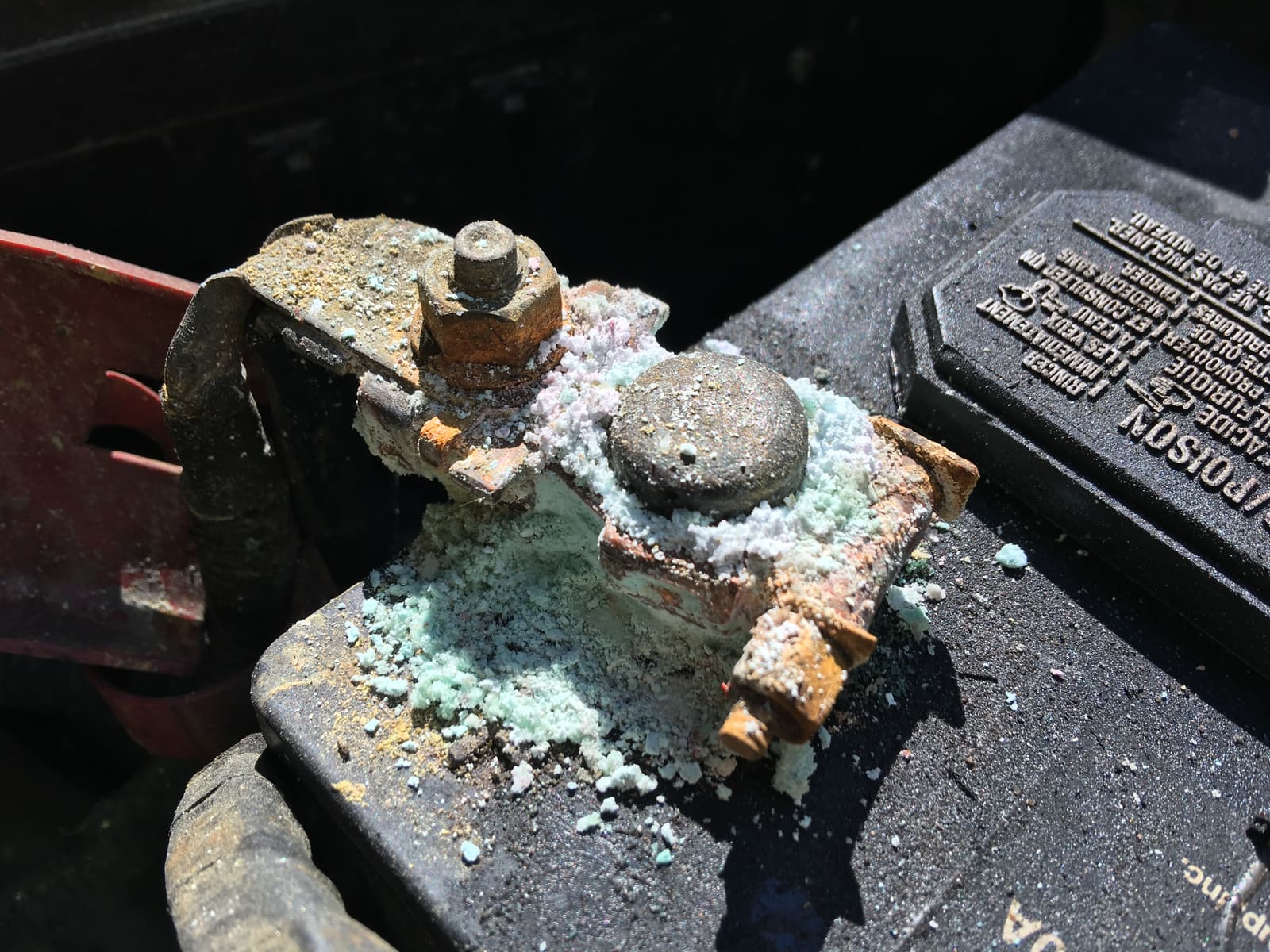
Track down the green crust and loose terminals behind flickering lights, dead gauges and slow cranking with a simple voltage-drop test, then remake the connection the marine way: tinned wire, a proper crimp, adhesive-lined heat shrink and a protective coating.

Fuse Keeps Blowing? How to Troubleshoot a Boat Fuse Block or Breaker Panel
Work through a blown fuse or tripping breaker the safe way: confirm it, tell a short from an overload, isolate the device or wire at fault, replace a worn breaker or panel switch with the same rating, and label every circuit, without ever fitting a bigger fuse.
Marine Battery Care: Test, Charge and Store for Winter
Check your boat battery's health, charge it the right way for its type (flooded, AGM or lithium), and store it so it is ready in spring. Most "boat won't start" calls start with a neglected battery.
Saltwater Outboard Care: The After-Every-Trip and Monthly Routine
A simple routine that keeps salt from eating your outboard, built from Honda, Yamaha, Mercury and Suzuki advice. It covers flushing after every trip, washing, where to spray anticorrosion (and where never to), monthly greasing, anodes, and tilting up or storing out of the water.
Get Your Boat Ready for the Road: Pre-Trailering Checklist
Most trailering trouble starts in the driveway: an engine left without support, a loose strap, a cover that balloons at 60 mph, gear that blows out or tongue weight that makes the rig sway. Work through this checklist before every trip and do a quick walkaround at each stop.
How to Winterize an Outboard Engine
Protect your outboard from freeze damage, stale fuel and internal corrosion over the off-season. Most owners can do it in an afternoon with basic tools, compared with a shop bill that often runs several hundred dollars.
Anchor Basics: Choosing the Anchor, Rode and Scope, Setting It and Checking Your Gear
Match your anchor to the bottom you usually anchor in, put together a chain-and-nylon rode, let out enough scope for the depth and weather, set and check the anchor, use an anchor alarm, and inspect the rode, splices and shackles every season so the weakest link isn't hiding in your ground tackle.