Boat Horns and Sound Signals: Requirements, Testing and the Signals Every Skipper Should Know
Every boat needs a way to make an efficient sound signal, and bigger boats need a proper whistle or horn. Learn the Coast Guard requirements by boat length, how to test and fix an electric horn, why a canister air horn makes a good backup, and the basic passing, danger and fog signals.
Time
30 min
Shop would charge
$100-300
Applies to
All engines
Safety first: Your horn is collision-avoidance and emergency gear, so test it before every trip. Never sound the danger signal or fog signals as a joke or a greeting; other boaters will act on them. In fog, a horn doesn't replace slowing down, radar or AIS and a sharp lookout. If you're lost or in danger, call the Coast Guard on VHF channel 16 (or 911) rather than relying on sound alone.
Owners often ask
- Do I need a horn on a small boat, or is a whistle enough?
- My boat horn stopped working. Is it the horn or the wiring?
This guide walks you through it. Still stuck? Ask the AI Mechanic about your engine.
Tools
- Multimeter (digital volt-ohm meter)
- Screwdrivers and small wrenches
- Wire brush or fine abrasive pad for terminals
- Soft brush and fresh water
- Corrosion-inhibiting spray or dielectric grease
Parts & supplies
- Marine horn rated for your boat's length (if replacing)
- Fuse of the rating the horn maker specifies
- Horn relay (for horns that call for one)
- Handheld canister air horn and a spare canister
- Marine-grade tinned wire, heat-shrink crimp connectors
Before you start
What you must carry (federal rules). The Inland Navigation Rules (33 CFR 83.33) and the Coast Guard's equipment guidance set the minimum by length:
| Boat length | Federal minimum |
|---|---|
| Under 39.4 ft (12 m) | Some means of making an efficient sound signal: a handheld air horn, a whistle or an installed horn. The Coast Guard says a human voice doesn't count. |
| 39.4 ft (12 m) to under 65.6 ft (20 m) | A whistle (in practice, a horn) that meets the Navigation Rules' technical specs. The Coast Guard describes it as an efficient signal audible for about half a mile, with a 4- to 6-second blast. A bell isn't federally required at this size. |
| 65.6 ft (20 m) and over | A whistle and a bell |
Some state rules and older study guides still mention a bell for boats over 39.4 feet. Check your state boating agency for anything beyond the federal minimum. Boats over 39.4 feet must also keep a copy of the Navigation Rules aboard (paper or electronic).
Short vs. prolonged. A short blast lasts about 1 second. A prolonged blast lasts 4 to 6 seconds (33 CFR 83.32).
Inland vs. international. On U.S. inland waters, passing signals announce what you intend to do, and the other boat answers if it agrees. Under the international rules used offshore and in many coastal areas, the same signals announce what you are doing right now. The basic danger, bend and fog signals are similar in both. Learn which rules apply where you boat.
Steps
With the boat at the dock, give a quick tap (a brief tap is enough in a quiet marina). It should sound loud and clear right away. A weak, raspy or delayed sound means low voltage, corrosion or a failing horn. Check it again before running at night or in fog.
When power boats are in sight of each other and meeting or crossing within half a mile:
- 1 short: "I intend to leave you on my port side" (pass port to port). When overtaking: "I intend to pass on your starboard side."
- 2 short: "I intend to leave you on my starboard side." When overtaking: "I intend to pass on your port side."
- 3 short: "I am operating astern propulsion" (backing).
- 5 or more short and rapid: Danger or doubt. "I don't understand your intentions" or "I don't think your maneuver is safe."
- 1 prolonged: leaving a dock or berth, or approaching a blind bend where boats on the other side can't see you.
If you agree with a one- or two-blast signal, answer with the same signal. If you don't, sound the danger signal and both boats slow down until it's sorted out. If you've already agreed on the radio, horn signals become optional (33 CFR 83.34); if the radio call doesn't produce a clear agreement, exchange horn signals in time, and the horn signals are what count.
Three more details from Rule 34 that confuse owners:
- At a blind bend, your prolonged blast should be answered with a prolonged blast by any boat coming the other way that can hear it. If you hear one coming around a bend, answer it, slow down and keep to the starboard (right) side of the channel.
- Flashing lights on big boats: a vessel may back up its whistle signals with an all-round white or yellow light that flashes in step with the horn: one flash, two flashes, three flashes, and five or more for danger. If you see a ship or tug flashing a light as it sounds, it means the same as the blasts.
- Danger signal goes both ways: any boat in doubt, including the one being overtaken, gives the five short blasts. Don't wait for the bigger boat to do it. BoatUS stresses that these passing signals are only for boats that can see each other; in fog, use the fog signals instead.
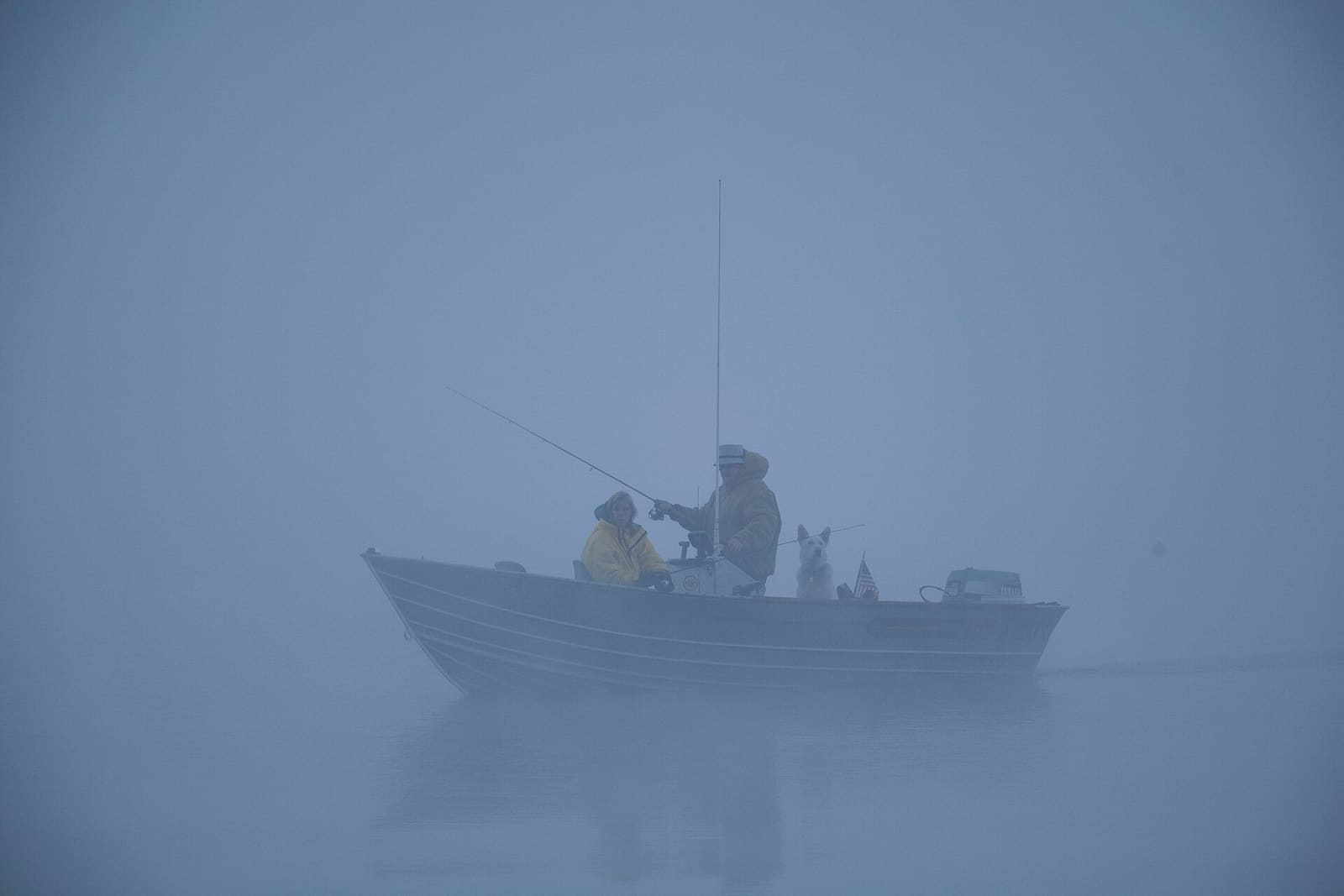
In or near fog, rain or any restricted visibility, day or night (33 CFR 83.35):
- Power boat moving through the water: 1 prolonged blast at least every 2 minutes
- Power boat underway but stopped (drifting): 2 prolonged blasts, about 2 seconds apart, at least every 2 minutes
- Sailboat under sail, boat fishing with nets or lines that restrict maneuvering, boat towing, or a boat that can't maneuver normally: 1 prolonged and 2 short at least every 2 minutes
- At anchor: ring a bell rapidly for about 5 seconds every minute. A boat under 20 m (65.6 ft) doesn't have to do this in a Coast Guard-designated special anchorage. An anchored boat may also sound 1 short, 1 prolonged, 1 short on the horn to warn a boat that seems to be coming too close.
Boats under 12 m (39.4 ft) aren't required to give these exact signals, but if they don't, they must make some other efficient sound signal at least every 2 minutes. In practice, a small-boat skipper should still give the standard signals with a horn.
BoatUS (2022) reminds owners that "restricted visibility" isn't only fog: heavy rain, night, dust and even wildfire smoke count. And sounding your own signal is only half the job. Mercury suggests listening for other boats between your blasts, and the Navigation Rules (33 CFR 83.19, Rule 19) say that if you hear another boat's fog signal apparently ahead of your beam, slow to the minimum speed that keeps you on course, stop if you need to, and go with extreme caution until the danger is past.
Most horns stop working because of the circuit, not the horn.
- Check the fuse or breaker for the horn circuit (see our fuse and breaker panel guide). Replace a fuse only with the same rating; if it blows again, find the short before going out.
- Make sure the battery switch is on and the battery is charged.
- With a helper pressing the horn button, measure the voltage at the horn's terminals with a multimeter. Full battery voltage while pressed means the problem is the horn itself. No or low voltage means the problem is upstream.
- Horn button: these sit in the weather and corrode. With the circuit fused and the battery on, check for voltage going in and coming out when pressed. A button that's crunchy, sticky or intermittent should be replaced with a marine switch rated for the horn's current.
- Relay: larger horns (especially dual-trumpet horns) use a relay so the small button doesn't carry the full current. Listen and feel for a click when the button is pressed. No click: check the relay's power and the button signal. A click but no horn: the relay contacts or the heavy wire to the horn may be bad.
- Ground: a loose or corroded ground wire is a classic cause of a weak or dead horn. Follow it to the negative bus or battery and clean both ends.
Disconnect power. Clean corroded terminals with a wire brush or fine pad until they're bright, reconnect them tightly and coat them with a corrosion inhibitor or dielectric grease. Replace any green, brittle wire ends with new tinned wire and heat-shrink crimp connectors. See our electrical corrosion guide.
Rinse salt and dirt off with fresh water and a soft brush. Check that the trumpet opening is clear of insect nests, spider webs, mud and water. Many horns are designed to be mounted with the opening angled slightly down so water drains out; if yours fills with water, check the maker's mounting instructions. Some electric horns have a tone adjustment screw on the back; only adjust it if the horn's instructions describe how, and in small steps.
If the horn gets full voltage and is still silent, weak or buzzy after cleaning, replace it. Pick a marine horn the maker rates for your boat's length. On boats 39.4 feet and longer, choose a horn or whistle advertised as meeting the Navigation Rules for your size. The rules' technical annex calls for the horn to point forward and be mounted as high as practicable so the sound isn't blocked (33 CFR 86.01). For boats under 20 m, the annex lists a typical audibility range of about half a nautical mile. Use wire sized for the horn's current draw and run length, a fuse of the rating the maker specifies close to the power source, and a relay if the instructions call for one.
A handheld canister air horn is a cheap, legal sound device for small boats and a good backup on any boat if the electric horn or battery fails.
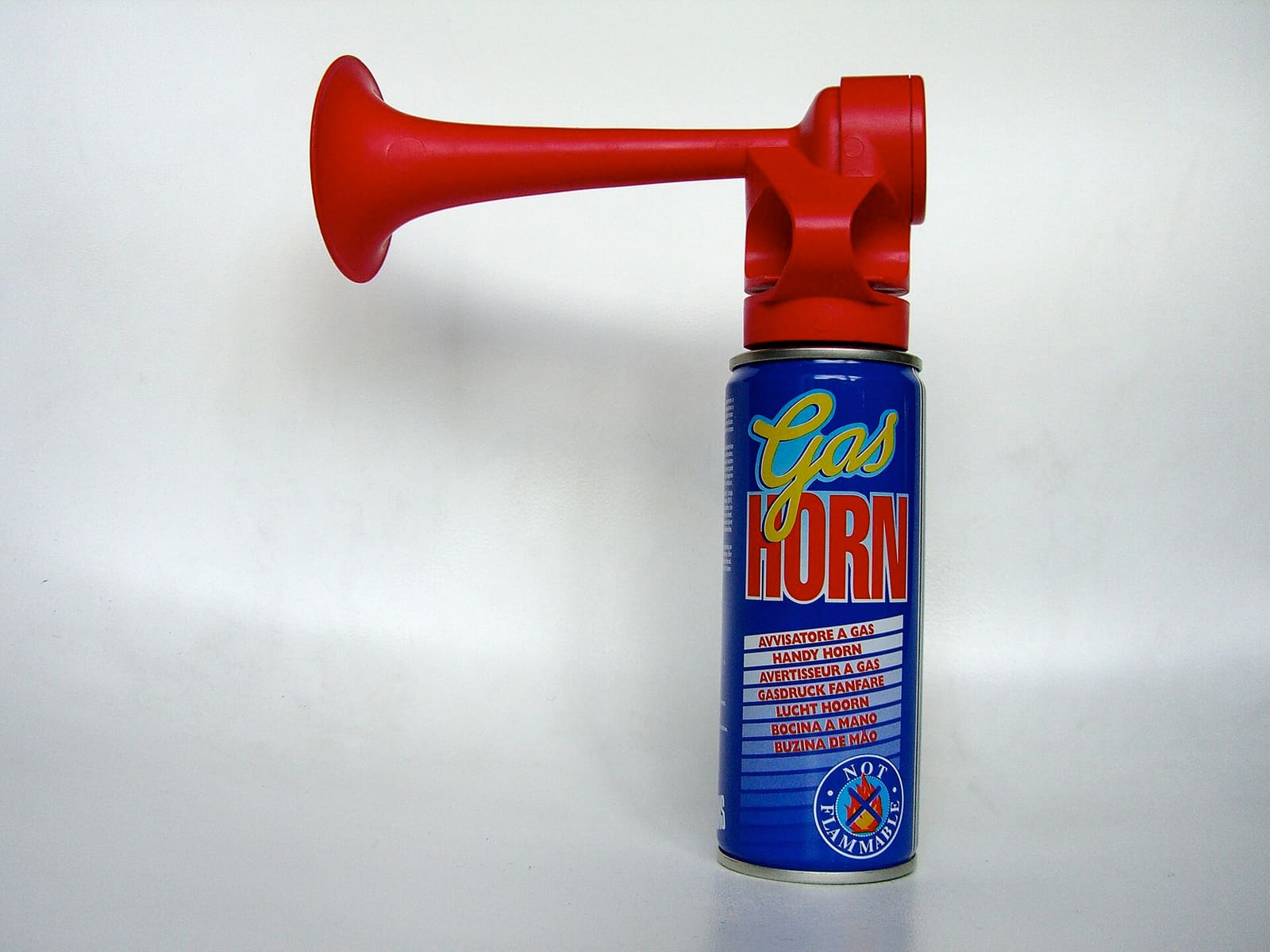
A handheld canister air horn: keep one where the skipper can reach it, plus a spare can. Photo: Edvvc / Wikimedia Commons · CC BY-SA 3.0 - Test it with a short burst at the start of the season and after long storage. Canisters slowly lose pressure.
- Carry a spare canister. A long fog signal every 2 minutes uses a lot of air.
- Cold weather lowers canister pressure and loudness; keep it somewhere warmer in cold-weather boating.
- Follow the label for storage and keep it out of direct sun in a hot console.
- A whistle on each life jacket is a smart extra for people in the water.
Some yachts use compressor-fed air horns with a small tank. Water collects in the tank and lines, and salt corrodes valves. Follow the system maker's instructions for draining and servicing; if the compressor runs but the horn is weak, or the compressor won't run, have a marine electrician check it.
On a quiet day, practice counting a 1-second short blast and a 4–6 second prolonged blast so they come out right under stress. Before a trip in fog-prone waters, review the fog signals with your crew and assign someone to time them.
Common mistakes
- Relying on shouting or a phone app instead of a real horn or whistle.
- Using passing signals (1 or 2 short) in fog, when the boats can't see each other.
- Tooting 5 short blasts as a greeting. That's the danger signal.
- Ignoring a weak, raspy horn until it quits completely.
- Replacing the horn when the real problem is a corroded button, relay or ground.
- Mounting a new horn behind a windshield or hardtop where the sound is blocked.
- Carrying a canister horn that's been empty since last season.
When to call a pro
- The horn circuit keeps blowing fuses or wires feel hot
- You can't trace the horn wiring behind a finished helm
- A compressor air horn system won't run or won't hold pressure
- You're fitting a new horn system on a boat over 39.4 feet and want to be sure it meets the Navigation Rules
Tips
- Add "horn test" to your BoatMend pre-departure checklist.
- Mark the horn fuse or breaker clearly on your panel.
- Keep the canister air horn near the helm, not buried in a locker.
- If you travel through locks, ask the lock operator or check the waterway guide for the local horn signal; many locks prefer a VHF call.
Official references
We read these to write this guide. Your engine's own manual always wins.
- eCFR – 33 CFR 83.32 to 83.37, Inland Navigation Rules, Sound and Light Signals (Rules 32–37)
- eCFR – 33 CFR 86.01, Annex III, Whistles (frequencies, audibility, positioning)
- U.S. Coast Guard Boating Safety – Frequently Asked Questions (Do I need a horn on my boat?)
- U.S. Coast Guard – A Boater's Guide to the Federal Requirements for Recreational Boats (2023)
- BoatUS Foundation – Navigation and Maneuvering, Navigation Sounds
- BoatUS Foundation – USCG Equipment Requirements
- Discover Boating – 7 Night Boating Tips
- eCFR – 33 CFR 83.19, Conduct of vessels in restricted visibility (Rule 19)
- BoatUS – Boat Sound Signals, Time To Sound Off (2022)
- Mercury Marine Dockline – 5 Tips for Safe Boating in Foggy Conditions
- eCFR – 33 CFR 83.34, Maneuvering and warning signals (Rule 34)
Safety: BoatMend is for information only and does not replace a certified marine technician. You are responsible for your safety and your boat. Read the full disclaimer.
Last updated 2026-10-25
Related guides

USCG Required Safety Equipment Check by Boat Length
Walk through your boat and confirm you carry every piece of safety gear the US Coast Guard requires for your boat's length and type, and that none of it is expired or worn out. Missing or expired gear is one of the most common tickets on the water, and it is the gear you need when things go wrong.
How to Prepare for a Free Vessel Safety Check
Volunteers from the Coast Guard Auxiliary and America's Boating Club will inspect your boat's safety gear for free, with no ticket if something is missing. Learn how to request a Vessel Safety Check, what the examiner looks at, how to get your boat ready and what to do with the fix list.
How to Test and Fix Your Boat's Navigation Lights
Learn which navigation lights your boat must show and when, then test them and fix the usual culprits such as corroded sockets, loose pole-light plugs and blown bulbs. Working lights are legally required at night and in poor visibility and are how other boats see which way you are heading.
Set Up Your VHF Radio: MMSI, DSC, GPS Hookup and Radio Checks
Get a free or low-cost MMSI number, program it into your DSC radio, connect your GPS so a distress alert sends your exact position, check the antenna, and learn the Channel 16 rules and the right way to do a radio check.

Fuse Keeps Blowing? How to Troubleshoot a Boat Fuse Block or Breaker Panel
Work through a blown fuse or tripping breaker the safe way: confirm it, tell a short from an overload, isolate the device or wire at fault, replace a worn breaker or panel switch with the same rating, and label every circuit, without ever fitting a bigger fuse.
12-Volt Boat Wiring Basics: Circuits, Color Codes, Fuses and Wire Size
Learn how your boat's 12-volt system is laid out, what the ABYC wire colors mean, how fuses and breakers protect the wiring, why voltage drop and tinned wire matter, and how to read a wiring diagram, so you can troubleshoot smarter and know which jobs belong to a marine electrician.
How to Find and Fix Corroded Electrical Connections on a Boat
Track down the green crust and loose terminals behind flickering lights, dead gauges and slow cranking with a simple voltage-drop test, then remake the connection the marine way: tinned wire, a proper crimp, adhesive-lined heat shrink and a protective coating.
Dinghy and Tender Rules: Lights, Registration, Capacity, Life Jackets and Kill Switch
Your dinghy is a boat in its own right. Learn which navigation lights it needs after dark (rowing or under power), when the outboard means it must be registered, and how capacity plates, life jackets and the kill-switch law apply to a small tender.

Cold-Weather Boating: Cold Water Safety, Gear and Engine Care in Late Fall and Winter
Boating after the crowds leave can be beautiful, but cold water changes the risks. Learn why cold shock is the first danger, why the popular 1-10-1 rule needs caution, what to wear, how to plan, and how to care for the engine, battery and anything that holds water between trips.
Emergency Drills for Your Crew: Engine Failure, Fire, Steering Loss and Man Overboard
Practice what everyone aboard does when the engine quits, a fire starts, the steering fails or someone falls in. A few short drills each season turn panic into a plan, and teach your crew to anchor, call for help on VHF 16 or DSC, and get a tow.