Guardian, Limp Home and Reduced Power Modes: Why Your Engine Cut Power and What to Do
Modern outboards and inboards cut power on their own when a sensor reports trouble. Learn what usually triggers Mercury's Engine Guardian, Yamaha's RPM reduction and other brands' limp-home modes, how to read the warning, and how to decide between idling home and stopping to call for help.
Time
20 min
Shop would charge
$100-400
Applies to
Outboard, Sterndrive (I/O), Gas inboard, Marine diesel, Jet boat
Safety first: When an engine suddenly drops power, the first danger is often other boats, a wake or a nearby shore, not the engine. Keep steering, look around, and get clear of traffic before you look down at the gauges. Stop the engine and do not try to run home if the warning is for low oil pressure, if there is no cooling water, or if you see smoke, smell fuel or hear new knocking or grinding. If you are adrift near hazards, anchor if you can, put life jackets on everyone, and call TowBoatUS or Sea Tow; for fire, flooding or anyone in danger, call the Coast Guard on VHF 16 or 911.
Owners often ask
- My Mercury went into Guardian mode and cut power. Can I keep running it?
- The engine went into limp mode, then reset itself. Do I still need a dealer?
- My Mercury beeps and won't go past a low rpm. What do the beeps mean?
This guide walks you through it. Still stuck? Ask the AI Mechanic about your engine.
Tools
- Your owner's manual (the warning system pages)
- Phone or notebook to photograph or write down the message, code and engine hours
- Flashlight
Parts & supplies
- None for the checks in this guide
Before you start
What a protection mode is. Most fuel-injected engines built in the last couple of decades have a computer that watches sensors: engine temperature, oil pressure (or oil level on oil-injected two-strokes), engine speed, battery voltage, water in fuel and more. When a reading goes out of range, the engine warns you (horn or beeps, a light, a message or a code) and often limits rpm or power so it can't hurt itself.
Brands use different names:
- Mercury: Engine Guardian. Mercury describes it as sorting problems into critical and non-critical faults. A critical fault, like low water pressure because a plastic bag is stuck on the intake, gets a warning and, on SmartCraft displays, a text message suggesting you return to port. If you keep the throttle down, the system brings power down to a safe level after a short time. Non-critical faults get a message to see a dealer when convenient (PDB Magazine, quoting Mercury). Mercury's own current MerCruiser 8.2L page still lists Engine Guardian, describing it as a system that monitors the engine and, if needed, adjusts engine functions to help get you home. In other words, the power cut is meant to protect the engine while still leaving you some propulsion, not to strand you.
- Yamaha: Yamaha notes that most outboards have an RPM reduction mode that limits engine speed when overheating is detected.
- Suzuki: a warning buzzer plus a monitor gauge that shows why it sounded. Suzuki says that if you can't tell why the buzzer sounded, check with a dealer before running any further.
- Other makers and many diesels use names like limp home, reduced power or "check engine" mode.
This guide is about the power cut and the decision it forces on you. For what each horn or light means, see the engine warning alarms guide; for an overheat alarm in particular, use the overheat alarm response guide.
Steps
Read the warning system pages in your owner's manual at the dock. Note:
- what the horn patterns mean (continuous versus short beeps)
- which lights or messages your display shows, and where
- which faults the manual says to stop for, and which allow slow running
Take a photo of that page and keep it on your phone. It is hard to read a manual while a horn is blaring.
Ease the throttle back, keep steering and check for traffic, wakes and shallows. If you are on plane in a channel, move to the side and come off plane in a controlled way. Then look at the gauges.
Before you touch anything else, note:
- the horn pattern
- any light, icon, message or fault code on the display
- engine temperature, oil pressure, voltage and rpm, if shown
- what you were doing (speed, load, how long you had been running)
Take a photo of the display. The dealer will want this, and some faults clear themselves, taking the evidence with them.
Almost every protection mode comes from one of these:
- Heat: engine overheat, low water pressure, or (on some newer engines) high exhaust temperature
- Lubrication: low oil pressure, or low oil level on an oil-injected two-stroke
- Fuel: water detected in the fuel filter, or a fuel pressure problem
- Electrical: battery voltage too low or too high
- Sensor or control fault: a sensor, wire or module reporting a reading that makes no sense, often with a "check engine" light and normal gauges
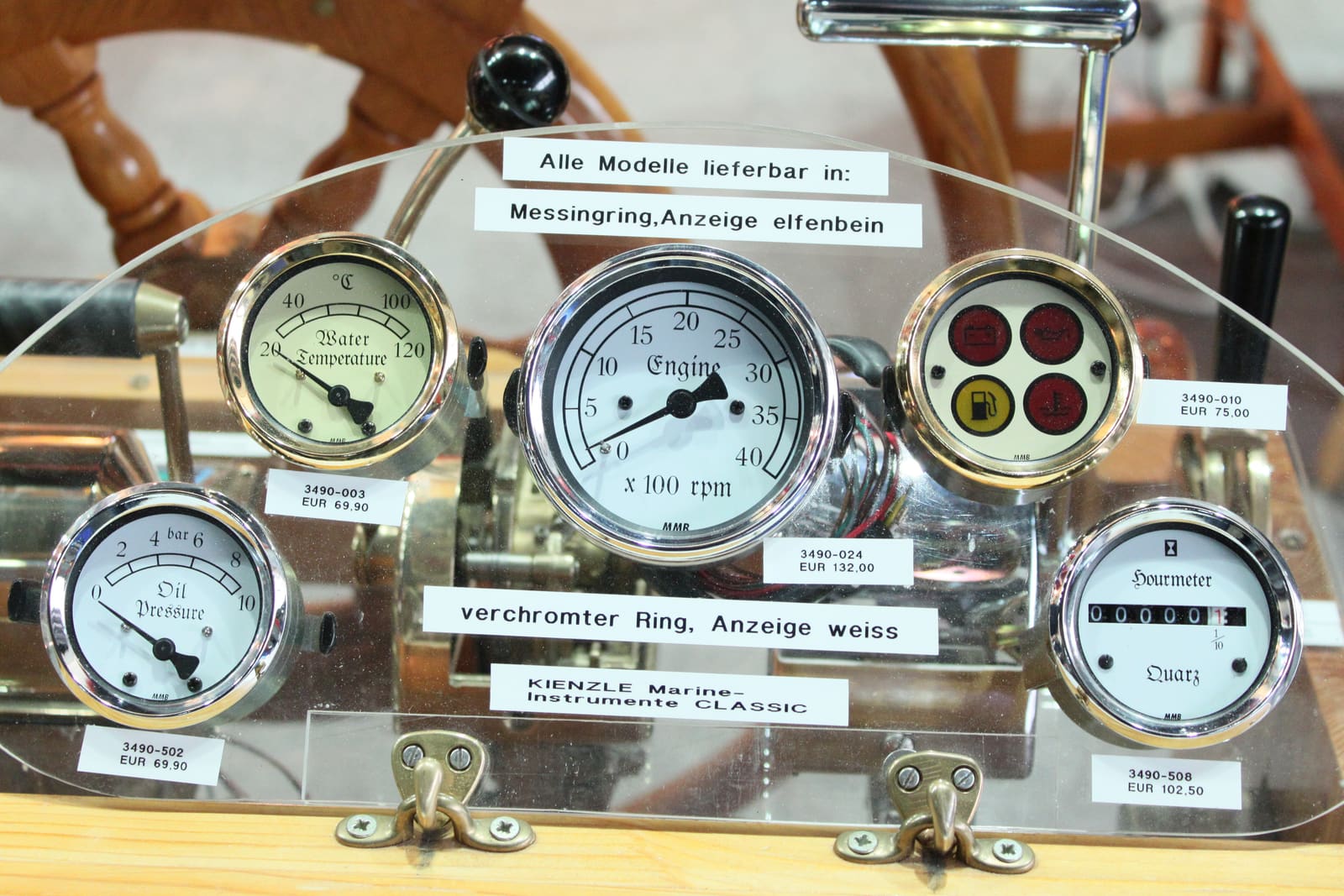
Water temperature, oil pressure, rpm and warning lamps map straight onto the heat, lubrication, fuel and electrical groups. Photo: Bin im Garten / Wikimedia Commons · CC BY-SA 3.0 Your display message or code tells you which group you are in. If you can't tell, treat it as serious until proven otherwise.
Look at the telltale or exhaust water. No water, weak water or steam means you stop the engine now and follow the overheat alarm response guide. If water is flowing well, idle in neutral for a minute or two and watch whether the temperature comes down. Weeds or a bag on the intake are common causes; clear them only with the engine off.
A low oil pressure warning means the engine may be running without proper lubrication. Bring it to idle and shut it off as soon as it is safe. Check the oil level (four-strokes) or the oil tank (oil-injected two-strokes). The low oil pressure guide explains the next steps. Don't idle home on a low oil pressure warning unless staying put is more dangerous, like drifting onto rocks.
If the warning is for water in fuel, look at the clear bowl of your water-separating filter, and at the on-engine filter if you can see it. Yamaha points out that a floating red ring in its on-engine filter means there is water in the trap. If you carry spare filters and can change them safely (engine off, no smoking, rags for spills), do it as the fuel water separator guide describes. If you smell fuel or see fuel in the bilge, stop: that is a fire risk and a call for help.
A low-voltage warning on a running engine usually means the charging system isn't keeping up or a connection is failing. Turn off everything you don't need (stereo, extra electronics, livewell, lights you don't need in daylight) and head for the dock at a moderate speed. A high-voltage warning can mean a failed regulator that is overcharging the battery. If the battery gets hot, hisses or smells of rotten eggs, shut down and ventilate. Afterward, work through the charging system test guide.
If temperature, oil pressure, voltage and cooling water all look normal and the engine runs smoothly at reduced power, you are probably looking at a non-critical or sensor fault. This is the case where a slow, steady run home is usually reasonable. Keep watching the gauges and the telltale, and stop if anything changes.
Stop the engine and get help if:
- the warning is low oil pressure, or there is no cooling water
- you see smoke or steam, smell fuel or burning, or hear new knocking or grinding
- the oil looks milky (see the water in engine oil guide)
- the boat is taking on water
- the warning keeps coming back within minutes of a restart
A slow run home is usually reasonable if:
- the cause is a sensor or non-critical fault and every reading is normal
- an overheat cleared after you removed weeds, water is flowing strongly and the temperature is back to normal
- the weather and distance are reasonable, and you have fuel to run slowly
When in doubt, a tow costs less than an engine. Pick the closest safe harbor, not your home dock.
On many engines the power limit lifts only after the fault clears and you return the throttle to idle or restart the engine. If it won't reset, don't keep cycling the key or disconnect the battery to clear it. It doesn't fix the cause, and on some engines it can wipe information the dealer would use to find it. Never turn the battery switch off with the engine running; the voltage spike can damage the charging system and electronics.
Most engines store fault codes the dealer can read with a diagnostic tool, along with when the fault happened and how often. Bring your photos and notes, and enter the event in your BoatMend log with the engine hours. A mode that kicked in once in rough water and never again may need nothing. One that keeps returning needs a diagnosis, even if the engine seems fine afterward.
Common mistakes
- Revving harder when power drops, which can turn a warning into real damage
- Assuming "it reset itself, so it's fine" and skipping the dealer visit after repeat events
- Ignoring a low oil pressure warning because the engine still runs
- Disconnecting the battery or switching it off to clear a fault
- Confusing a normal rpm limit in neutral with a protection mode (many engines limit rpm when not in gear; your manual explains this)
- Not knowing where the telltale is, so you can't check cooling water in the first minute
- Running a small battery flat with electronics and a big stereo, then blaming the engine for a low-voltage warning
When to call a pro
- Any low oil pressure or no-water overheat event, even if the engine seemed fine afterward
- Protection mode that returns after a restart, or comes on at the same speed every trip
- Fault codes you can't explain from your manual
- High-voltage warnings or a battery that gets hot
- Throttle or shift problems that come with the warning (on electronic controls, this is a dealer job)
- Exhaust temperature warnings on closed-cooled engines (often clogged elbows; see the exhaust elbow guide)
Tips
- Practice the first minute of a power loss with your crew: who steers, who checks the telltale, who reads the display.
- Keep your manual's warning section, spare fuel filters and your towing membership card on board.
- A clean intake and a fresh impeller prevent most heat-related power cuts.
- If you buy a used boat, ask the dealer to read the stored fault history. It shows how the engine was treated.
Official references
We read these to write this guide. Your engine's own manual always wins.
- Mercury Marine – MerCruiser 8.2L Sterndrive (Engine Guardian system description)
- PDB Magazine – MerCruiser Dependability (Engine Guardian critical and non-critical faults, 2012)
- Yamaha Outboards – Maintenance Matters, Additional Tasks (telltale and RPM reduction mode)
- Yamaha Outboards – Maintenance Matters, Fuel and Fuel System (water in the on-engine filter)
- Suzuki Marine – FAQs (warning buzzer and monitor gauge)
Safety: BoatMend is for information only and does not replace a certified marine technician. You are responsible for your safety and your boat. Read the full disclaimer.
Last updated 2026-10-26
Related guides
Engine Warning Horn and Dash Lights: What They Usually Mean and What to Do
Learn what a warning horn, beeps or a dash light usually mean on a boat engine, from overheating and low oil pressure to water in the fuel and reduced-power (limp) mode. Find out what to do right away and when to stop the engine. Patterns differ by brand, so match what you hear and see to your owner's manual.
Overheat Alarm: What to Do in the First 60 Seconds
A short, practiced routine for the moment the temperature alarm goes off: take the load off, look for cooling water, shut down if it isn't there, and check every space the exhaust runs through for heat or fire. Based on a June 2026 Coast Guard safety alert about a fatal fire that started with an overheat alarm.
Low Oil Pressure Warning: What to Do on a Sterndrive, Inboard or Diesel
A low oil pressure alarm or a gauge that drops toward zero means the engine may be running without proper lubrication. Learn what to do in the first minute, the simple checks you can make yourself, how to tell a bad sender from a real pressure problem, and why you should never keep running on the alarm.
Engine Overheating - Troubleshooting Guide
Work through the most likely causes of a hot engine or overheat alarm, from a blocked water intake to a worn impeller or stuck thermostat. Acting fast and in the right order can save your engine and often gets you home without a tow.
Loss of Power, Hesitation or Misfire - Troubleshooting Guide
Figure out why your engine bogs down, stumbles, will not reach full rpm or runs rough. Work from simple checks like trim, prop and fuel filter to ignition and engine protection modes before paying for diagnostics.
How to Replace a Fuel/Water Separating Filter (and Check for Water in Your Fuel)
Swap the spin-on fuel/water separator on your gas boat and learn to spot water and ethanol phase separation before it stalls the engine. It is one of the cheapest jobs on the boat and one of the best protections for a fuel-injected engine.
Is My Engine Charging the Battery? Test the Charging System With a Multimeter
A step-by-step way to find out whether your outboard's stator and rectifier/regulator or your inboard's alternator is really charging the battery, what the voltage readings usually mean, and when the problem is just a dirty connection. Exact test specs come from your engine's service manual.
Two-Stroke Oil Injection vs. Premix: How It Works and How to Check It
A two-stroke engine dies quickly without oil in its fuel, so the oil injection system and its alarms deserve regular attention. Learn how injection and premix differ, what the warning horn is telling you, how to check the system, how to premix safely using your manual's ratio, and the real risks of disabling injection.
Closed-Cooled Gas Engines: Why the Exhaust Elbows Still Need Checking
Closed (freshwater) cooling protects the block, but on gas sterndrives and inboards the exhaust elbows or risers, and on some systems the manifolds, are still cooled by raw water. Learn which parts still see salt or lake water, the warning signs, what the engine makers and BoatUS say about intervals, and how to inspect and look after them.
Emergency Drills for Your Crew: Engine Failure, Fire, Steering Loss and Man Overboard
Practice what everyone aboard does when the engine quits, a fire starts, the steering fails or someone falls in. A few short drills each season turn panic into a plan, and teach your crew to anchor, call for help on VHF 16 or DSC, and get a tow.