Isolation Transformer vs. Galvanic Isolator: Which Does Your Boat Need?
Understand how a galvanic isolator and an isolation transformer each protect a boat on shore power, when the heavier, pricier transformer is worth it (stray-current marinas, aluminum boats, liveaboards), and what to ask the ABYC-certified electrician who installs it.
Time
45 min
Shop would charge
$200-4000
Applies to
All engines
Safety first: Shore power is 120/240-volt AC and can kill, both aboard and in the water around the boat. This guide is for understanding and planning only: don't open the shore power inlet, the AC panel or any isolator or transformer yourself. Never cut or disconnect the green grounding wire to stop corrosion. Never swim near docks or boats plugged into shore power. If anyone in the water feels tingling, shout for them to swim away from the dock, shut off the power at the pedestal, and throw a flotation device rather than jumping in. Call 911 or the Coast Guard on VHF 16 in an emergency.
Owners often ask
- Is an isolation transformer worth it, or is a galvanic isolator enough for my boat?
This guide walks you through it. Still stuck? Ask the AI Mechanic about your engine.
Tools
- Flashlight
- Phone camera to photograph labels and model numbers
- Notebook for anode replacement dates
Parts & supplies
- None for this guide; any isolator or transformer is chosen and installed by a marine electrician
Before you start
Every boat plugged into a marina is connected to every other plugged-in boat through the green grounding wire in the shore power cords. BoatUS explains that this turns the whole dock into a giant battery: an aluminum outdrive on one boat and a bronze propeller on the next are linked by that wire through the water, and the less noble metal (often your expensive aluminum drive or hull) corrodes. Ed Sherman, former ABYC education director, writes that after missing anodes, shore power is probably the most common cause of severe underwater corrosion.
Two devices break that connection without giving up safety:
- Galvanic isolator: a small, inexpensive diode unit in the green wire.
- Isolation transformer: a heavy transformer that gives the boat its own AC supply with no wired connection to the dock.
This guide helps you understand both, decide which fits your boat, and talk to the electrician who installs it. If you already have a galvanic isolator, our galvanic isolator test guide covers checking it.
Steps
Write down what's actually happening:
- Anodes (zincs) disappearing much faster at the marina than on a mooring or trailer
- Pitting or paint blistering on an aluminum outdrive, lower unit or hull
- Frequent reversed-polarity warnings at different marinas
- Worry about electric shock drowning around your boat
- Sensitive AC electronics that misbehave on dock power
Corrosion alone often points to a galvanic isolator. Corrosion plus polarity or safety worries, or a boat that lives on shore power, is where the transformer starts to make sense.
The green grounding wire normally carries no current. If an appliance or charger shorts, it carries the fault current safely back to the dock so the breaker trips. BoatUS stresses that this wire saves lives, which is why cutting it to stop corrosion is so dangerous: a fault could then energize the boat and the water around it.
So any fix has to stop the slow galvanic current but still let a big fault current through, or remove the dock connection entirely in a safe way.
A galvanic isolator is a set of diodes wired into the green wire between the shore power inlet and the boat's grounding bus. Galvanic voltages are small, generally around a volt or less. BoatUS puts the isolator's blocking point at about 1.2 volts; Victron gives about 1.4 volts. Below that, nothing flows, so your anodes stop protecting the neighbors. A real AC fault is far above that, so the isolator passes it and the breaker still trips.
Key points from BoatUS:
- Choose one with a UL marine rating. These are fail-safe: if the diodes fail, the ground connection stays intact.
- It must be rated for your service (usually 30 or 50 amps), hard-wired, and one per shore inlet.
- Typical cost is around $200, and it weighs very little.
- A remote monitor lets you see that it's working, since a fault or nearby lightning can knock it out.
An isolation transformer is two big coils of wire on an iron core. Shore power runs through one coil and creates a magnetic field that induces power in the second coil, which feeds the boat's AC panel. There is no wire connecting the dock side to the boat side.
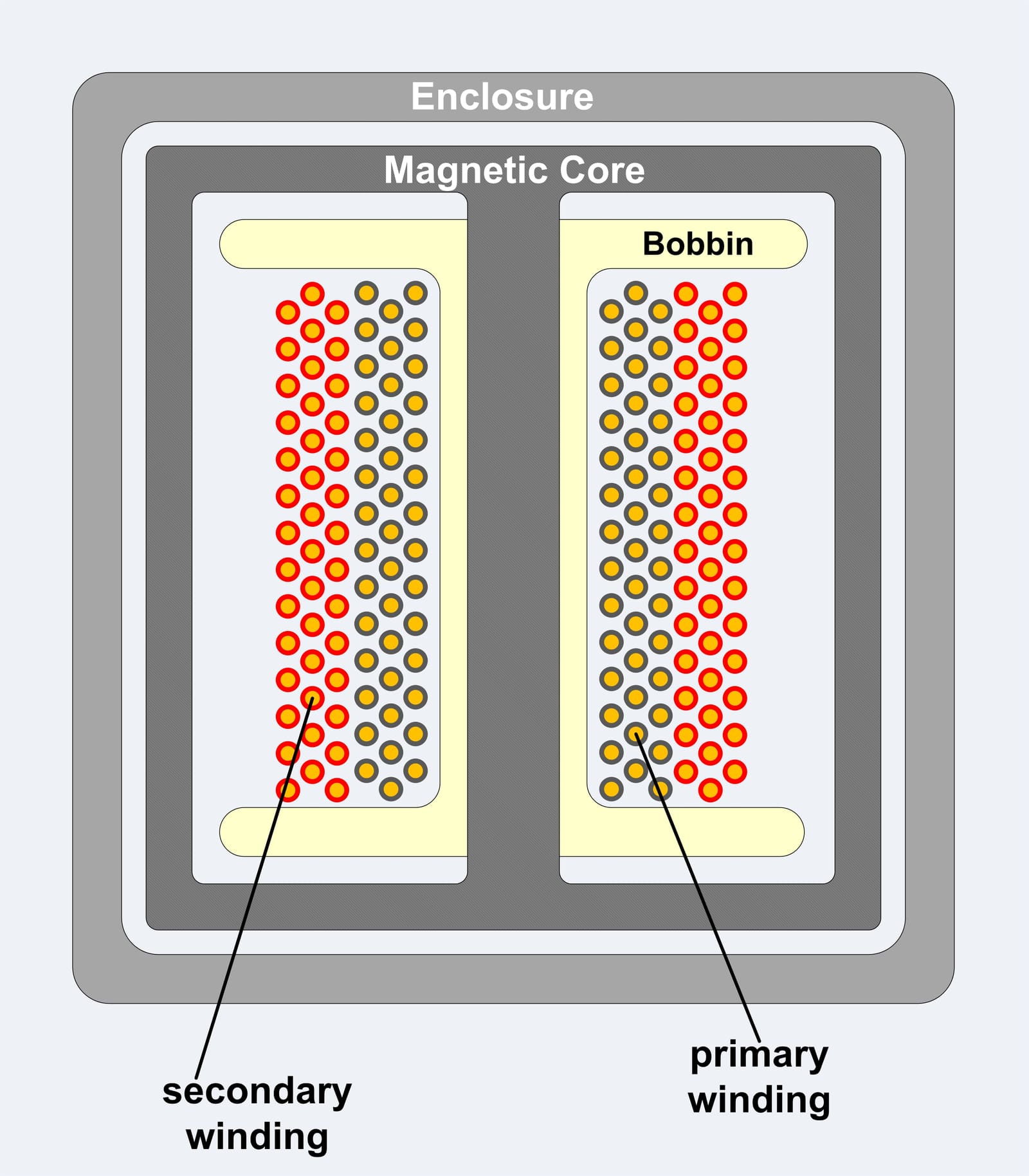
Inside an isolation transformer: the shore side (primary winding) and the boat side (secondary winding) share a magnetic core but never touch electrically. Diagram: Constant314 / Wikimedia Commons · CC0 1.0 Because nothing is wired through, galvanic current from the dock has no path to your underwater metals. Victron notes that the transformer becomes the boat's own power source, so faults on board return to the transformer, not through the water, and it isolates you from electrical problems on neighboring boats.
BoatUS lists several things a transformer does that a galvanic isolator can't:
- Corrects reversed polarity. The transformer doesn't care which dock wire is hot and which is neutral, so your boat always gets correct polarity.
- Protects swimmers. With the boat side correctly wired, leakage current returns to the transformer aboard instead of heading for shore through the water.
- Cleaner power for sensitive electronics.
- Voltage options. Victron notes many transformers can step voltage up or down, handy for a boat that travels between 120- and 230-volt countries.
Victron also points out a galvanic isolator depends on a good ground wire and can't stop galvanic current that sneaks in through the neutral wire on some boats, while a transformer blocks both.
- Weight: BoatUS puts typical units at about 80 to 200 pounds; an older BoatUS article cites roughly 60 to 70 pounds for a 30-amp unit. Small boats may not tolerate that well.
- Space and heat: they're bulky and get quite hot while running, so they need a ventilated spot.
- Inrush when you plug in: a big transformer draws a short surge of current the moment it's energized, which can trip the dock pedestal breaker. Victron builds soft-start circuitry into its marine transformers for exactly this reason, so the shore breaker doesn't trip at plug-in. If an older unit trips the pedestal every time you connect, ask your electrician whether it has (or needs) a soft start, rather than resetting the breaker over and over.
- One per inlet: a boat with two 30-amp inlets needs two transformers, doubling weight and cost.
- Cost: BoatUS quotes from about $600 and up for the unit, plus installation. Larger units and multi-inlet boats cost far more.
- Location limits: BoatUS notes the transformer has to sit close to the shore power inlet (within about 10 feet in its example). Your electrician will confirm the exact rule for your setup.
For most trailer boats and weekend boats that plug in mainly to charge batteries, BoatUS calls the galvanic isolator the best option: low cost, nearly no weight, and good corrosion protection. Pair it with healthy anodes and an annual check.
A transformer starts to pay off when several of these are true:
- You live aboard or stay plugged in for months. Constant connection means constant exposure to the dock's problems.
- Your marina has known stray-current or corrosion trouble, or you keep eating anodes even with a working galvanic isolator.
- Aluminum hull or aluminum drives. Victron notes aluminum hulls are notoriously susceptible to galvanic corrosion, and aluminum outdrives are the classic victim in BoatUS examples.
- You cruise to many marinas with unknown wiring or reversed polarity.
- Mid-size or larger boat that can carry the weight, often with 50-amp or 240-volt service.
- You want the strongest in-water shock protection around your boat.
BoatUS's Ed Sherman sums it up: on a mid- to large-size boat that regularly plugs in, a transformer improves both the shore power system and onboard safety.
Newer ABYC rules call for ground-fault protection on the whole shore power system, through either an isolation transformer or an equipment leakage circuit interrupter (ELCI), a whole-boat version of a household GFCI. BoatUS says an ELCI can be added to many older boats for around $200 plus installation. Ask your electrician how your choice of isolator or transformer fits with ELCI protection.
Without opening anything, look near the shore power inlet and AC panel for:
- A heavy metal box with vents and a data plate mentioning "isolation transformer" or "polarization transformer"
- A smaller finned or sealed box labeled "galvanic isolator," often with a status light or remote monitor
- An ELCI main breaker, usually with a test button
Photograph the labels. BoatUS warns that older galvanic isolators may not meet current standards and can even be unsafe; only a proper test shows whether yours works.
Keep a simple log of anode replacement dates and how much was left each time, at the marina versus away from it. A marine electrician or corrosion specialist can measure your hull's protection with a reference electrode and check for stray current at your slip. Those readings tell you whether a galvanic isolator, a transformer or a marina wiring fix is the real answer.
Have an ABYC-certified marine electrician choose and install the unit, and ask:
- Will it be a galvanic isolator, an isolation transformer or a polarization transformer, and why? (BoatUS notes polarization transformers keep the green wire connected and need a galvanic isolator added.)
- Is it rated for my service (30 or 50 amp, 120 or 240 volt) and every inlet?
- Where will it go, how will it be ventilated, and how much weight does it add?
- Is the unit UL marine-rated and will it have a remote status display?
- How does it work with my ELCI, inverter and generator transfer switch?
- What should I check each season?
After installation, glance at the status display every time you plug in and after any nearby lightning. Keep vents clear and the area dry. Have the system checked at least annually, along with your anodes, and keep the paperwork in your boat profile for surveyors and future buyers.
Common mistakes
- Cutting the green wire (or using a "ground-cheater" adapter) to stop corrosion. It removes the protection that trips the breaker in a fault. ProMariner, which makes both galvanic and battery isolators, puts it plainly: a galvanic isolator is the only device permitted to interrupt a boat's AC ground.
- Buying a galvanic isolator by price alone. Makers describe "fail-safe" models by the fault and inrush current they're tested to carry (ProMariner lists separate criteria for its 30- and 60-amp units); let your electrician match the rating to your shore service and the number of cords.
- Assuming an old galvanic isolator still works because it's still there.
- Buying a transformer for a small trailer boat that rarely plugs in, when a galvanic isolator would do.
- Forgetting the second shore inlet, so half the boat is still connected.
- Installing a transformer in a closed locker with no ventilation.
- Blaming the neighbor's boat for corrosion without checking your own anodes first.
- Swimming off the boat or dock while boats are plugged in.
When to call a pro
- Choosing, installing or replacing a galvanic isolator, isolation transformer, polarization transformer or ELCI: always an ABYC-certified marine electrician
- Anodes wasting away in weeks, or new corrosion on drives or an aluminum hull
- Reversed-polarity lights, tripping ELCI or pedestal breakers, or any shock or tingle on the boat or in the water
- A galvanic isolator status light showing a fault, or a transformer that runs unusually hot, hums loudly or smells
- Corrosion surveys and stray-current checks at your slip
Tips
- If you stay at a marina long term, ask the dock manager whether they test for leakage current and whether the pedestals have ground-fault protection.
- Log every anode change in your BoatMend maintenance plan. A sudden jump in consumption is your early warning.
- If your batteries can keep the bilge pump running between visits (or solar keeps them topped up), unplugging while you're away removes the galvanic path through the dock entirely. Don't unplug if the charger is what keeps the bilge pump alive.
Official references
We read these to write this guide. Your engine's own manual always wins.
- BoatUS – How To Control Electrical Flow On Your Boat (isolation transformers)
- BoatUS – Isolation Transformers
- BoatUS – Galvanic Isolators Explained
- BoatUS – Install A Galvanic Isolator
- BoatUS – Understanding The Green Ground Wire
- BoatUS – The Electrical Dilemma On The Dock (ELCI)
- ProMariner – Galvanic Isolators, Battery Isolators and Combiners
- Victron Energy – Wiring Unlimited, Galvanic Corrosion
- Victron Energy – Isolation Transformers 2000 to 8000 W (soft start, marine use)
Safety: BoatMend is for information only and does not replace a certified marine technician. You are responsible for your safety and your boat. Read the full disclaimer.
Last updated 2026-10-25
Related guides
Galvanic Isolator: Why Shore-Powered Boats Need One and How to Tell If It's Working
A galvanic isolator (or an isolation transformer on bigger boats) keeps stray DC current from the marina's ground wire from eating your anodes, drive and running gear, without cutting the safety ground. Learn what it does, the owner-level checks you can do, what failure looks like, and why the actual meter test is usually a job for a marine electrician.
Shore Power Safety: Cords, Inlets, Burned Plugs and Electric Shock Drowning
An owner's inspection routine for your shore power cord, plugs, boat inlet, galvanic isolator and ground-fault protection, plus the right way to plug in and the facts about Electric Shock Drowning. This guide is for looking and testing only; any electrical repair belongs to an ABYC-certified marine electrician.
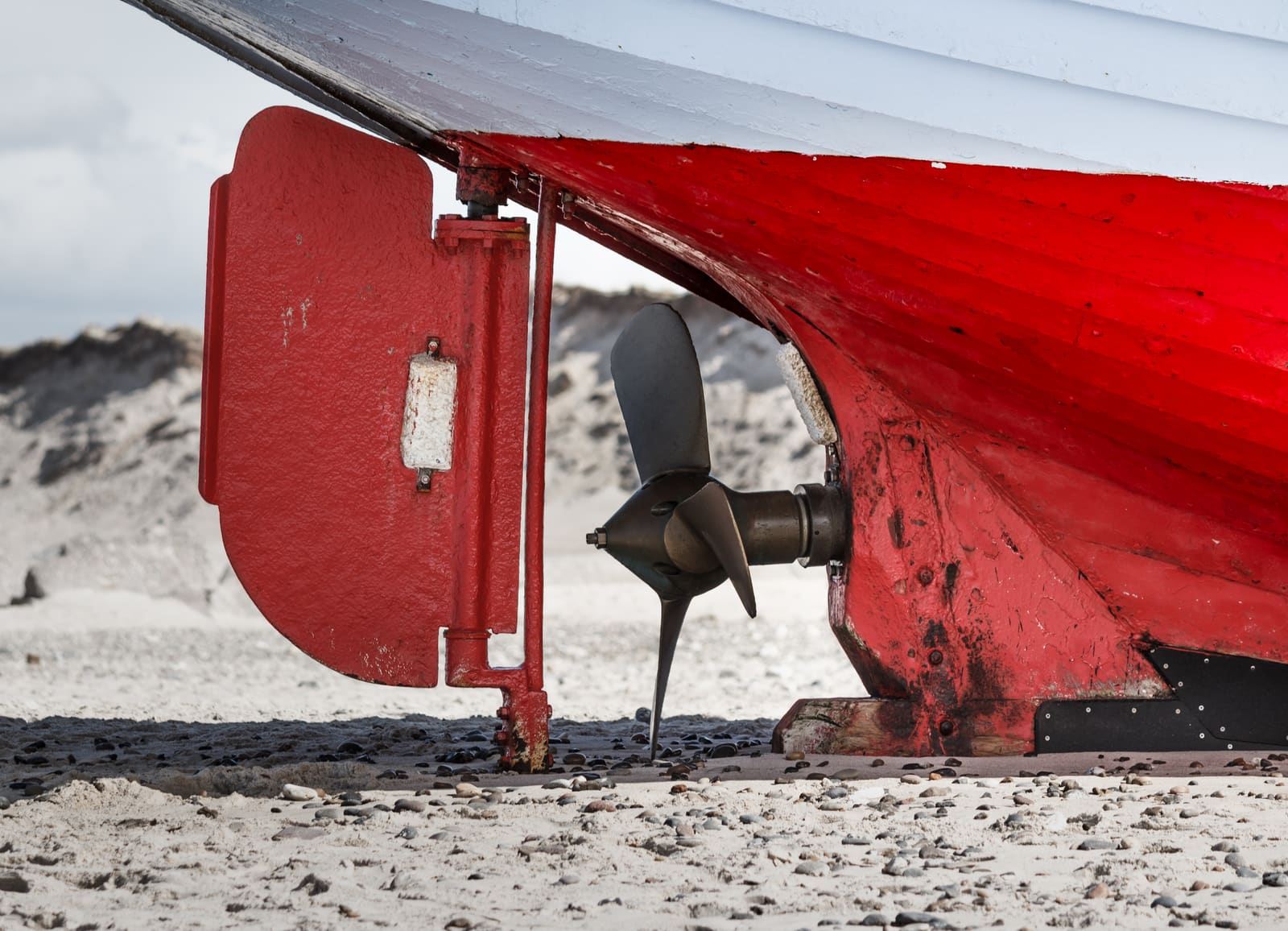
Boat Bonding System Explained: How to Inspect Bonding Wires, Through-Hulls and Anodes
Understand what the green bonding wires on your boat do, how they tie through-hulls, running gear, tanks and engines to your anodes and DC negative, how to inspect and test the connections yourself, and which corrosion warning signs mean it's time for an ABYC-certified technician.
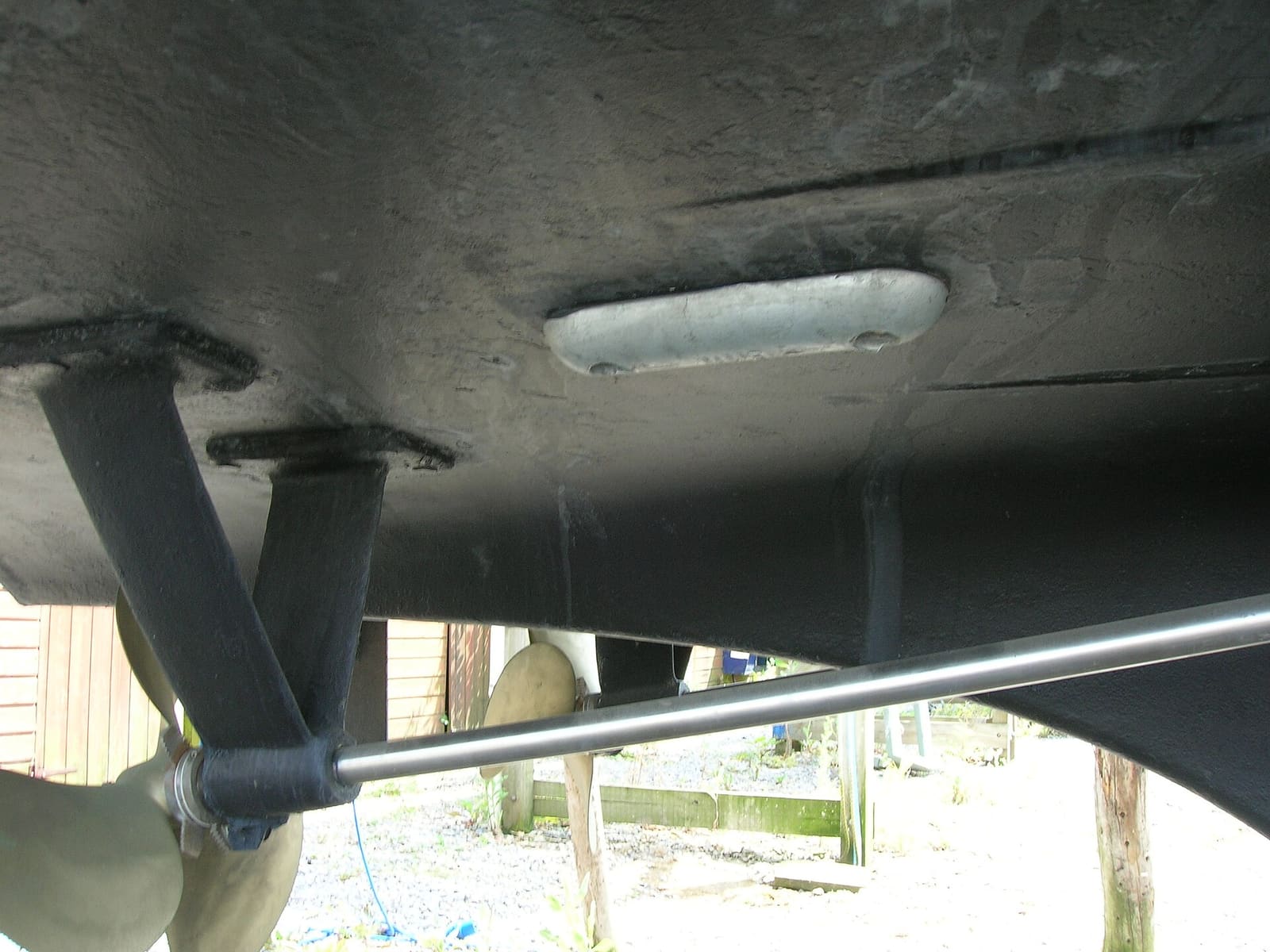
How to Inspect and Replace Sacrificial Anodes (Zincs)
Check the anodes on your outboard, sterndrive or inboard running gear, replace them when they are half gone, and choose the right metal for the water you boat in. Fresh anodes are cheap insurance against expensive corrosion damage to your lower unit, drive and prop.

How to Spot and Prevent Corrosion on an Aluminum Boat
Aluminum hulls and pontoon tubes are tough, but they lose almost every fight with other metals. Learn the warning signs of galvanic and stray current corrosion, keep copper and loose metal away from the hull, choose the right anodes, touch up paint with the proper primer and know when a repair needs a welder.

Electrical Safety at Your Private Dock or Boat Lift: GFCI, Shock Drowning and Annual Checks
Lights, outlets, lift motors and de-icers at a home dock put household current right next to the water, and a hidden fault can kill a swimmer without any warning. Learn the owner checks you can do safely, the protection your dock should have, the no-swimming rule, and which jobs must go to a licensed electrician.

Sterndrive Corrosion: Paint Blisters, Anodes, MerCathode and Galvanic Isolators
Learn to spot the early signs of corrosion on an aluminum sterndrive, check the anodes and the MerCathode or Volvo Penta ACP system, and understand when a galvanic isolator or a hull potential test is needed. Caught early, corrosion costs a few anodes; caught late, it can cost the whole drive.
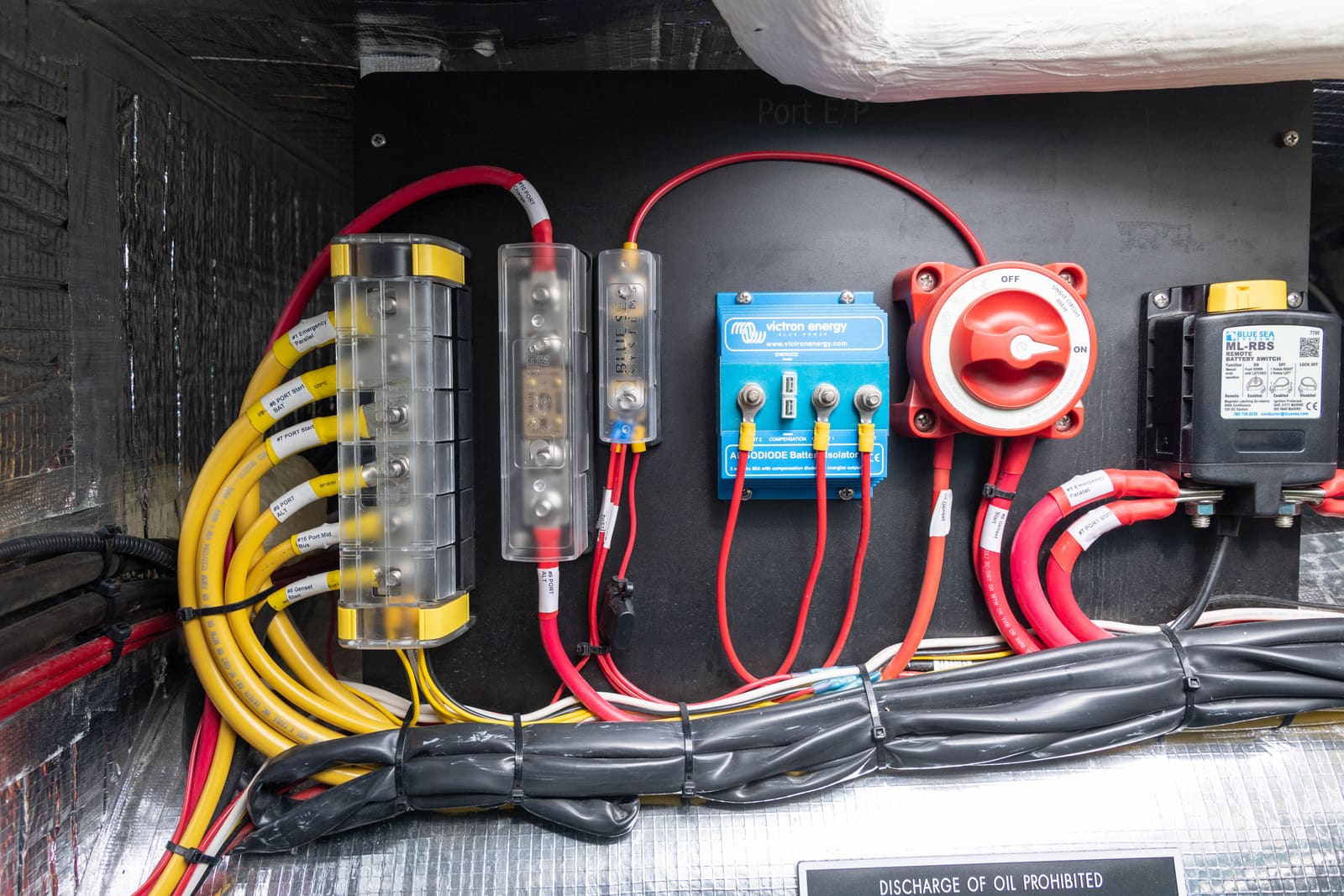
Boat Inverters and Inverter/Chargers: Sizing, Safe Use and What a Pro Must Install
An inverter turns battery power into 120-volt household current, which makes it as dangerous as shore power and a serious fire risk if it is fused or wired wrong. Learn how to size one realistically, what a safe installation looks like, the owner checks to do, and the mistakes (like backfeeding) that hurt people.