Switching to Lithium (LiFePO4) Boat Batteries: What Changes and When It's Worth It
What really changes when you swap lead-acid for lithium iron phosphate (LiFePO4) batteries on a boat: the battery management system, charger settings, protecting the alternator with a DC-DC charger, not mixing chemistries, cold-weather charging, and which jobs (trolling, house, starting) suit lithium. House-bank conversions should be designed and installed by a qualified marine electrician.
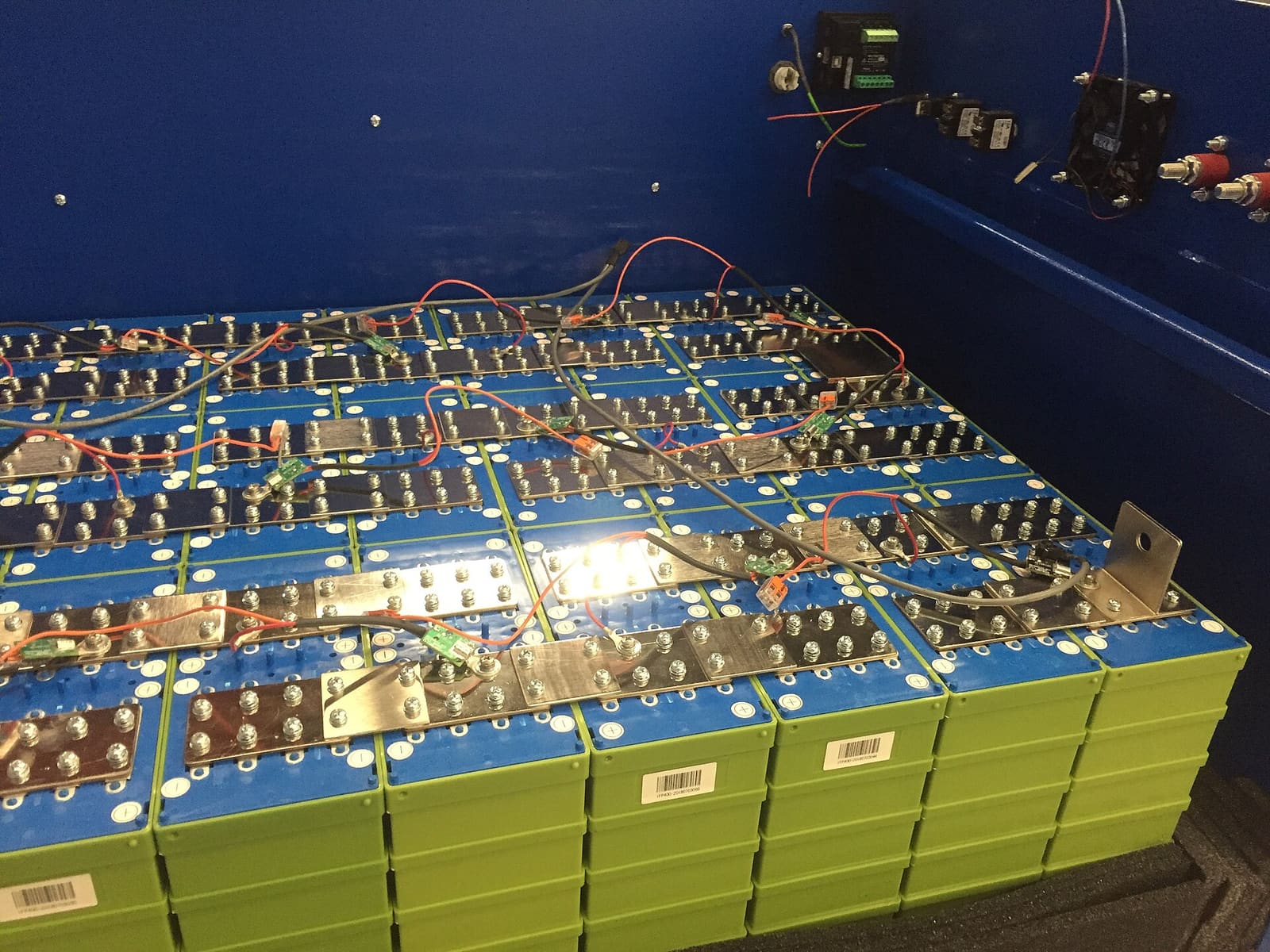
Time
4 h
Shop would charge
$500-5000
Applies to
All engines
Safety first: LiFePO4 is one of the more stable lithium chemistries, but a lithium bank stores a lot of energy and can deliver enormous current into a short circuit. A house-bank conversion (anything tied to an alternator, inverter, shore-power charger or multiple banks) should be designed and installed by an ABYC-certified marine electrician. Never connect a lithium house bank straight to an engine alternator without the protection described below. If a lithium battery gets hot, swells, smokes, hisses or smells, disconnect charging sources if you can do it safely, get everyone away from it and call 911 (or the Coast Guard on VHF 16 if underway). Do not try to put out a battery fire in an enclosed space yourself.
Owners often ask
- Can I just drop a lithium (LiFePO4) battery in place of my lead-acid battery and keep my old charger?
- Will a lithium house battery burn up my alternator? Do I need a DC-DC charger?
This guide walks you through it. Still stuck? Ask the AI Mechanic about your engine.
Tools
- Digital multimeter
- Battery monitor with shunt (or the battery's own Bluetooth app)
- Ratchet crimping tool and heavy-cable lug crimper
- Heat gun
- Wrenches and screwdrivers
- Safety glasses and insulated gloves
Parts & supplies
- LiFePO4 battery (or batteries) with a built-in or matching external battery management system (BMS)
- Charger, or charger settings, approved by the battery maker for lithium
- DC-DC charger or lithium-capable external alternator regulator (when the engine will charge the bank)
- Main fuse rated for the battery's short-circuit current, sized by the installer
- Battery hold-downs or a secured box
- Tinned marine cable and heat-shrink lugs sized for the load
Before you start
Lithium iron phosphate (LiFePO4, also called LFP) batteries are showing up on everything from bass boats to cruising sailboats. Boating Magazine sums up the appeal: they weigh roughly half as much as lead-acid batteries, you can use nearly all of their rated capacity (versus about half for lead-acid), they recharge faster and can last 10 years or more. The catch is the price, and the fact that a lithium battery is a system, not a drop-in part. The charging equipment around it usually has to change too.
The standard behind it: The American Boat & Yacht Council (ABYC) publishes a standard for lithium batteries on boats, E-13, which grew out of its earlier technical report TE-13. As Boating Magazine summarizes it, a BMS must automatically stop charging if voltage or temperature goes outside safe limits, with high- and low-voltage and high- and low-temperature cutoffs that work independently of the chargers, plus an alert the skipper can see or hear. The batteries must be tested to recognized standards (such as UL 1973 or UL 2580) and secured against boat movement. ABYC standards are voluntary, but Practical Sailor notes insurers and surveyors increasingly look for compliance, so ask your insurer before you convert.
When lithium is usually worth it:
- Trolling motor banks: big weight savings and longer run time, with steady power until nearly empty.
- House banks on boats that anchor out, cruise or run lots of electronics, a fridge or an inverter.
- Owners who want fewer battery replacements over the long run and will set up charging properly.
When it often isn't:
- A single starting battery on a weekend outboard boat. A good lead-acid or AGM cranking battery is cheap and simple, and Practical Sailor notes ABYC E-13 leans away from using LiFePO4 for engine starting.
- Boats that sit in freezing weather with no way to keep the battery warm or charging blocked.
- When you aren't ready to change the charger, alternator charging or battery isolator to suit lithium.
- Small boats with only a fish finder and bilge pump, where a lithium battery's advantages hardly matter.
Steps
Write down each battery on the boat and what it does: starting, house (lights, electronics, fridge, inverter) or trolling motor. Practical Sailor's conclusion for a typical boat is to keep lead-acid on the starting side and use LiFePO4 for the house (or trolling) side. Starting a big engine with lithium is possible with batteries designed and approved for it, but it is a separate decision; check your engine manual's battery requirements (type, marine cranking amps and reserve capacity) before replacing a cranking battery.
Each one must be compatible with lithium, or be changed:
- Onboard shore-power charger
- Engine alternator (inboard, sterndrive) or outboard charging output
- Solar or wind charge controller
- Battery isolator, automatic charging relay (ACR) or battery combiner
- Inverter/charger, generator-powered charger
Also note the loads: a windlass, bow thruster or inverter can draw hundreds of amps, and the battery and its BMS must be rated for that.
The BMS is the electronic brain that protects the cells. Points to check:
- Built-in or external: many "drop-in" batteries have the BMS inside. Others, such as Victron's Lithium Battery Smart line, need a separate external BMS, and Victron lists which of its BMS units suit marine systems with alternators and DC loads.
- Protection that meets ABYC E-13 as described above, including low-temperature charge protection.
- Ratings for continuous and peak discharge that cover your biggest load. Practical Sailor warns that some makers stretch "cold cranking amps" claims and suggests trusting conservative continuous ratings.
- An alarm you'll notice. Practical Sailor cautions against relying on a phone app alone for low-charge warnings; ABYC calls for a visible or audible alert.
- One larger battery is usually simpler than several small ones in parallel or series. Practical Sailor describes parallel batteries with separate BMSs falling out of balance and shutting down.
Lithium needs different charge voltages than lead-acid. Dakota Lithium, for example, publishes about 14.4 volts bulk/absorption and 13.6 volts float for its 12-volt batteries, with equalization, desulfation and lead-acid temperature compensation turned off; other brands differ, so use your battery maker's numbers. Dakota adds that a lead-acid charger may fully charge, undercharge or use the wrong stage on a lithium battery depending on its profile. Use a charger with a lithium setting the battery maker approves, or replace it. See the onboard battery charger guide for mounting and fusing.
This is the most important change on boats with inboard or sterndrive engines (and big outboards with high-output alternators).
- A discharged lithium bank will try to draw as much current as the alternator can make, for as long as it can. A standard alternator can overheat doing that. Practical Sailor puts it bluntly: don't connect an alternator directly to an LFP house battery.
- If the BMS suddenly disconnects the battery while the alternator is charging it, Battle Born warns the alternator and the boat's electrical system can be severely damaged.
The two common solutions:
- A DC-DC charger: the alternator charges the starting battery as usual, and the DC-DC charger feeds the lithium house bank at a controlled rate with a lithium profile. Battle Born calls this the simple, safe option (slower); Dakota Lithium calls it the appropriate choice for most installations with a factory alternator.
- An external alternator regulator designed for lithium, which controls alternator output using voltage, current and temperature. This charges faster but must be designed around your alternator and the BMS's disconnect behavior.
Dakota notes some lithium starting or dual-purpose batteries are approved for direct alternator charging in specific applications. Only rely on that if the battery maker approves it for your engine.
Never wire a lithium battery in parallel or series with lead-acid batteries; their voltages and charging needs are different, and one will be over- or undercharged. Keeping a lead-acid starting battery and a separate lithium house bank is fine when they are linked by the right device (usually a DC-DC charger). Check any existing ACR, isolator or combiner: many were designed around lead-acid voltages and may not behave correctly with a lithium bank. Ask your installer whether yours can stay or should be replaced by a DC-DC charger. Owners with older diode-type isolators often notice their batteries never seem to reach full charge from the engine: the diodes drop some voltage on the way to the battery, so charging is slower and may stop short of full. Lithium batteries want a specific charge voltage, which makes this worse, and it's one more reason installers usually swap a diode isolator for a DC-DC charger in a lithium conversion.
Check what your engine already provides, too. Yamaha notes that many of its larger outboards (150 hp and up) have separate isolator or charging leads meant for a house battery, which charge the starting battery first and then switch to the house bank. That system was designed around lead-acid, so ask the dealer and the battery maker whether it is approved for a lithium house bank before you connect one.
Dakota Lithium's rule: most LiFePO4 batteries should not be charged below 32°F (0°C) unless the battery has internal heating; warm the battery first or use a heated model. A good BMS will block charging when it is too cold, which is why a lithium bank may refuse a charge on a frosty morning. For winter layup, follow your battery maker's storage instructions and switch off or disconnect every load so small parasitic draws can't run the battery down to its BMS cutoff over the winter.
For 24- or 36-volt trolling motors, Dakota cautions to connect batteries in series only when that model permits it, and to use a charger that matches the full bank's voltage and chemistry (or one lithium-compatible output per battery, as the battery maker specifies). Don't keep the old lead-acid charger profile, and don't mix one new lithium battery with older lead-acid ones in the same trolling bank. The trolling motor wiring guide covers fusing and wire size.
A common question is whether the outboard will recharge the lithium trolling bank on the way home. On most small and mid-size outboards the charging output is modest and goes to the starting battery first, so plan to recharge the trolling bank with its lithium charger at the dock or at home. If you want the outboard to top it up underway, the usual safe route is a small DC-DC charger fed from the starting battery, sized to what the outboard's charging system can spare. Check your engine manual for its charging output.
- Secure the battery with hold-downs or a fixed box so it can't move in rough water, as ABYC E-13 requires.
- Keep it cool and dry. Practical Sailor advises avoiding direct sun and hot spots such as a hot engine compartment; the BMS should have an over-temperature cutoff.
- Fuse the main positive cable close to the battery, with a fuse type rated to interrupt the very high current a lithium battery can deliver. Your installer will size it per ABYC E-11 and the battery's specs.
- Use correctly sized tinned cable, crimped lugs and strain relief. Practical Sailor stresses that loose connections become hot connections, which can start a fire.
- Include a battery switch so you can fully isolate the bank.
A LiFePO4 battery's resting voltage barely changes across most of its charge range, then drops off sharply near empty. A voltmeter that reads "13.1 volts" can't tell you whether you're at 30 or 80 percent. A battery monitor with a shunt, or the battery's own app, counts amp-hours in and out and gives a real percentage.
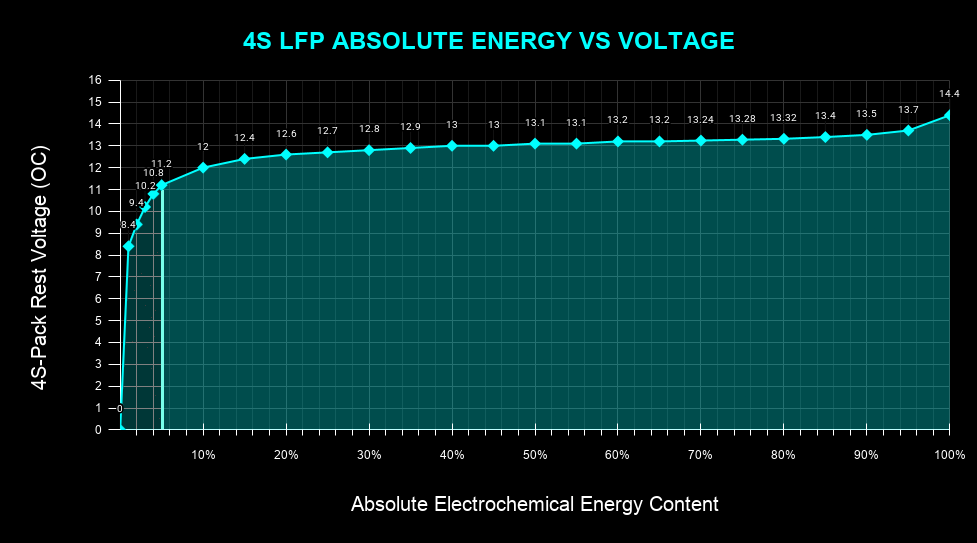
The flat middle of the curve is why voltage alone is a poor fuel gauge for lithium. Graph: Thomas Appel / Wikimedia Commons · CC BY-SA 4.0 For anything beyond a simple trolling-motor or electronics battery swap, hire an ABYC-certified marine electrician. A typical house conversion touches the charger, alternator, DC-DC charger, inverter, battery switches, fusing and monitoring, and each needs to be set for the specific battery. Ask for:
- A wiring diagram and a list of the charge settings used for every source
- Proof the battery is tested to a recognized standard and meets ABYC E-13
- Paperwork for your insurer and future surveyor
On the first outings, watch the battery monitor and app:
- Each charging source (shore charger, alternator via DC-DC, solar) shows charge current going in.
- The alarm sounds or lights in a test (your installer can show you how).
- No cable, fuse holder or charger runs hot after an hour of charging.
- Update the battery type and charge settings in your BoatMend boat profile.
Common mistakes
- Treating a lithium battery as "drop-in" and leaving a lead-acid charger profile, equalize mode or temperature compensation switched on.
- Connecting a lithium house bank directly to a standard alternator.
- Paralleling a new lithium battery with existing lead-acid batteries.
- Using lithium for engine starting without checking the engine maker's battery requirements.
- Relying on a phone app as the only low-battery warning.
- Charging below freezing with a battery that has no low-temperature protection or heater.
- Buying several cheap batteries to build a big bank instead of a properly matched system.
- Leaving loads connected all winter so the BMS shuts the battery off at empty.
When to call a pro
- Any house-bank conversion, or any system with an alternator, inverter, inverter/charger, generator or solar
- Choosing and setting up a DC-DC charger or external alternator regulator
- Starting batteries for inboard, sterndrive or large outboard engines
- Fusing, main cable sizing and battery switch changes on high-current circuits
- A battery that gets hot, swells, smells or keeps shutting down
- Insurance or survey questions about ABYC E-13 compliance
Tips
- Before you buy, ask your insurer whether they have rules for lithium batteries or require an ABYC-certified installer.
- Keep the battery's datasheet, BMS settings and charge parameters in a waterproof folder aboard and in your BoatMend boat profile.
- Label every charging source with the setting used ("Charger: LiFePO4 profile").
- Size a DC-DC charger to what your alternator can comfortably supply, not to the biggest model available.
- If you only need more trolling time, a lithium trolling bank with its own lithium charger is the simplest, lowest-risk place to start.
Official references
We read these to write this guide. Your engine's own manual always wins.
- Battle Born Batteries – Alternator Charging 101 for Marine Applications
- Dakota Lithium – How to Charge Dakota Lithium and LiFePO4 Batteries
- Dakota Lithium – FAQ, Charging Your Batteries
- Victron Energy – Lithium Battery Smart 12,8V & 25,6V
- Boating Magazine – Five New Technologies That ABYC Helped Standardize
- Practical Sailor – Lithium Batteries for Small Boats, A LiFePO4 Buyer's Guide
- Practical Sailor – Power Up, Installing Your Budget Lithium System and Keeping It Safe
- Yamaha Outboards – Maintenance Matters, Electrical System (starting and house batteries)
Safety: BoatMend is for information only and does not replace a certified marine technician. You are responsible for your safety and your boat. Read the full disclaimer.
Last updated 2026-10-24
Related guides
Marine Battery Care: Test, Charge and Store for Winter
Check your boat battery's health, charge it the right way for its type (flooded, AGM or lithium), and store it so it is ready in spring. Most "boat won't start" calls start with a neglected battery.
How to Choose, Install and Maintain an Onboard Battery Charger
Pick the right marine charger for your batteries (how many banks, how many amps, flooded, AGM or lithium), mount and fuse it safely, set the charge profile, and use it to keep batteries healthy all season and through the winter. The AC (shore power) side is a job for a marine electrician.
How to Use a 1-2-Both Battery Switch and Run Two Batteries
Learn what the 1, 2, Both and Off positions really do, a simple routine that keeps one battery ready to start the engine, how to check that both batteries are charging, and when an automatic charging relay makes life easier. Rewiring high-current cables is a job for a marine electrician.
Is My Engine Charging the Battery? Test the Charging System With a Multimeter
A step-by-step way to find out whether your outboard's stator and rectifier/regulator or your inboard's alternator is really charging the battery, what the voltage readings usually mean, and when the problem is just a dirty connection. Exact test specs come from your engine's service manual.
How to Wire a 12, 24 or 36-Volt Trolling Motor and Charge Its Batteries
Set up the battery bank for your electric trolling motor the right way: matched deep-cycle batteries in series or parallel, a circuit breaker sized from the motor maker's chart, a proper plug, and a multi-bank charger that keeps every battery healthy. High-current wiring that runs long distances or ties into other systems is a job for a marine electrician.
How to Find and Fix Corroded Electrical Connections on a Boat
Track down the green crust and loose terminals behind flickering lights, dead gauges and slow cranking with a simple voltage-drop test, then remake the connection the marine way: tinned wire, a proper crimp, adhesive-lined heat shrink and a protective coating.
Shore Power Safety: Cords, Inlets, Burned Plugs and Electric Shock Drowning
An owner's inspection routine for your shore power cord, plugs, boat inlet, galvanic isolator and ground-fault protection, plus the right way to plug in and the facts about Electric Shock Drowning. This guide is for looking and testing only; any electrical repair belongs to an ABYC-certified marine electrician.
How to Maintain a Bow Thruster (Anode, Prop, Shear Pin, Gear Leg and Batteries)
Keep your electric bow or stern thruster ready for the moment you need it, with seasonal checks of its anode, prop and shear pin, gear leg oil, motor compartment, batteries and heavy cables, plus how to avoid overheating it. Most thruster failures build slowly from corrosion and weak batteries.