How to Maintain Your Mainsail Reefing System and Practice a Reef at the Dock
Check the reef lines, blocks, hooks and cringles of a slab (jiffy) reefing system, keep in-mast and in-boom furling mains running smoothly, and practice tucking in a reef at the dock so it is quick and safe when the wind comes up.
Time
1 h 30 min
Shop would charge
$150-600
Applies to
All engines · Sailboat
Safety first: Do maintenance and practice in calm conditions, at the dock or on a mooring, with the boat head to wind. Keep fingers clear of winches and blocks when a line is loaded, and never force a jammed in-mast or in-boom furler with a winch handle; you can tear the sail or break the gear. Wear a life jacket and clip on to a jackline (not a lifeline) if you go to the mast underway. If the wind builds and you can't shorten sail, start the engine, head for shelter, and call your tow service or the Coast Guard on VHF 16 if you need help.
Owners often ask
- My in-mast furling mainsail keeps jamming halfway. What am I doing wrong?
- When should I put a reef in the mainsail?
- Should I lash the reefed clew to the boom as well as using the reef line?
This guide walks you through it. Still stuck? Ask the AI Mechanic about your engine.
Tools
- Flashlight and a small mirror
- Garden hose with fresh water
- Soft brush and mild soap
- Rigging knife and a lighter or hot knife for line ends
- Pliers and seizing wire
- Marker pen or whipping twine for halyard marks
- Phone camera
Parts & supplies
- Replacement reef lines of the right size and type (if worn)
- Dry lubricant recommended by your track, block or furler maker
- Spare shackles, cotter pins and seizing wire
- Sail ties or reef lines (nettles) for the reef points
Before you start
Know which system you have:
- Slab (jiffy) reefing: the most common. The mainsail has one or more rows of reef points. To reef, you lower the halyard part way and pull the luff (front) and leech (back) cringles down to the boom with reef lines, then tie up the loose sail. Good Old Boat notes this usually gives the best sail shape.
- Single-line reefing: one line pulls both the luff and leech down, usually from the cockpit.
- In-mast furling: the mainsail rolls up on a rod inside the mast. Fast and easy, but it can jam if rolled loosely.
- In-boom furling: the sail rolls up inside a special boom. Good Old Boat points out that if it jams, the sail can usually still be lowered, which is not always true of in-mast systems.
When: inspect at spring commissioning, again mid-season if you sail a lot, and after any hard blow. Practice a reef at the start of every season and whenever new crew join. Typical; adjust for how much you sail.
Why practice matters: BoatUS says to reef too soon rather than too late, and Good Old Boat says a strong blow is the worst time to learn. A reef you've done ten times at the dock takes a couple of minutes under way.
Steps
Pull each reef line out of the boom or along its run and look at every inch. Replace lines that are stiff, glazed, fuzzy, or have a cover that has slipped or worn through, especially where they turn around a block or exit the boom. See /guides/running-rigging-synthetic for how to judge wear.
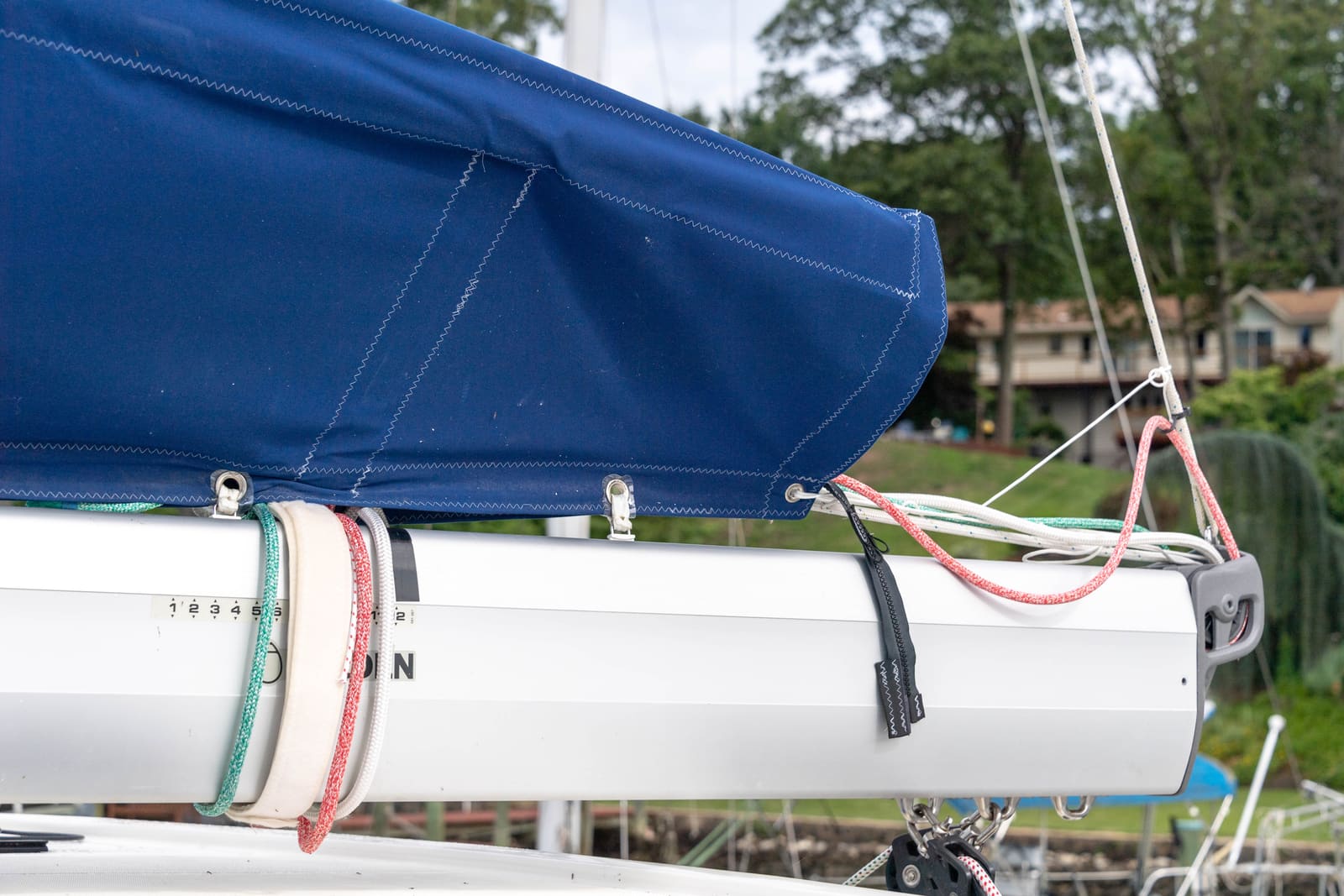
Photo: Craig Stanfill / Wikimedia Commons · CC BY-SA 2.0 Color-coding each reef line, as on this boom, makes it much easier to grab the right one in a hurry.
Spin every block and sheave the reef lines run through. BoatUS's rig inspection calls for all blocks to turn freely. Look for cracked cheeks, flat spots on sheaves, and loose rivets or screws holding blocks and cheek plates to the boom. Check shackles are seized with wire.
At the gooseneck, look at the reef hooks (or ram's horns) that hold the luff cringle. They should be straight and firmly attached. Look for cracks or corrosion around the gooseneck and vang fittings, which BoatUS lists as common trouble spots on older boats.
Lower the mainsail or hoist it on a calm day and look at the reef cringles (metal rings) at the luff and leech. Check the stitching and patches around them are intact and that the rings are not pulling out. Check that the small reef point lines or grommets along each reef row are all there. Small tears here grow fast; take them to a sailmaker early (see /guides/sail-care-storage).
Look closely at the leech next to each clew cringle. Rigger Herb Benavent (Rigging Doctor) explains that the usual way of running the clew reef line, up through the cringle and back down the other side, can bunch sail cloth under the line and drag it into the cringle, wearing a hole in the leech. One fix is to lead the line over the leech instead, which keeps the cloth clear but moves the rubbing onto the leech edge. Either way, ask your sailmaker about a chafe patch: a small, replaceable piece of sailcloth sewn on where the line rubs.
With the sail hoisted, pull the clew reef line down and watch where it pulls. The leech cringle should come down to the boom and slightly aft so the foot of the reefed sail is tight. If it only pulls straight down or forward, the padeye or block on the boom is in the wrong place; a rigger or sailmaker can fix the lead.
Reef lines often end at a rope clutch or cam cleat in the cockpit. Close the clutch on a loaded line and tug hard; BoatUS says a line stopper shouldn't let the line slip at all. Service winches as in /guides/sailboat-winch-service.
A reef only works if the halyard can be eased and the sail slides down. BoatUS explains that friction between the sail slides and the mast track is usually what makes a mainsail hard to lower. Clean the track, and use only the dry lubricant your track or slide maker recommends. Check the slides and shackles along the luff are all present and not cracked.
With the sail reefed at the dock (step 11), put a durable mark on the halyard at the clutch or winch for each reef position. Under way you then ease the halyard to the mark, hook the luff, and haul the leech down without guessing.
- Rinse the furling gear, drum and the opening in the mast with fresh water, especially after salt spray, so salt and grit don't build up on bearings.
- Inspect the inhaul (furling) and outhaul lines for wear and their blocks and guides for free movement.
- Unfurl the sail fully on a calm day and look for creases, wear or stretched cloth, which make the sail roll badly.
- Modern Sailing, which runs a fleet with these masts, inspects its units every two weeks; owners should at least check them each season.
- Follow the maker's instructions for any lubrication. Don't spray anything into the mast that isn't recommended.
Modern Sailing's key point is that jams usually come from rolling the sail in loosely. To furl or reef:
- Head nearly into the wind, with the correct slight tack for your furler's rotation direction.
- Tighten the vang (or keep the boom down) to flatten the sail.
- Keep tension on the outhaul while winching in the inhaul, so the sail wraps tightly.
- If it jams, roll the sail back in a little and try again with more outhaul tension. Never grind hard on a winch to free it.
In-boom systems have their own rules about boom angle and halyard tension; follow your maker's guide closely.
On a calm day, with the bow pointing into the wind:
- Hoist the main and take up the topping lift (if you have one) so the boom won't drop.
- Ease the mainsheet and vang.
- Lower the halyard to your mark and hook the luff cringle on the reef hook (or pull the luff line tight).
- Re-tighten the halyard.
- Haul in the leech (clew) reef line until the cringle is down on the boom and the foot is tight.
- Ease the topping lift, then tidy the loose sail with the reef point lines, tied around the sail only, not around the boom (check with your sailmaker for your sail). Good Old Boat stresses that reef points should be tied with a reef knot only tight enough to hold the bundle: the luff and leech reef lines carry the sail's load, not the reef points.
- Shake out the reef in reverse order: untie the reef points first, then ease the leech line, ease the luff, and hoist.
Time yourself. Do it until each person aboard can do it without help.
Note line replacements, blocks serviced, and your reefing practice dates in your BoatMend log.
Common mistakes
- Waiting too long to reef. Reefing is much harder once the boat is overpowered.
- Tying the reef points around the boom instead of only around the bundled sail, which can tear the sail if the clew line slips. Follow your sailmaker's advice.
- Shaking out a reef with the reef points still tied.
- Forgetting the topping lift, so the boom drops onto the cockpit or the leech takes the boom's weight.
- Loosely rolled in-mast mains that jam halfway.
- Using a winch to force a jammed furler.
When to call a pro
- Torn or pulled-out reef cringles, or worn patches at reef points (sailmaker)
- Reef line leads that pull the sail out of shape, or blocks that need new padeyes on the boom (rigger)
- An in-mast or in-boom furler that keeps jamming even when furled tight, has a noisy or stiff gearbox, or makes grinding noises
- Cracks at the gooseneck, vang fitting or boom-end casting
- You'd like to convert to single-line reefing or lead lines to the cockpit
Tips
- Leading reef lines aft to the cockpit means less time on deck in rough weather.
- Wash reef lines with mild soap and fresh water each season; BoatUS recommends checking with the maker first for high-tech lines.
- Put a reef in before nightfall or before you leave if a front is forecast (see /guides/marine-weather-forecasts).
- Keep a short checklist of your reefing steps taped inside the companionway for guests and new crew.
Official references
We read these to write this guide. Your engine's own manual always wins.
- Good Old Boat – Mainsail Handling 101 (reefing and furling systems)
- Modern Sailing – The Ins and Outs of In-Mast Furling Mainsails
- BoatUS – Roller Furling and Reefing
- BoatUS – 5 Secrets of Sailboat Line Maintenance
- BoatUS – Drop Your Sail With Ease (mast track friction)
- BoatUS – Inspecting Sailboat Rigging (blocks, line stoppers, gooseneck)
- Good Old Boat – Mainsail Reefing 101 (Don Launer)
- Rigging Doctor – Reef Clew Line Setup (Herb Benavent)
- Rigging Doctor – Reef Clew Line, a Closer Look (chafe patch)
Safety: BoatMend is for information only and does not replace a certified marine technician. You are responsible for your safety and your boat. Read the full disclaimer.
Last updated 2026-10-26
Related guides

Sail Care and Winter Storage: Rinse, Dry, Inspect, Fold and Store
Keep your sails out of the sun, rinse and dry them before they go away, catch small tears and rotten stitching early, and fold and store them so they come back in spring without mildew or hard creases. Good habits can add years to an expensive set of sails.
Running Rigging Care: Inspecting Halyards, Sheets and Dyneema Lines
Check your halyards, sheets and control lines for chafe, sun damage, glazing and cover slip, wash them the right way, end-for-end them to spread the wear, and know when a line has to go. A halyard that parts drops a sail; a sheet that parts in a gust can be worse.

Roller Furler Care: Inspection, Drum and Swivel Service, and Halyard Wrap
Keep your headsail roller furler turning easily with a yearly unroll-and-inspect, fresh-water rinses of the drum and swivel, a correct halyard angle and a clean furling line lead. A neglected furler can jam with the sail half out, and a halyard wrap can damage the forestay.
Electric and Hydraulic Headsail Furlers: Care, Manual Override and Safety
Keep a powered headsail furler working with simple care: furl the right way, rinse the swivels, check the wiring, breaker and switches, and practice the manual override before you need it.
How to Service Sailboat Winches (Clean, Oil the Pawls, Grease the Gears)
Take your sheet and halyard winches apart, clean out old grease and salt, oil the pawls, lightly grease the gears and bearings, and put them back together. A serviced winch turns easily and, more importantly, its pawls catch every time so the drum can't spin backward under load.
How to Inspect Your Sailboat's Standing Rigging
A step-by-step owner's inspection of the wires, fittings, turnbuckles, pins, chainplates and mast that hold your rig up, plus how to decide when it is time for a rigger and new rigging. Includes what insurers commonly expect for older rigs.
Basic Rope Work for Boat Owners - Eye Splices, Whipping and Sealing Line Ends
Learn the rope skills every owner uses: put an eye splice in three-strand dock or anchor line, stop line ends from unraveling with a whipping or by melting them, know when double-braid splicing is worth it or when to buy pre-spliced line, and inspect splices so you retire a line before it fails.

Reading Marine Weather Forecasts: Advisories, Wind, Waves and Go/No-Go
Learn where to get the official NOAA marine forecast for your waters, what small craft advisories and warnings really mean, how to read wind and wave numbers, and how to make a simple go/no-go call before you leave the dock.