Marine Water Heater Care: No Hot Water, Relief Valve, Anode and Winter Draining
Most boat water heaters warm up two ways: a 120-volt electric element at the dock and a coil that borrows hot coolant from the engine underway. Learn the safe owner checks when the hot water quits, what a dripping relief valve means, and how to drain and bypass the tank for winter.
Time
1 h
Shop would charge
$150-600
Applies to
All engines · Cabin cruiser, Yacht, Sailboat
Safety first: The heater's element runs on 120 or 240 volts AC, which can kill. Owners can check breakers, the reset button and the plumbing, but opening the electrical cover, testing the element or thermostat live, or replacing them is a job for a qualified marine electrician. Never switch the heater on while the tank is empty: the element burns out in seconds. Water from the engine coil can be far hotter than you expect, so let everything cool before you open a fitting. If you smell burning insulation, see scorch marks, or a breaker trips again right after reset, leave it off and call a pro.
Owners often ask
- My boat has no hot water at the dock but it gets hot when the engine runs. What should I check?
- The relief valve on my water heater keeps dripping. Is that dangerous and can I just cap it?
This guide walks you through it. Still stuck? Ask the AI Mechanic about your engine.
Tools
- Flashlight or headlamp
- Masking tape and a marker (for breaker tags)
- Bucket, rags and a small wet/dry vacuum or sponge
- Wrenches sized for the drain plug and anode fitting
- Infrared thermometer (optional, for checking the engine coil hoses)
Parts & supplies
- Replacement anode for your heater model (if it uses one)
- PTFE thread tape
- Bypass hose kit or bypass valves (if your boat has none)
- Engine coolant specified in your engine manual (if you open the engine loop)
Before you start
A boat water heater is an insulated tank, usually 6 to 20 gallons, on the pressure water system. Most have two heat sources:
- An electric element that works when you have shore power or the generator running. A thermostat switches it on and off, and a high-limit safety switch (often with a red reset button) cuts power if the tank overheats.
- A heat exchanger coil inside the tank. Hot engine coolant flows through it while the engine runs, so you get hot water underway for free. Raritan notes the coil is fed by the engine's cooling system; on most engines that means the closed (freshwater) coolant loop, not seawater.
Every heater also has a temperature and pressure (T&P) relief valve, and many tanks have a check valve on the cold inlet and a mixing valve that blends hot and cold so water from the engine coil does not scald anyone.
Find your heater's manual and label first. Tanks differ: some are glass-lined steel with a magnesium anode, others are stainless with no anode. Element wattage, thermostat range and the winterizing method all come from the maker. Note whether your boat has bypass valves at the heater.
What you can safely do yourself: breaker and reset checks, inspecting plumbing and the relief valve, bleeding air from the engine loop, replacing an anode, draining and bypassing. What goes to a pro: anything inside the electrical cover, element and thermostat testing or replacement, and new wiring.
Steps
Ask two questions. Is the water cold at the dock on shore power, underway with the engine warm, or both? If only one source fails, the problem is on that side: electrical at the dock, the engine loop underway. If both fail, start with the plumbing (a closed valve, a stuck mixing valve or an empty tank).
At the AC panel, make sure the boat actually has power (shore cord connected, source selector set to shore or generator, main breaker on). Then find the breaker labeled for the water heater. If it is off or tripped, switch it on once. If it trips again right away, leave it off: that points to a shorted element or wiring, which is a job for a marine electrician.
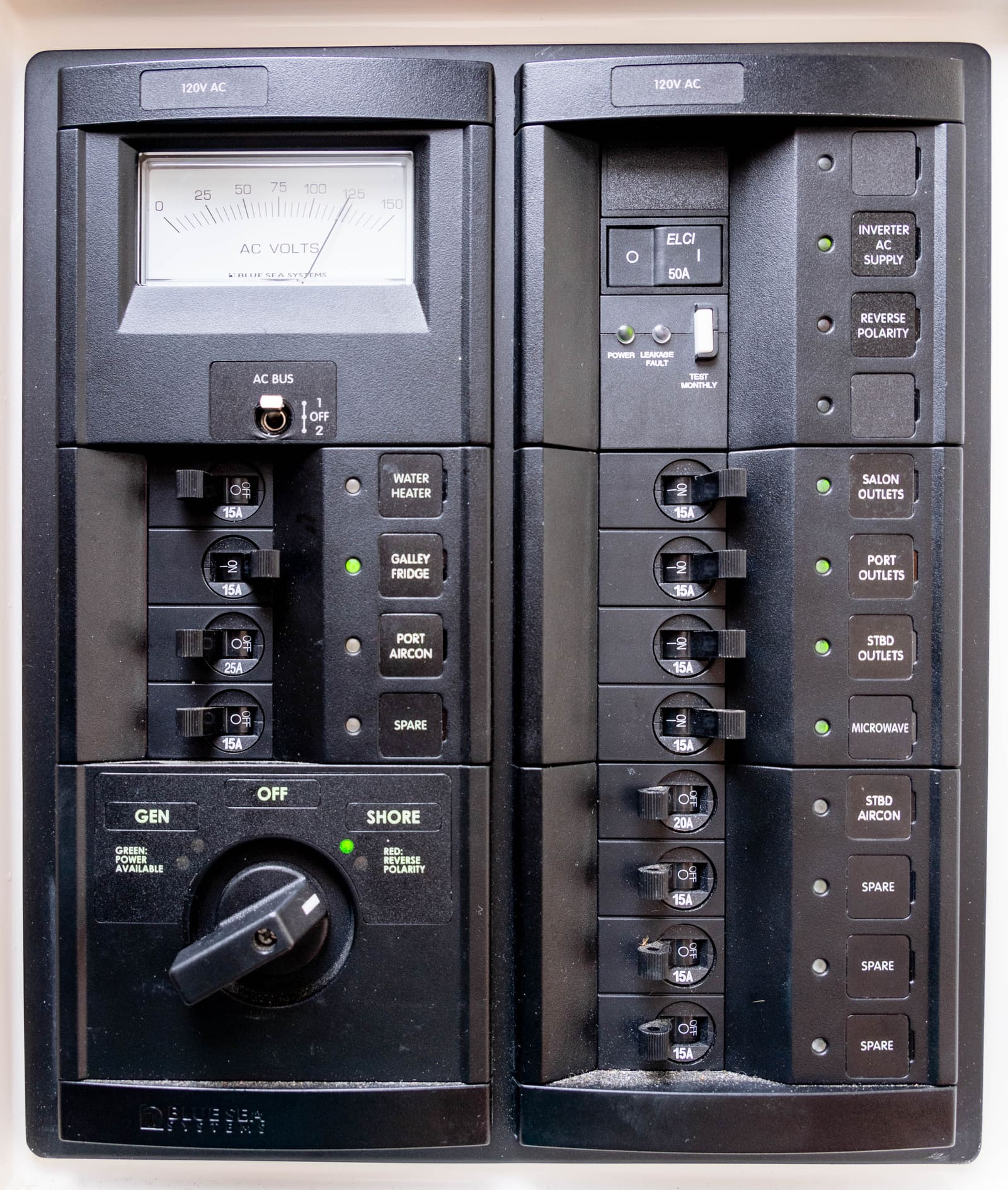
On this 120-volt panel the water heater has its own breaker, and the selector below must be set to shore or generator. Check both before anything else. Photo: Craig Stanfill / Wikimedia Commons · CC BY-SA 2.0 Many owners switch the heater breaker off to save power or when the generator is small, then forget. A tag on the breaker solves that.
Many heaters have a manual-reset safety switch that trips if the tank gets too hot, for example after running with low water or after winter recommissioning. With the breaker off, check your manual for where the reset button is and whether it can be reached without removing a live cover. If the manual shows it under the electrical cover, have a technician do it. If it trips more than once, something is wrong (low water, a failing thermostat or a stuck relay) and a pro needs to find out why.
A heater that was bypassed for winter and never put back will give you cold water from the hot tap. Check that the bypass valves are in the normal position, the inlet and outlet valves are open, and that water flows steadily from a hot faucet with no air spurts. BoatUS reminds owners to never power the element until a steady stream comes from the hot tap.
If the tank feels hot but the hot taps are only lukewarm, the mixing valve may be stuck or set too cool. With the breaker off and the water cooled, look for the adjustment knob (if your model has one) and see your manual for the procedure. A mixing valve that will not adjust usually gets replaced; it is plumbing, not electrical, but use only the part your heater maker specifies.
If the breaker holds, the tank is full and the water still never heats at the dock, the element, thermostat or wiring is the usual cause. Testing them means working near live 120- or 240-volt terminals, and replacing an element means draining the tank and sealing a new gasket. Book a marine electrician. Tell them the breaker status, whether the reset button trips, and the heater make and model so they can bring the right parts.
If dock heating works but engine heating does not, feel or use an infrared thermometer on the two hoses at the heater with the engine fully warm (boat in the water; an inboard or sterndrive never runs without its cooling water supply). Both should be hot. If they are cool:
- Check the engine coolant level (cold engine only; see the closed cooling guide). A low level lets air into the coil.
- Look for closed valves on the heater hoses.
- Make sure the engine actually reaches operating temperature; a stuck-open thermostat keeps coolant lukewarm.
Air trapped in the heater coil is the classic reason for no engine heat, especially after coolant work or when the heater sits higher than the engine. Practical Sailor explains why: the engine's coolant pump is not self-bleeding, so a pocket of air at a high loop can stop circulation through the coil, and makers often want the heater at or below engine level for that reason. Your engine or heater manual should show the bleed screw or procedure. Some installations with a heater above the engine need a remote expansion tank, which Raritan also mentions. If you cannot clear the air, a mechanic can.
The T&P relief valve opens if pressure or temperature gets too high. A valve that drips constantly may have a worn seal, debris on the seat, or it may be doing its job because pressure really is too high (often from thermal expansion when a check valve traps the heated water). Look at the valve and its discharge hose:
- The outlet should be piped to a safe place, such as the bilge, so hot water cannot spray someone.
- Lift the test lever briefly only if your manual says to, standing clear of the outlet; BoatUS suggests checking afterward that it is not dribbling. Raritan's owner's manual asks owners to lift the lever at least once a year so mineral deposits cannot seal it shut, to confirm a discharge hose is connected first, and to switch the heater off and replace the valve right away if no water comes out.
- Drips only while the tank is heating? Raritan explains that a check valve on the cold line traps the water, so as it heats and expands the relief valve lets a little out. Its fix is a small expansion tank (accumulator) in the cold line after the check valve, not a new relief valve.
- If it keeps leaking, it must be replaced. Use the rating and part the heater maker specifies; marine valves are usually rated lower than household ones.
Glass-lined tanks often use a magnesium anode, usually built into the hot water outlet fitting. BoatUS recommends checking it every year at layup and replacing it if it is more than half gone; a smelly or discolored hot water supply can also be a sign. The job: breaker off, run hot water until it is cold, pump off, open faucets to relieve pressure, drain the tank below the outlet, unscrew the fitting, then install the new anode with thread tape. Stainless tanks without an anode skip this step. Raritan adds two practical points: the magnesium rod reaches well into the tank, so you need clear space in front of the fitting to pull it out, and how fast it wears depends on your water, so check it within the first year and set your schedule from what you find.
Electric side first: breaker off and tagged "HEATER EMPTY – DO NOT TURN ON." Let the tank cool. Then:
- Open the drain plug (or disconnect the cold inlet) and drain into the bilge or a bucket.
- Set the bypass valves, or join the inlet and outlet hoses with a bypass hose, so you do not fill the tank with gallons of antifreeze.
- Finish the rest of the freshwater system with the freshwater winterizing guide.
The engine coil is protected when the engine's closed cooling system has the right antifreeze mix. On a raw-water-cooled engine that sends seawater through the coil (uncommon), the coil must be drained or protected as part of engine winterizing; check with your mechanic.
Close the drain, remove the bypass, open a hot faucet and run the pump until the tank fills and water flows with no air. Only then remove the tag and switch the breaker on. Check every fitting, the relief valve and the drain plug for drips over the next hour, and look again after your first engine run.
Common mistakes
- Switching the heater on in spring before the tank is full, and burning out the element.
- Forgetting that the heater breaker was turned off to save power, then chasing a "broken" heater.
- Leaving the bypass in the winter position and wondering why the hot taps run cold.
- Capping or plugging a dripping relief valve instead of finding the cause and replacing it.
- Replacing a dead element over and over without finding why the tank ran dry or the element shorted.
- Draining coolant from the engine and refilling without bleeding the heater loop, then getting no hot water underway (or an engine that runs hot because of air in the system).
- Using a household relief valve or plastic fittings at the heater. Raritan recommends metal fittings for water heater plumbing.
When to call a pro
- The breaker trips again as soon as you reset it, or the high-limit reset keeps tripping
- Any work inside the electrical cover: element, thermostat, wiring or reverse polarity problems
- The tank itself leaks, or the relief valve keeps dripping after replacement
- The engine runs hot, or you cannot clear air from the engine coil
- You smell burning, see scorched wires, or feel a tingle from any faucet or metal fitting (stop, switch off shore power and call a marine electrician)
- The heater also runs on propane or diesel; follow that system's safety rules and call a certified technician
Tips
- Label the bypass valves "NORMAL" and "WINTER" and the breaker "Fill tank first."
- If your heater has no mixing valve, keep the thermostat moderate. Water from the engine coil can be scalding.
- The tank is for fresh water only. Raritan warns that salt water in the tank damages internal parts and voids the warranty, so never cross-connect a washdown or seawater line to the hot water system. Its heaters also need a pressurized water system (they will not work on a gravity-fed tank) and must be mounted the way the installation manual shows.
- Put the anode check on your fall layup list in BoatMend; it is a cheap part that protects an expensive tank.
- Take a photo of the heater's label and plumbing before winter so spring is easy.
Official references
We read these to write this guide. Your engine's own manual always wins.
- BoatUS – Replacing Your Boat's Water Heater Anode
- Practical Sailor – Installing Water Heaters
- Raritan Engineering – 1700 Marine Water Heater
- Raritan Engineering Blog – 1700 Series Marine Water Heater
- BoatUS – How to Winterize Boat Plumbing
- Raritan – Water Heater Owner's Manual, maintenance page (online HTML version)
Safety: BoatMend is for information only and does not replace a certified marine technician. You are responsible for your safety and your boat. Read the full disclaimer.
Last updated 2026-10-24
Related guides
How to Winterize (and Recommission) Your Boat's Freshwater System
Protect the tank, pump, water heater, faucets and showers from freeze damage with non-toxic antifreeze, then flush and sanitize everything in the spring so the water is clean again. A cracked pump or split fitting is a common, avoidable winter repair bill.
Shore Power Safety: Cords, Inlets, Burned Plugs and Electric Shock Drowning
An owner's inspection routine for your shore power cord, plugs, boat inlet, galvanic isolator and ground-fault protection, plus the right way to plug in and the facts about Electric Shock Drowning. This guide is for looking and testing only; any electrical repair belongs to an ABYC-certified marine electrician.
How to Check and Change Coolant in a Closed Cooling System
Check, test and change the coolant in a freshwater-cooled (closed cooling) inboard, sterndrive or diesel, and learn the heat exchanger basics that keep it working. Old coolant quietly eats hoses, pumps and engine passages, and many boats go a decade without a change.
Spring Commissioning - Getting Your Boat Ready for the Season
Wake your boat up after storage with a step-by-step check of the battery, fuel system, engine, drive and safety gear. Catching a cracked hose or dead battery in the driveway beats a tow on opening weekend, and saves a typical shop commissioning fee.
Marine Generator Routine Maintenance and CO Safety
Keep an Onan, Kohler/Rehlko, Northern Lights, Westerbeke or similar marine generator reliable with regular checks of oil, raw-water cooling, fuel, exhaust and the start battery, plus a monthly run under load. Generator exhaust is a leading source of carbon monoxide on boats, so safety checks come first.
How to Inspect and Replace Sacrificial Anodes (Zincs)
Check the anodes on your outboard, sterndrive or inboard running gear, replace them when they are half gone, and choose the right metal for the water you boat in. Fresh anodes are cheap insurance against expensive corrosion damage to your lower unit, drive and prop.
How to Winterize a Marine Diesel Inboard (Sailboat or Trawler)
Lay up a marine diesel for winter the way the engine makers describe it, covering fresh oil, a full and treated fuel tank, antifreeze through the raw-water side, the impeller out, the coolant checked, openings plugged and the battery cared for. Freeze damage to a diesel's raw-water circuit is one of the most expensive and most avoidable winter repairs.