How to Check and Test a Gasoline Vapor (Fume) Detector
A gasoline vapor detector sniffs the bilge all the time and sounds an alarm long before fumes can explode. Learn how these detectors work, where the sensor belongs, how to test the system the way its maker says, what causes false alarms, what to do when it goes off, and why it never replaces the blower and your own sniff test.
Time
30 min
Shop would charge
$150-450
Applies to
Sterndrive (I/O), Gas inboard
Safety first: Treat every vapor alarm as real until you prove otherwise. When it sounds: don't start the engine or touch any switch, shut down if the engine is running, get everyone out of the cabin and off the boat if you can, open hatches to ventilate, and look for the leak only from outside the space. If you smell gas or see fuel, call a marine technician; on the water, put on life jackets and call the USCG on VHF 16 or dial 911. Never test a sensor with gasoline, a gas-soaked rag or an open fuel container.
Fuel smell, water coming in, CO alarm or smoke? Stop, get everyone in life jackets and call USCG on VHF 16 or 911. For a tow: Sea Tow or TowBoatUS.
Owners often ask
- My fume detector alarm keeps going off but I can not smell gas. What should I do?
- How do I test my gas fume detector, and how often should the sensor be replaced?
This guide walks you through it. Still stuck? Ask the AI Mechanic about your engine.
Tools
- Your detector's owner's manual (download it from the maker if it's lost)
- Flashlight
- Unlit butane lighter, only if your detector's manual calls for it as a test gas
- Clean, dry rag
Parts & supplies
- Replacement sensor made for your detector model (when due or after it gets wet)
Before you start
Gasoline vapor is heavier than air. It sinks into the lowest part of the bilge, where your nose in the cockpit can't smell it. A vapor detector (also called a fume detector or "sniffer") has two parts:
- A sensor mounted in the engine compartment bilge.
- A display at the helm with lights and a horn.
BoatUS explains that gasoline vapor can explode at roughly 1.5% of the air by volume, and detectors alarm at about 20% of that level (20% of the "lower explosive limit"), so you get a warning while there's still time to act. BoatUS recommends a vapor detector on any boat with a gasoline tank below decks or a propane system, and suggests choosing one listed to UL 2034.
Fireboy-Xintex points out why a blower alone isn't enough: a fuel leak makes new fumes as fast as the blower clears them, and the blower normally runs only before start-up, so it doesn't protect you from a spark later on. A detector watches the whole time the system is powered.
This guide is for checking and testing an existing detector. Wiring a new one is a moderate DIY job if you follow its installation manual, but keep the sensor location and cable rules below in mind.
Steps
Look at the helm for a small panel labeled "fume," "vapor" or "gasoline" detector, usually with green, yellow and red lights and a test or reset button. Note the brand and model and download the manual. Testing and sensor replacement vary by maker, so the manual comes first.
Most units use a similar pattern (check yours):
- Green: powered and working.
- Yellow (fault): a wiring problem or a disconnected or failed sensor.
- Red with horn (danger): vapor at the alarm level. On many units, the horn can be silenced for a short time but comes back while vapor is still there. A red light means the problem is not solved.
With the detector powered (often whenever the battery switch or ignition is on), press the test button. On many units the lights cycle and the horn sounds. No horn or no lights means the display, fuse or power wiring needs attention before you trust it.
Open the engine hatch and find the sensor (a small round or square puck on a cable). BoatUS advises mounting it in the engine-space bilge as low as possible, but above the normal slosh height of bilge water, because the sensor is not waterproof. One maker's rule of thumb is no lower than the starter solenoid. Also check that:
- It's away from the hottest parts of the engine, such as exhaust manifolds, which can damage it.
- It's not where washdown water or spray hits it.
- If the boat has a second sensor (some have one under a cabin sole or near the tank), it follows the same rules. A sensor mounted high on a bulkhead will smell vapor late. If yours is badly placed, have it moved.
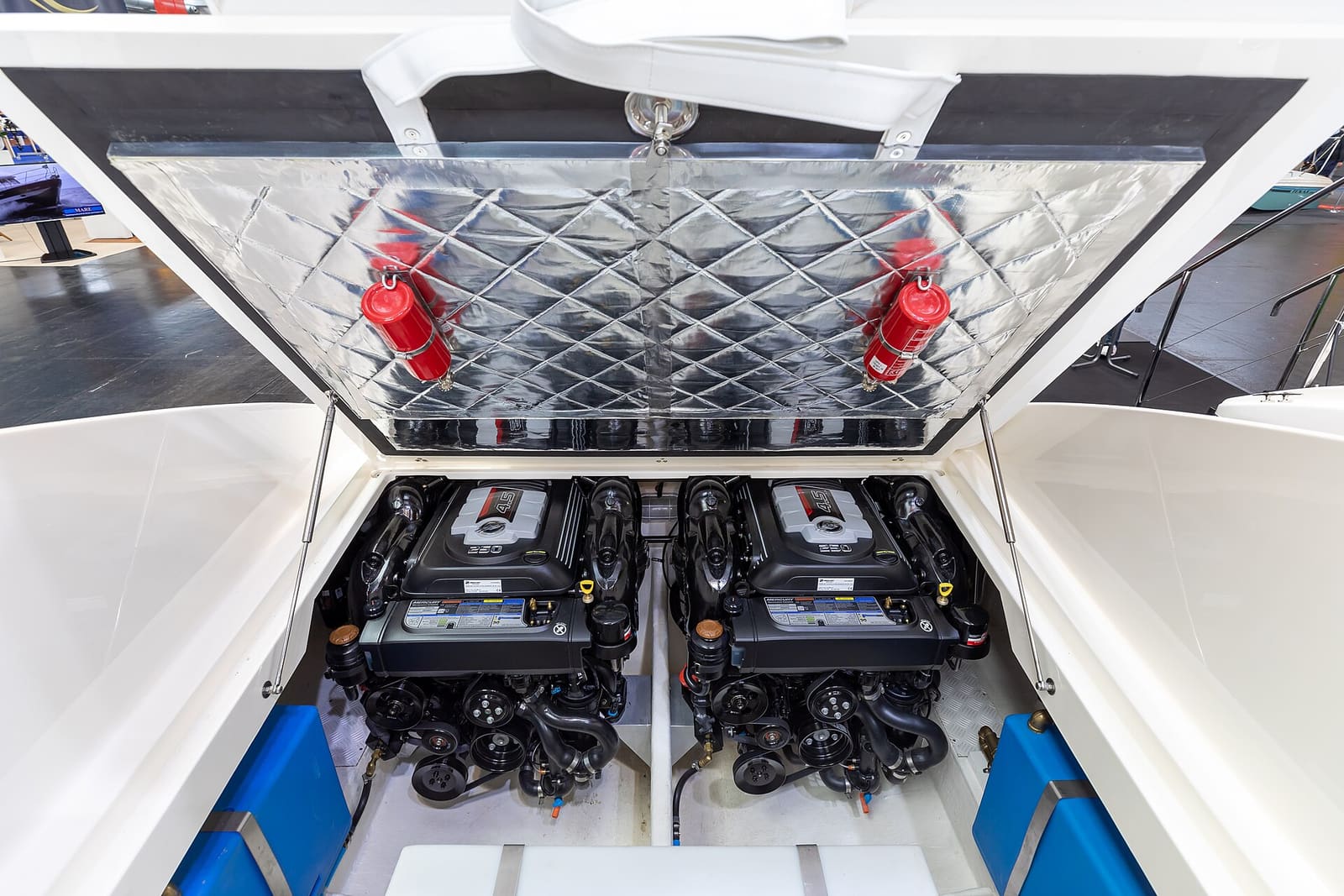
In an engine space like this, vapor sinks to the lowest part of the bilge. The sensor belongs down there, above the normal bilge water and away from the hot exhaust manifolds. Photo: Matti Blume / Wikimedia Commons · CC BY-SA 4.0 Follow the sensor cable to the display. Look for chafe, pinched spots and corroded plugs. BoatUS notes the sensor cable usually can't be cut or shortened, because its length is part of the calibration; coil extra cable neatly instead. Many units show a yellow fault light if the sensor is unplugged; that is one way your manual may tell you to check the fault circuit.
Use only the test method in your manual. Some makers say to hold an unlit butane lighter next to the sensor and press the button to release a little gas; within seconds the red light and horn should come on, then clear about a minute after you take it away. Do this with the engine off and nothing else running in the space, and never use gasoline. If the alarm doesn't trip, the sensor is not doing its job.
- BoatUS suggests testing vapor alarms monthly, using the maker's procedure.
- Sensors wear out in the marine environment. BoatUS advises replacing them after no more than five years; one maker recommends every three to four years. Follow your manual.
- Replace a sensor right away if it has been underwater or soaked. Mark the install date on the sensor cable with a tag.
Some detectors switch on the bilge blower automatically when they sense vapor. If yours does, the alarm test in step 6 should start the blower too. The blower must be ignition protected (made not to spark), as all electrical gear in a gas engine space must be.
The detector is an extra layer, not a replacement. Federal rules require boats with gasoline inboard and sterndrive engines in closed compartments to have a blower and a label near the ignition telling you to run it for four minutes and check the bilge for vapor before starting. BoatUS adds: sniff the engine compartment and bilge, especially around the tank, after every fueling and before every start. Detector makers say the same thing: their units supplement normal safety practices.
First assume the alarm is real and follow the safety box. Once you are sure there is no fuel leak, common causes of nuisance alarms include:
- Solvent, paint, adhesive or degreaser fumes after work in the bilge.
- Bilge cleaners, alcohol or aerosol sprays.
- Hydrogen given off by batteries while charging; some sensor makers warn against mounting sensors near or above batteries.
- Exhaust fumes drawn into the engine space.
- A wet, dirty or old sensor, or a weak connection. Ventilate, clean up the source, and test again. If alarms keep happening with no cause, replace the sensor or have the system checked. Never unplug a detector because it is "annoying".
Follow the safety box. BoatUS advises shutting down the engine, turning off the battery switch, opening the engine compartment and looking for the source. A blower can help clear vapor from a small leak, but it won't remove liquid gasoline. With a large spill at the dock, get everyone off and call 911; don't run anything electrical, including the blower. On the water, use a cellphone or a handheld VHF away from the fumes rather than a fixed radio, keep everyone in life jackets toward the bow, and call for help.
One more warning sign, even with no alarm: an engine that refuses to start right after fueling. BoatUS explains that a leaking fill hose can make the bilge vapor too rich to burn inside the engine; as fresh air mixes in, for example when someone opens the engine hatch, it drops into the explosive range and a spark from the starter or a switch can set it off. Stop cranking and check for a spill. See Fuel Fill and Vent Hoses. BoatUS reports that boats with older fill hoses have exploded right after refueling, including a cruiser that blew up leaving the fuel dock when the owner restarted an engine that had stalled. Its fueling routine helps the detector do its job: engines, motors and stoves off and the battery switch off while fueling, hatches and ports closed so fumes stay out, then open everything, air out and sniff before starting.
Write the test date and result in your boat log each time. It's a simple habit that shows when the sensor is getting old and gives a surveyor or insurer proof that the system works.
Common mistakes
- Testing with a gasoline-soaked rag (an ignition risk and a way to ruin the sensor).
- Mounting the sensor high "so it stays dry," where it can't smell sinking vapor.
- Cutting or splicing the sensor cable.
- Unplugging a detector after a few nuisance alarms.
- Treating the detector as a reason to skip the blower and the sniff test.
- Never replacing the original sensor on an older boat.
When to call a pro
- Any alarm you can't explain, any gas smell, or fuel in the bilge.
- The display won't self-test, the fault light stays on, or the sensor doesn't respond to the maker's test.
- Installing a new detector or moving a sensor if you're not comfortable with 12-volt wiring.
- After any fuel system repair, before the boat goes back in service.
- On the water with a fuel leak: shut down, life jackets on, call the USCG on VHF 16 or 911.
Tips
- Keep the detector manual in your boat binder with a note of the sensor install date.
- If your boat also has a propane system, it needs its own propane sensor mounted low near the appliances; see the propane safety guide.
- A vapor detector does not detect carbon monoxide. Boats with enclosed cabins also need a CO detector.
Official references
We read these to write this guide. Your engine's own manual always wins.
- BoatUS – Electronic Detectors for Your Boat
- BoatUS – Dangerous Gases Aboard
- Fireboy-Xintex – Gasoline / Petrol Fume Detectors
- BoatUS – Three Alarms That Can Save Your Boat (vapor, smoke and high-water alarms)
- eCFR – 33 CFR 183.610, Powered Ventilation System (blower and warning label)
- BoatUS – Gasoline Refueling Dangers (explosions right after fueling)
- BoatUS – Your Boat's On Fire, Now What? (remote helm alarms)
Safety: BoatMend is for information only and does not replace a certified marine technician. You are responsible for your safety and your boat. Read the full disclaimer.
Last updated 2026-10-25
Related guides
Bilge Blower and Engine Compartment Ventilation on Gas Inboards and Sterndrives
Learn why gas boats have a "run the blower 4 minutes" label, how to check that the blower and vent ducts actually move air out of the engine compartment, and how to replace a blower safely with an ignition-protected marine unit.
How to Refuel a Boat Safely (Gas Dock, Gas Station and Portable Tanks)
A step-by-step fueling routine that keeps gasoline vapor out of your bilge and fuel out of the water: shut everything down, close up, keep the nozzle in contact, stop short of full, ventilate, run the blower and sniff before you start. Includes portable tanks, personal watercraft and what to do about a spill.
Fuel Smell on Board: What to Do and How to Find the Source
A gasoline smell on a boat is a fire and explosion warning. Learn what to do in the first minutes, the most common sources (fill and vent hoses, tank fittings, fuel lines, carburetors and injectors, overfilling), how to look safely, and when to stop and call a pro.
How to Inspect Your Boat's Fuel Tank, Fill, Vent and Hoses
A leaking gas tank is one of the most dangerous problems a boat can have, and it usually starts out of sight. Learn how to inspect portable and built-in tanks, spot aluminum tanks corroding from below, know the ethanol risk for old fiberglass tanks, and check the fill, vent, hoses, clamps and sender, plus why tank replacement is a job for a pro.
How to Inspect and Replace Boat Fuel Fill and Vent Hoses
Old fill and vent hoses crack, go soft and leak gasoline into the bilge, often where you can't see them. Learn the signs of aging, which USCG hose types (A1, A2, B1, B2) belong on fill and vent lines, why fill hoses need two clamps at each end, how to check the vent fitting, flame arrester and anti-spill devices, and how a careful replacement is done.
Carbon Monoxide on Boats: Where It Comes From, CO Alarms and Warning Signs
Carbon monoxide can build up in cabins, under canvas and around the swim platform, and its first symptoms look like seasickness. Learn the danger zones, where to mount marine CO alarms, how to test and replace them, and exactly what to do if an alarm sounds or someone feels sick.
Propane (LPG) Safety on Boats - Locker, Solenoid, Sniffer and Leak Test
Learn why leaking propane sinks into the bilge, how to inspect the locker, cylinders, hoses, solenoid and gas alarm, and how to run a simple leak test. Repairs to a propane system belong to a qualified marine technician.
How to Check, Mount and Replace Boat Fire Extinguishers
A monthly five-minute check of every fire extinguisher aboard, plus how the 2022 Coast Guard rule changes affect you, where to mount them, and when to recharge or replace. A boat fire spreads in seconds, and an extinguisher with a dead gauge, missing pin or expired date will not help you or pass a boarding.