How to Get Rid of an Old Boat: Sell, Donate, Turn In or Scrap It the Right Way
An old boat nobody wants can cost you money for years. Learn your real options (selling as-is, donating, state vessel turn-in programs, landfill or dismantling), the tax rules on donations, how to cut your name off the registration and title, and why you should never abandon a boat.

Time
4 h
Applies to
All engines
Safety first: Never abandon, sink or "lose" a boat to get rid of it. It is illegal everywhere in the US, it pollutes, it endangers other boaters, and you can still be billed for the removal. Before any boat is hauled, cut up or crushed, the fuel, oil, batteries and other hazardous materials must come out. If you smell gasoline or see fuel in the bilge, stop: no sparks, no power tools, ventilate, and call a marine technician. Never cut into a hull with a saw near a fuel tank or fuel lines.
Owners often ask
- My old boat is worth nothing and nobody wants it. Is there a free way to get rid of it legally?
- I gave my old boat away. How do I make sure it is out of my name if the new owner never registers it?
- How does a big boat that's too large to trailer get disposed of, and who pays if the owner walks away?
This guide walks you through it. Still stuck? Ask the AI Mechanic about your engine.
Tools
- Phone camera (photos for listings, applications and your records)
- Folder for the title, registration, bill of sale and receipts
- Approved fuel containers and a hand pump (to remove fuel)
- Basic hand tools for removing electronics, batteries and hardware
- Gloves and safety glasses
Parts & supplies
- Bill of sale form (your state's form if it has one)
- Your state's notice-of-sale or transfer form (if it has one)
Before you start
Getting rid of a boat is mostly paperwork and planning. The order that usually saves the most money is: sell it → give it away → donate it → state turn-in program → dismantle and dispose of it yourself or through a yard. Each step down costs you a little more time or money, but every one of them is better than letting the boat rot.
Gather these first:
- The title (or the registration card and your bill of sale in states that don't title boats). Trailers and, in some states, outboard motors have their own titles.
- The HIN (hull identification number) on the upper right of the transom.
- Proof any loan is paid off. A boat with a lien on the title can't be sold, donated or turned in cleanly until the lender releases it.
- Federally documented boat? Documentation is handled by the Coast Guard's National Vessel Documentation Center, not your state. Contact them when you sell or scrap the boat so the record is updated.
Steps
Be honest. Look at listings for the same make, size and age in your area, and remember that a boat that hasn't run in years may be worth little or nothing. Discover Boating points out that condition, region and season all move the price, and that buyers pay more in spring than in late fall. If the cost of fixing it is more than the boat would sell for, plan for one of the lower options below.
Clean it out, take good photos, and describe it honestly: "runs" or "doesn't run," known problems, and what comes with it (motor, trailer, electronics). Write "sold as-is, no warranty" on the bill of sale. A boat with a good trailer often sells on the strength of the trailer alone. Part out valuable items (electronics, the motor, a good trailer) if the hull itself has no value. See the boat sale records guide for what buyers will ask for.
A free boat finds takers fast. The catch is that you stay responsible until the record leaves your name. Washington DNR warns that without proof you sold or gave the boat away, you can still be held liable for removal and disposal costs if the new owner abandons it. Do these every time:
- Use a written bill of sale (even for $0 or $1) with the new owner's printed name, signature, address and phone.
- Sign over the title the way your state requires.
- File your state's notice of sale (step 9) the same day.
- If you can, go to the licensing office with the new owner and watch the boat get titled in their name.
Some charities accept boats, but many quietly sell them at auction. Check the group is a qualified organization (the IRS Tax Exempt Organization Search, linked from Publication 526, does this). The IRS rules in Publication 526 for donated cars, boats and airplanes, in plain terms:
- If you claim more than $500, your deduction is usually limited to what the charity sells the boat for (the "gross proceeds"), not what you think it is worth.
- You need Form 1098-C from the charity, and you must attach it to your return. Without it, the IRS says you can't deduct the gift. The charity has 30 days after the sale to send it.
- There are two exceptions where you can deduct fair market value: the charity makes significant use of or materially improves the boat first, or gives it (or sells it far below value) to a needy person. Form 1098-C shows whether an exception applies. Selling at auction never qualifies.
- If the charity sells it for $500 or less, different limits apply, and for a boat worth $250 to $500 you need a written acknowledgment from the charity.
- The IRS says boats other than small, inexpensive ones should be valued by a marine surveyor or appraiser.
- You only benefit if you itemize deductions.
Tax rules change and depend on your situation, so ask a tax professional before you rely on a deduction. Donating is still a clean way out if the charity handles the title transfer correctly; keep copies of everything.
Several states pay to remove unwanted boats before they become derelict, because that is far cheaper than pulling a sunken wreck later. Rules and funding change every year, so always check the current program page:
- California: The Vessel Turn-In Program (VTIP) lets owners surrender unwanted recreational boats free of charge through local agencies (harbor departments, cities, regional agencies) that receive grants from the state's Division of Boating and Waterways. You must be the registered owner, and the City of Newport Beach requires a title free of loans, liens and taxes. Commercial vessels are not covered. You apply to a participating agency, not directly to the state. The Richardson Bay Regional Agency, for example, asks for a release form plus a copy of your title.
- Florida: State law (s. 327.4107) lets the FWC run a turn-in program for owners whose boats law enforcement has found at risk of becoming derelict. The owner signs the boat and title over to be destroyed without penalty. It is aimed at boats that have already been cited, depends on state funding, and is not a general free disposal service. Check the FWC derelict vessel pages for the current rules.
- Washington: The DNR Vessel Turn-in Program takes boats that are likely to become derelict soon. You fill out an eligibility form and application; applications are ranked by risk to safety and the environment, so there may be a wait.
- Other states: Search "[your state] vessel turn-in program" or call your state boating agency or the nearest harbor master. Some counties also run boat and trailer recycling days.
Whether the boat goes to a turn-in program, a landfill or a scrapyard, someone will require this. Washington DNR notes that most landfills want oil, fuel, batteries and refrigerators removed before they will accept a boat.
- Fuel: pump it into approved containers outdoors, away from sparks. Old or water-contaminated fuel goes to a household hazardous waste site. Portable tanks leave the boat.
- Engine oil, gear oil, coolant and hydraulic fluid: drain into sealed containers and recycle at an auto parts store or hazardous waste site.
- Batteries: remove and recycle (most battery sellers take them).
- Expired flares, paint, solvents and cleaners: follow the flare disposal guide and your local hazardous waste rules.
- Propane cylinders, fire extinguishers, holding tank contents: remove, pump out at a pump-out station and dispose of properly.
- Oily bilge water: don't pump it overboard; see the bilge oil spill cleanup guide.
Before the hull goes, take off anything worth money: electronics, the motor, props, stainless and aluminum hardware, rails, T-tops and the trailer. Washington DNR points out that engines and boat trailers can go to a metal recycler. Sell good parts online; scrap the rest by metal type.
Fiberglass hulls are hard to recycle, so most end up in a landfill after stripping. Your options:
- Landfill or transfer station: call first. Ask about size limits, required paperwork (proof of ownership is often needed), fees and whether they need the hull cut up.
- Cut it up yourself: on land only, after every hazardous item is out. Washington DNR describes renting a dumpster and dismantling the boat with a saw. Note that cutting up a boat on a beach is not legal in Washington without permits, and similar rules exist elsewhere. Wear a respirator; fiberglass dust is an irritant.
- Boatyard or salvage contractor: some will haul, dismantle and dispose of the boat for a fee. A boat in the water that doesn't run needs a tow or a haul-out first.
- Big boats (too large to trailer): owners often ask how a 35- to 50-foot boat that nobody wants ever goes away. Usually a salvage company hauls it, breaks it up with heavy equipment and charges by the foot plus equipment, barge and disposal fees, which can run into five figures. If the owner walks away, the marina or the state pays first and then bills the owner of record. Get written quotes while the boat still floats; a sunken one costs far more.
- Recycling: the BoatUS Foundation is pushing for more sustainable disposal options that keep fiberglass boats out of landfills, but true hull recycling is still rare. The NOAA Marine Debris Program publishes a guide, developed with the Rhode Island Marine Trades Association, on recycling fiberglass from end-of-life boats through turn-in and derelict-vessel programs, covering preparation, dismantling, transport and finding partners. Ask your state boating agency whether anything like it exists near you.
Keep every receipt and disposal ticket; it proves what happened to the boat.
This is the step people forget, and it's the one that comes back to bite them. Rules differ by state:
- California: the DMV says you must file a Notice of Transfer and Release of Liability within 5 calendar days of selling or transferring a vessel (it uses the vessel's CF number and HIN). Only the buyer's title transfer actually removes your name, so keep the NRL confirmation.
- Texas: state law requires the recorded owner to notify Texas Parks and Wildlife within 20 days of a sale, donation or gift, or of the destruction or disposal of the boat.
- Other states: look for a "notice of sale," "release of liability" or "vessel transfer notification" form, and ask how to report a boat that was scrapped or turned in.
- Remove or cover the registration numbers and validation decals on a boat you scrapped, and cancel any remaining registration renewal if your state allows it.
- Cancel the insurance only after the transfer or disposal is done and recorded.
Abandoned and derelict boats are a national problem. BoatUS describes them as boats that are unseaworthy from neglect and left by owners unwilling or unable to deal with them; the common reasons are the high cost of disposal and a lack of options. Leaving a boat behind does not end your responsibility:
- The City of Newport Beach warns that abandoning or sinking a boat in California is illegal, with fines of $1,000 to $3,000 plus the cost of removal and disposal.
- Removal of a sunken or derelict boat costs far more than disposal of one that is still afloat or on a trailer. BoatUS Magazine's report on the BoatU.S. Foundation's NOAA-funded removal grants puts typical removals at anywhere from a few thousand dollars to hundreds of thousands, and notes that the federal money covers coastal waters and the Great Lakes, with none for inland lakes and rivers. Don't count on a public program to clean up after an abandoned boat, and the owner on record may be the one who gets the bill.
- Grinding off the HIN to hide who owned the boat is not an option: federal rules (33 CFR 181.35) say no one may remove or alter it without Coast Guard authorization.
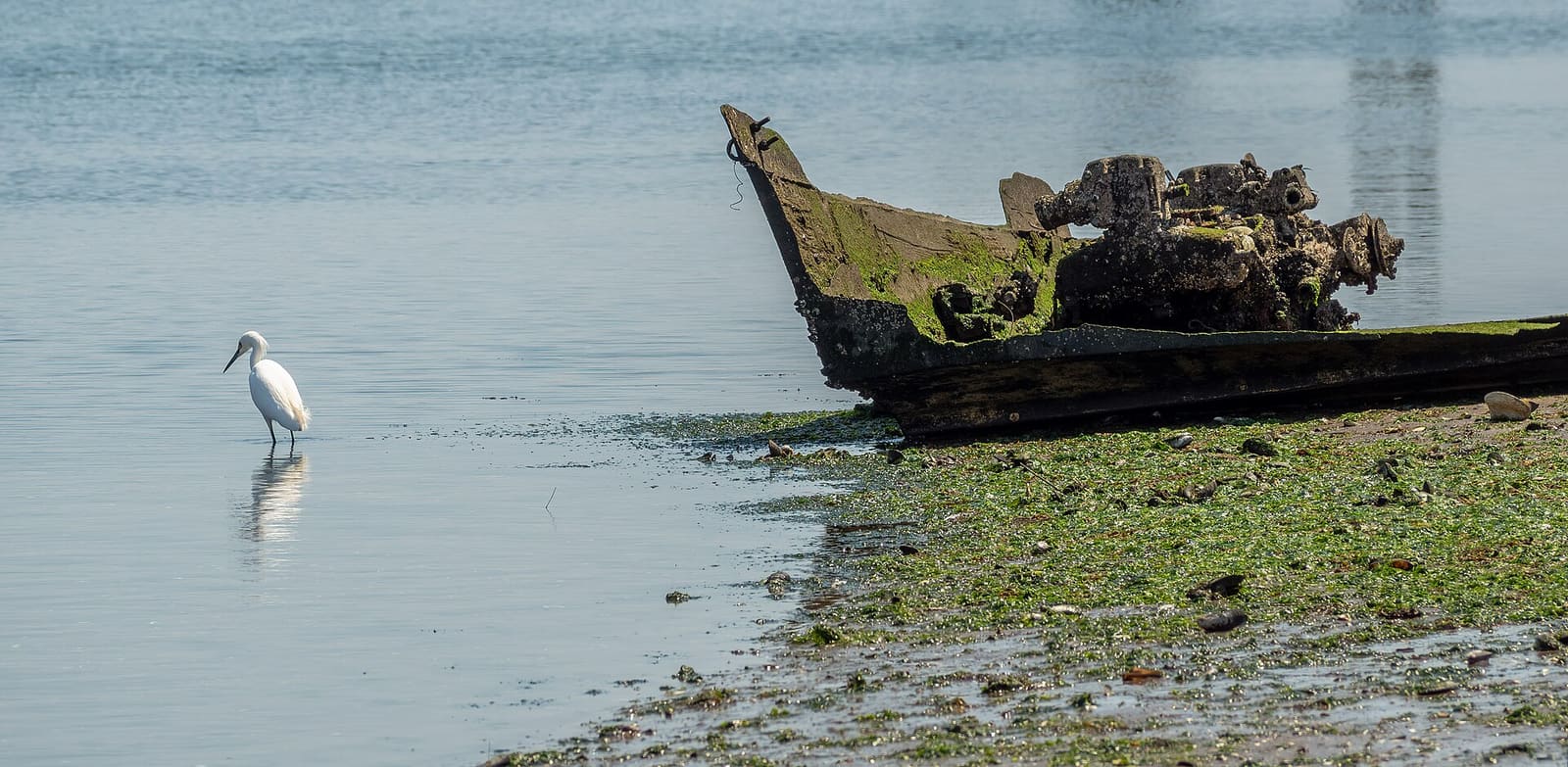
An abandoned boat breaking apart on the shore. Wrecks like this leak, become hazards and cost far more to remove than a planned disposal. Photo: Rhododendrites / Wikimedia Commons · CC BY-SA 4.0 If you see an abandoned boat, the BoatUS Foundation runs a national database where anyone can report it with photos and a location.
Store copies of the bill of sale, the signed title (front and back), the notice of sale confirmation, turn-in or disposal paperwork, and any Form 1098-C for several years. California's DMV notes that collection notices can show up months or years after a sale; your paperwork is your defense.
Common mistakes
- Handing over a signed title and never filing the notice of sale, then getting a bill when the buyer abandons the boat.
- Giving a boat away with no bill of sale "because it was free."
- Expecting a big tax deduction for a donated boat that the charity sells at auction for a few hundred dollars.
- Taking a boat to the landfill with fuel, oil or batteries still aboard and being turned away.
- Assuming a turn-in program will take any boat, any time; most have eligibility rules, waiting lists and limited funding.
- Forgetting the trailer has its own title and registration.
- Letting a boat sit at a marina or storage yard unpaid until it is sold for back fees (see the storage lien guide).
When to call a pro
- Fuel smell, fuel in the bilge, or a tank that must come out before disposal: a marine technician should drain and remove it.
- The boat is sinking, sunk or can't be moved safely: call a salvage or towing company (Sea Tow, TowBoatUS) or your harbor master. In an emergency on the water, call the USCG on VHF 16 or 911.
- The title is lost, has a lien, or the owner has died: your state titling agency or an attorney can explain the process.
- Large boats (cabin cruisers, sailboats with keels, anything you can't trailer): a boatyard or salvage contractor.
- Donations above a few thousand dollars: a tax professional and a marine surveyor for the appraisal.
Tips
- List the boat in early spring if you're trying to sell; buyers are scarce in late fall.
- Photograph the boat, the HIN and the signed paperwork on the day it leaves your property.
- Ask your marina or local boat dealer; they often know who takes old boats or runs turn-in days.
- Turn-in programs often open applications once a year when grant money arrives. Get on the list early.
Official references
We read these to write this guide. Your engine's own manual always wins.
- City of Newport Beach – Vessel Turn-In Program (California DBW program)
- Richardson Bay Regional Agency – Vessel Turn-In Program (California)
- Florida Statutes – s. 327.4107, Vessels at risk of becoming derelict (vessel turn-in program)
- Washington DNR – Vessel Turn-in Program (and other disposal options)
- IRS – Publication 526, Charitable Contributions (cars, boats and airplanes; Form 1098-C)
- California DMV – Notice of Transfer and Release of Liability (NRL)
- Texas Parks and Wildlife – Buying and Selling a Boat (owner notice within 20 days)
- BoatUS Foundation – Abandoned and Derelict Vessels (ADV) Program
- BoatUS – Derelict Boats (BoatU.S. Foundation NOAA removal grant, 2023)
- BoatUS – Tracking Trouble (national abandoned vessel database)
- Discover Boating – How to Sell a Boat
- eCFR – 33 CFR Part 181 Subpart C, Hull Identification Numbers (181.35, removal of numbers)
- NOAA Marine Debris Program – End-of-Life Vessel Material Management Guide (fiberglass recycling)
Safety: BoatMend is for information only and does not replace a certified marine technician. You are responsible for your safety and your boat. Read the full disclaimer.
Last updated 2026-10-25
Related guides

How to Get Your Boat Ready to Sell (Records, Title and Prep)
Prepare your boat for sale the way buyers and surveyors expect: gather the title, registration and HIN paperwork, organize your maintenance records and receipts, fix the small stuff, detail the boat, get it ready for a sea trial and buyer's survey, and close the deal with the right documents.
Used Boat Paperwork: Titles, Liens, HIN Checks, Bill of Sale and Registration
A practical checklist for the paperwork side of buying a used boat: state title or Coast Guard documentation, checking for liens and theft, verifying the hull ID number, writing a proper bill of sale, the trailer's own title, registering in your name, and transferring warranties and checking recalls. Rules vary by state, so confirm each step with your state agency.
Marina and Storage Liens: How Lien Sales Work, Buying a Lien-Sale Boat, and Not Losing Yours
How unpaid slip, storage or repair bills turn into a lien and then a sale, using Florida and California as examples; what an owner can do to stop it; and how a buyer checks that a lien-sale or abandoned boat comes with paperwork the state will actually title. Every state has its own process and deadlines, so confirm with your state agency.
Boat Registration Numbers and Validation Decals: Federal Display Rules, State Placement and Renewals
Display your state registration number and validation decal the way federal rules (33 CFR 173 and 174) and your state require: size, block style, contrast, spacing, placement on the forward half, decal position, what documented boats show instead (name and hailing port), what to carry aboard, and how to never miss a renewal. States add their own details, so check your state boating agency.
Salvage and Branded Title Boats: What They Mean, the Risks, and How to Check Before You Buy
Understand boats that an insurer declared a total loss: what salvage, rebuilt and hull-damaged title brands mean, why flood and storm boats hide expensive problems, how branded titles affect insurance, financing and resale, how to dig into a boat's history, and what a survey should check. Title branding rules differ a lot by state, and some states don't brand boat titles at all.
Visual Distress Signals: Flare Expiry, Storage, Practice and Safe Disposal
Make sure your flares, smoke signals, distress flag or electronic distress light meet the Coast Guard rules for day and night, are not past their 42-month date, and are stored where you can grab them. Then get rid of expired flares the safe and legal way instead of letting them pile up in a locker.
Portable Gas Cans and Fuel Storage: Filling, Storing at Home and Aboard, and Getting Rid of Old Gas
Gas cans and portable boat tanks are handy and dangerous in equal measure. Learn what makes a modern can compliant, why you always fill it on the ground, how to store gasoline at home and on the boat, how long ethanol fuel really lasts, and how to dispose of old gas legally.

Oil or Fuel in the Bilge: Safe, Legal Cleanup
What to do when you find oil, diesel or gasoline in your bilge. Soak it up with oil-only absorbents, keep it from being pumped overboard, dispose of it properly, report any sheen on the water to the National Response Center, and find the leak so it does not happen again.