Cabin Heater Safety Aboard: Diesel, Propane and Electric Heaters
Heat your cabin without poisoning the crew or burning the boat. Covers carbon monoxide alarms, exhaust and through-hull checks for diesel and propane heaters, fuel and ventilation, why household and camping heaters don't belong in a closed cabin, and how to use electric space heaters on shore power safely.
Time
1 h
Shop would charge
$200-600
Applies to
All engines · Cabin cruiser, Yacht, Sailboat
Safety first: Carbon monoxide (CO) has no smell or color and can kill sleeping people in a small cabin. If a CO alarm sounds, or anyone aboard has a headache, dizziness, nausea or unusual sleepiness while a heater, engine or generator is running, shut off the heater and all fuel-burning equipment, get everyone into fresh air right away and call 911 (or the Coast Guard on VHF channel 16 if you are underway). The Coast Guard says to treat seasickness-like symptoms as possible CO poisoning. If you smell propane or diesel fumes, shut the fuel off at the tank, do not touch electrical switches, get off the boat and call for help. Never sleep aboard with an unvented, portable or open-flame heater running.
Fuel smell, water coming in, CO alarm or smoke? Stop, get everyone in life jackets and call USCG on VHF 16 or 911. For a tow: Sea Tow or TowBoatUS.
Owners often ask
- Can I use a portable propane camping heater in my boat cabin overnight?
- Is it safe to leave an electric space heater running on my boat in winter?
This guide walks you through it. Still stuck? Ask the AI Mechanic about your engine.
Tools
- Flashlight
- Phone camera
- Spray bottle of soapy water (for propane joint checks)
- Digital multimeter (for checking heater supply voltage)
- Screwdrivers for access panels
Parts & supplies
- Marine-rated carbon monoxide alarms (UL 2034 with marine listing) for every sleeping area
- Replacement batteries for alarms, if battery powered
- Stainless hose clamps for heater ducting, if any are rusted
Before you start
Know what kind of heater you have.
- Diesel forced-air heater (Webasto, Eberspächer/Espar and similar): burns fuel in a sealed chamber, blows warm cabin air through ducts and pushes exhaust out through a pipe to a through-hull fitting. Usually needs 12 or 24 volts to run.
- Diesel or propane bulkhead heater: mounted on a bulkhead, with a flue (chimney) through the deck. Natural-draft models need no electricity; some propane models are fully sealed and use a small fan.
- Hydronic (hot-water) heater: burns diesel to heat coolant that runs to radiators or fan coils, common on larger yachts.
- Electric heaters: built-in units or reverse-cycle air conditioning that heat on shore power or a generator, and portable space heaters.
The two big dangers. Fuel-burning heaters can leak CO into the cabin if the exhaust, flue or installation is faulty. Electric heaters can overload shore power wiring and start fires. In winter, heaters are a leading cause of boat fires, as SpinSheet's winter safety article reminds boaters.
What owners can do. Check alarms, look over the visible exhaust, flue, fuel and wiring, keep vents clear and use heaters sensibly. Installation, internal repairs, burner service and gas work are for trained technicians. Webasto, for example, asks owners to use its marine installation partners for retrofits.
Steps
Before the heating season starts, make sure every sleeping area and the main cabin has a working marine-rated CO alarm (look for the UL 2034 listing with marine approval). The BoatUS Foundation suggests mounting them where people spend time and sleep, at about eye level, and away from hatches, doors and dead-air corners. Press the test button on each one. Replace alarms when they reach the end-of-life date printed on the unit or the alarm signals end of life. The Coast Guard's advice is simple: install alarms, maintain them, and never ignore one. See our CO detector guide for details.
Portable propane "camping" heaters, kerosene heaters, charcoal, barbecue grills and the gas stove are not cabin heaters. Even "indoor-safe" portable propane heaters burn cabin oxygen and release combustion gases into the space. Practical Sailor points to one popular portable LPG heater that carries a prominent warning against use in unventilated areas, and notes that safe LPG cabin heaters need a room-sealed design, where the air intake, flame and exhaust are all isolated from the cabin. The Coast Guard recommends using only fuel-burning devices that are certified or designed for marine use. Portable diesel heaters made for tents or workshops are just as unsuitable.
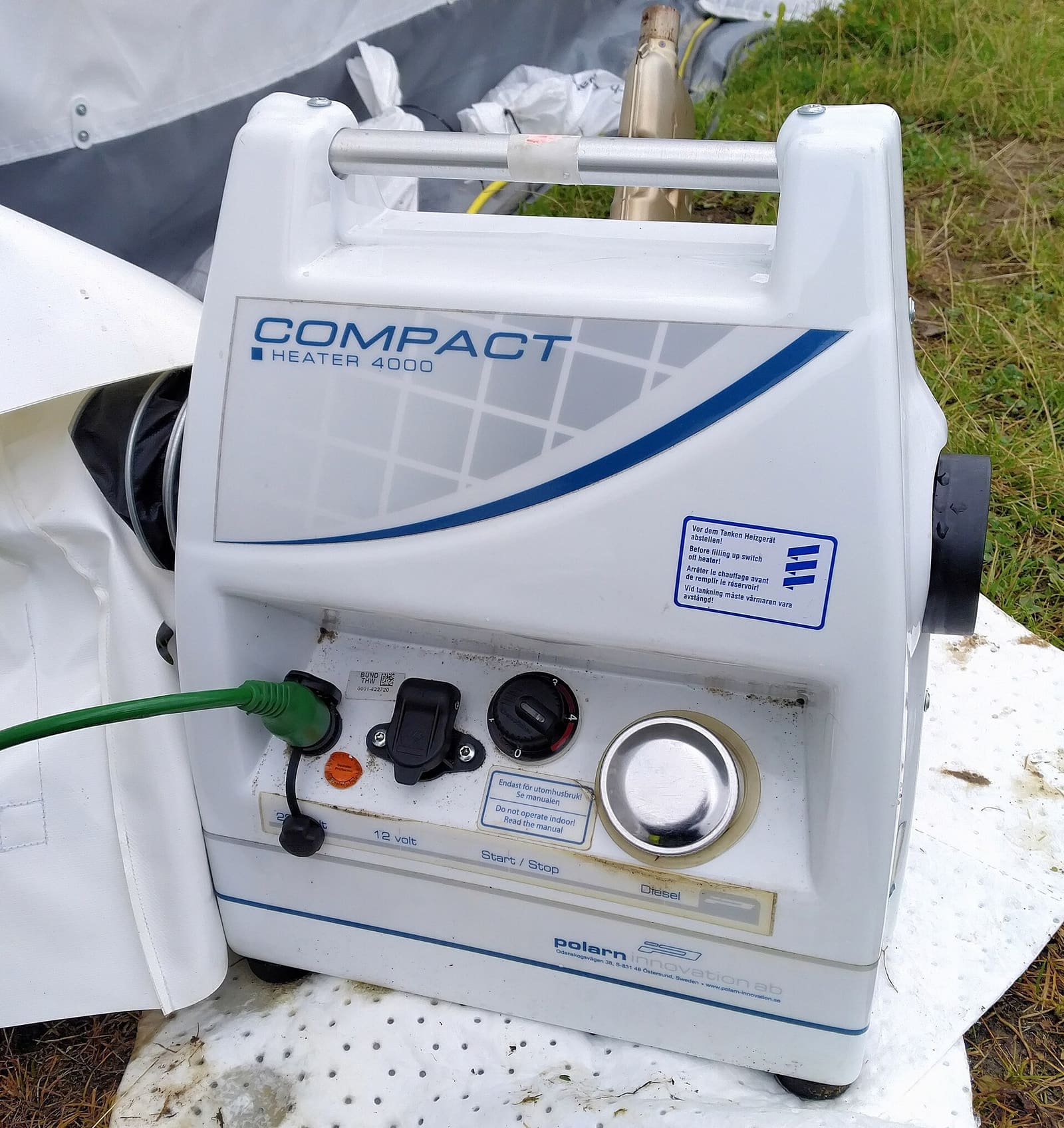
Photo: MAbW / Wikimedia Commons · CC BY-SA 4.0 In December 2019, two men died sleeping aboard the motor cruiser Diversion in York, England. The UK Marine Accident Investigation Branch found CO had leaked into the cabin from the diesel cabin heater's exhaust. The exhaust silencer was not designed for marine use and its joint was not gas-tight, the owner-fitted installation had never been checked by a professional heater installer or serviced, cabin ventilation was poor, and no CO alarm was fitted. Every one of those is something you can check on your own boat.
With the heater off and cool, follow the exhaust pipe from the heater to the through-hull:
- Every joint should be clamped tight with no gaps, soot marks or black stains around it
- The pipe should be the maker's marine exhaust pipe, with insulation or lagging where it passes near wood, wiring, fuel lines or people
- Look for crushed, kinked, cracked or rusted-through sections
- Any silencer must be the maker's approved marine part
- Outside, the through-hull fitting should be clear, not cracked, and not near an opening hatch, port or cockpit seating where exhaust can blow back in
If there is soot inside the boat, a smell of exhaust when the heater runs, or a loose or damaged section, do not use the heater until a technician fixes it.
Diesel heaters take combustion air from outside or from a separate space through an intake pipe. Make sure it is not blocked and is well away from the heater's own exhaust and from engine or generator exhaust; the MAIB has investigated other cases where engine exhaust was drawn into a heater intake and blown through the boat. Keep the boat's fixed vents (dorades, vented hatches and cabin vents) open when any fuel-burning heater runs, even in cold weather. Check that warm-air outlets and return grilles are not blocked by bedding, cushions or gear.
- Diesel heaters: look along the fuel line from the tank pickup to the heater pump and heater for drips, weeps, cracked hose or diesel smell. A heater that keeps failing to start or smokes may have air or water in its fuel line.
- Propane heaters: Practical Sailor's LPG safety guidance includes a tank solenoid tied to a gas sensor, a locker that drains overboard, one continuous gas line per appliance, and periodic leak checks with soapy water on joints. Brush soapy water on each joint you can reach; growing bubbles mean a leak. See our propane safety guide for the full routine, and never use a flame to look for leaks.
Forced-air diesel heaters draw a lot of current while starting and need good voltage to burn cleanly. With the heater running, measure voltage at its supply if you can reach a safe point. Low voltage can cause failed starts, smoky burns or error shutdowns. Make sure the heater has its own fuse or breaker, wires are secure with no chafe, and the control panel shows no stored fault codes. If it does, look the code up in the manual or call a dealer.
Start the heater from its control and stay with it for the first half hour of the season:
- A little smoke or smell on the first start after storage can be normal, but it should clear quickly
- Watch the exhaust outside: heavy or continuous smoke means a burner or fuel problem
- Inside, there should be no smell of exhaust or fuel
- Check the CO alarms stay quiet
If something seems wrong, shut it down and call a technician. Don't keep restarting a heater that is smoking or throwing faults.
For natural-draft diesel or propane bulkhead heaters:
- Check the flue pipe for rust, gaps and soot at joints, and the deck fitting for cracks and leaks
- Make sure the chimney cap is fitted and clear, and that it is the type your heater maker specifies for your location
- Keep the clearances to woodwork, curtains and cushions your manual requires
- Practical Sailor notes that heater flues can get hot enough to damage running rigging; fit a guard where lines can touch it
Never run a natural-draft heater with all hatches sealed tight; it needs the air supply its manual describes.
A BoatUS Magazine writer who installed a natural-draft diesel bulkhead heater explains why: the hot chimney creates the draft, so the cabin needs enough fresh air coming in to replace what goes up the flue. His heater's instructions called for a fresh-air opening that stays open whenever it runs, plus marine smoke and CO alarms in the main cabin and every sleeping area. Other points from his install worth checking on yours:
- Woodwork closer than the maker's clearances should be shielded (insulation or a metal heat shield with an air gap behind it)
- The deck fitting needs the air gap around the chimney pipe that the maker specifies, and cored decks should be sealed where the hole was cut
- Flue length and elbows matter: a short flue or several bends can weaken the draft, so follow the maker's minimum length and keep the run as straight as you can
- On diesel models with an overflow fitting, the overflow line should be connected the way the manual describes, not capped off
- On the first firing of the season, feel nearby woodwork and anything that can burn as the heater reaches full temperature
Have fuel-burning heaters serviced by a qualified technician on the schedule your maker recommends (yearly is common for boats used often in winter). Service usually covers the burner, glow plug, fuel pump and filters, exhaust and safety controls. As one example, Webasto's operating instructions ask for an inspection by an authorized Webasto dealer at regular intervals of no more than two years, say repairs need special knowledge and tools, and recommend running the heater about once a month for at least 20 minutes, even in summer, so it stays ready. They also say never to clean the heater with a pressure washer or compressed air. Other makers set their own schedule, so check your manual. The MAIB's follow-up warning after Diversion was clear: diesel cabin heaters need regular checks and servicing, and CO alarms must be fitted. Keep service receipts in BoatMend.
BoatUS's claim files include boats lost when a space heater tipped over in a wake, when a heater ignited something nearby, and when the damaged extension cord powering a heater shorted, destroying the boat and damaging another boat and the dock. To use electric heat safely:
- Use a heater with a tip-over switch and an overheat shutoff, set on a flat surface on the cabin floor
- Keep it well clear of bedding, curtains, cushions and anything that can burn. The U.S. Fire Administration's home rule is at least 3 feet from anything flammable, and space on a boat makes that hard, so choose the spot carefully
- Plug it straight into a boat outlet, not into a household extension cord or power strip
- Don't leave it running with nobody aboard, and never use a heater instead of winterizing
- A space heater draws a lot of power. Check the shore power cord ends and the boat's inlet for heat, discoloration or burn marks, and replace damaged cords. See our shore power safety guide
BoatUS also notes that heaters can increase mold and mildew because warm air condenses on cold portlights and hatches, so ventilate as well as heat.
If an alarm goes off or someone feels unwell: turn off the heater and any engine or generator, open hatches, get everyone into fresh air, and get medical help. Do not go back below until the source is found and fixed. Have the heater and exhaust inspected before using it again. Check on anyone sleeping aboard nearby boats too; CO from a neighbor's exhaust can drift into your cabin.
Common mistakes
- Sleeping with a portable propane or camping heater running in a closed cabin.
- No CO alarm, or one with a dead battery or past its end-of-life date.
- Owner-fitted heater exhaust with automotive or non-marine parts, or loose joints wrapped in tape.
- Exhaust through-hull placed under a hatch or by the cockpit, so fumes blow back in.
- Sealing the boat up tight with every vent closed to "keep the heat in."
- Running an electric heater from a household extension cord, or leaving it on while nobody is aboard.
- Using the galley stove or oven to heat the cabin.
When to call a pro
- Any CO alarm, exhaust smell, soot inside the cabin or damaged exhaust pipe
- Any fuel or propane smell or leak
- Installing a new heater, moving the exhaust or through-hull, or replacing a silencer
- A heater that smokes, keeps failing to start or shows repeated fault codes
- Yearly or maker-scheduled service of diesel, propane and hydronic heaters
- Warm or burned shore power plugs, inlets or outlets
Tips
- Put a CO alarm in every cabin people sleep in, not just one in the main saloon.
- Before winter, take a photo of the heater's exhaust through-hull from outside so you know what "normal" looks like.
- Keep a spare fuel filter and the heater's fault code list aboard if you rely on it.
- Don't let snow, ice or a winter cover block the exhaust or intake fittings.
- Brief guests on where the CO alarms are and what the alarm sounds like.
Official references
We read these to write this guide. Your engine's own manual always wins.
- GOV.UK (MAIB) – Carbon monoxide poisoning on motor cruiser Diversion with loss of 2 lives
- U.S. Coast Guard Boating Safety – Protect Yourself from Carbon Monoxide
- BoatUS Foundation – Carbon Monoxide
- BoatUS Magazine – Electric Heaters
- Practical Sailor – Playing it Safe with LPG Heat
- BoatUS Magazine – Extend your boating season by installing a diesel heater (2023)
- SpinSheet – Winter Boat Safety, Heaters and Other Hazards
- U.S. Fire Administration – Heating Fire Safety
- Webasto – Heater operating instructions, Maintenance (dealer documentation)
- Webasto – Marine heating solutions
Safety: BoatMend is for information only and does not replace a certified marine technician. You are responsible for your safety and your boat. Read the full disclaimer.
Last updated 2026-10-24
Related guides
Carbon Monoxide on Boats: Where It Comes From, CO Alarms and Warning Signs
Carbon monoxide can build up in cabins, under canvas and around the swim platform, and its first symptoms look like seasickness. Learn the danger zones, where to mount marine CO alarms, how to test and replace them, and exactly what to do if an alarm sounds or someone feels sick.
Propane (LPG) Safety on Boats - Locker, Solenoid, Sniffer and Leak Test
Learn why leaking propane sinks into the bilge, how to inspect the locker, cylinders, hoses, solenoid and gas alarm, and how to run a simple leak test. Repairs to a propane system belong to a qualified marine technician.
Shore Power Safety: Cords, Inlets, Burned Plugs and Electric Shock Drowning
An owner's inspection routine for your shore power cord, plugs, boat inlet, galvanic isolator and ground-fault protection, plus the right way to plug in and the facts about Electric Shock Drowning. This guide is for looking and testing only; any electrical repair belongs to an ABYC-certified marine electrician.
How to Check, Mount and Replace Boat Fire Extinguishers
A monthly five-minute check of every fire extinguisher aboard, plus how the 2022 Coast Guard rule changes affect you, where to mount them, and when to recharge or replace. A boat fire spreads in seconds, and an extinguisher with a dead gauge, missing pin or expired date will not help you or pass a boarding.
Bilge Blower and Engine Compartment Ventilation on Gas Inboards and Sterndrives
Learn why gas boats have a "run the blower 4 minutes" label, how to check that the blower and vent ducts actually move air out of the engine compartment, and how to replace a blower safely with an ignition-protected marine unit.
How to Keep Your Boat in the Water Over Winter (De-Icers, Covers and Checks)
Wintering afloat can be safe if you still winterize every water system, keep the bilge pump and batteries working, use a de-icer correctly on a GFCI-protected circuit, respect the shock and thin-ice risks, and visit the boat regularly.
Winter Layup Master Checklist (Step-by-Step, With Links to Each Job)
One ordered checklist for putting any boat away for winter, from booking storage and treating the fuel to winterizing the engine, water systems, head and batteries, then blocking, covering and securing the boat. Each step links to the detailed BoatMend guide for that job.
Boat Inverters and Inverter/Chargers: Sizing, Safe Use and What a Pro Must Install
An inverter turns battery power into 120-volt household current, which makes it as dangerous as shore power and a serious fire risk if it is fused or wired wrong. Learn how to size one realistically, what a safe installation looks like, the owner checks to do, and the mistakes (like backfeeding) that hurt people.
How to Prevent and Remove Mold and Mildew on Your Boat
Stop the musty smell and black spots before they start. Find and fix the water source, keep air moving, control humidity safely, and clean mold off gelcoat, vinyl and cabin surfaces with products that won't damage them.